Ballistic Missiles vs Cruise Missiles
Updated 6 Nov 2026: Added Pralay's range, fuel, warhead type and trial status as of November 2026, and China's Dongfeng-12 as a similar missile.
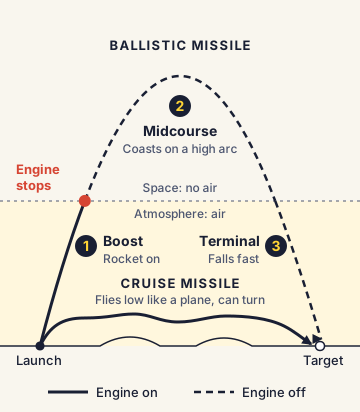
Missiles are of two main kinds. A ballistic missile is pushed up by a rocket for a short time, then coasts in a high arc, like a thrown cricket ball, and falls onto its target pulled by gravity. A cruise missile flies like a small unmanned plane: an engine keeps it powered almost all the way, and it stays inside the atmosphere, often flying very low. Knowing this difference helps you place any missile in the news, from Agni to BrahMos to Pralay.
Why does the difference matter?
The two types are good at different jobs. Ballistic missiles are very fast and can go very far, so they are used for long-range and nuclear delivery. Cruise missiles are slower but very accurate and hard to detect because they fly low and can change course. A country's choice of missile tells you what kind of war it is preparing for.
How does a ballistic missile work?
Its flight has three phases:
- Boost phase: The rocket motor burns and pushes the missile up at great speed.
- Midcourse phase: The motor stops. The missile coasts on a high arc, and long-range ones go outside the atmosphere into space.
- Terminal phase: It falls back into the atmosphere at very high speed onto the target.
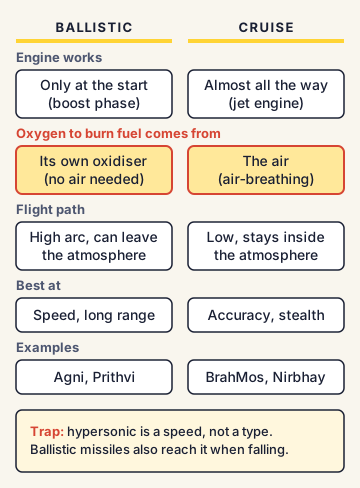
Because its engine works only at the start, it carries its own fuel and oxidiser (the chemical that lets fuel burn), so it does not need air.
How does a cruise missile work?
It uses an air-breathing jet engine (such as a turbojet, turbofan or ramjet) that takes in oxygen from the air. So it must stay inside the atmosphere. It has wings for lift and flies a path much like an aircraft, often hugging the ground or sea surface to stay under enemy radar. It can turn and follow a planned route.
Types by range (ballistic missiles)
A common classification:
- Short-Range Ballistic Missile (SRBM): less than 1,000 km (example: Prithvi, Pralay)
- Medium-Range (MRBM): 1,000-3,000 km (example: Agni-II)
- Intermediate-Range (IRBM): 3,000-5,500 km (example: Agni-IV)
- Intercontinental (ICBM): more than 5,500 km (example: Agni-V, range over 5,000 km, often described as near-ICBM class)
These cut-offs are used for convenience; different countries and sources use slightly different numbers.
Types by speed (cruise missiles)
- Subsonic: slower than sound (below Mach 1). Example: India's Nirbhay and the US Tomahawk.
- Supersonic: faster than sound, roughly Mach 2-3. Example: BrahMos, about Mach 2.8.
- Hypersonic: faster than Mach 5 (five times the speed of sound).
The in-between types
- Quasi-ballistic missile: Flies a lower, flatter ballistic path and can manoeuvre during flight. It trades some range for speed and surprise. It is hard to predict where it will land. Examples: India's Pralay, Russia's Iskander, China's Dongfeng-12. Pralay is a solid-fuel missile that carries conventional (non-nuclear) warheads. It strikes targets 150-500 km away and fires from a mobile launcher. As of November 2026, it is in user evaluation trials (tests for the forces that will use it) and has not yet entered service.
- Hypersonic glide vehicle: Launched by a rocket, then glides at over Mach 5 inside the upper atmosphere while manoeuvring. India's long-range hypersonic missile, tested on 16 November 2024, is designed to carry payloads to over 1,500 km.
- MIRV (Multiple Independently Targetable Re-entry Vehicle): One ballistic missile carrying several warheads, each able to hit a different target. India first tested this on Agni-V under Mission Divyastra on 11 March 2024.
India's missile journey
The IGMDP, started in 1983 under Dr. A.P.J. Abdul Kalam, produced Prithvi, Agni, Akash, Trishul and Nag. BrahMos is a joint venture between India's DRDO and Russia's NPO Mashinostroyeniya. When India joined the Missile Technology Control Regime (MTCR) in June 2016 as its 35th member, it could extend the BrahMos range from 290 km to about 450 km. The MTCR is an informal group, set up in 1987, that controls exports of missiles able to carry at least 500 kg to at least 300 km.
Commonly confused concepts
- Powered all the way vs powered only at the start: Cruise = engine works through most of the flight. Ballistic = engine works only in the boost phase.
- Air-breathing vs rocket: Cruise missiles breathe air, so they stay in the atmosphere. Ballistic missiles carry their own oxidiser, so they can leave it.
- Speed vs accuracy: Ballistic missiles are generally faster; cruise missiles are generally more accurate and stealthier because they fly low.
- "Hypersonic" is a speed, not a type. Ballistic missiles also reach hypersonic speeds when falling. What makes the new hypersonic weapons special is that they manoeuvre at those speeds.
- Missile vs rocket: In defence usage, a missile is guided (it steers to the target). An unguided rocket, like many artillery rockets, simply flies where it is pointed.
Issues, criticism and the way forward
- Missile defence race: Faster and manoeuvring missiles push countries to build costly missile defences, and then even faster missiles. This is an arms race.
- Dual use and confusion: Many missiles can carry nuclear or conventional warheads. In a crisis, the other side may assume the worst.
- Arms control gaps: The MTCR is not a treaty and has no legal force, and major missile powers like China are not members. There is no global treaty banning ballistic or cruise missiles.
- Way forward for India: Keep conventional and nuclear forces clearly separate, continue indigenous development, and build both strike missiles and air and missile defence.
Concepts to Know
- Mach number: A measure of speed compared with the speed of sound. Mach 1 is the speed of sound (about 1,235 km per hour at sea level); Mach 2 is twice that.
- Trajectory: The path an object follows as it moves through the air or space.
- Oxidiser: A chemical that supplies oxygen so the fuel can burn, needed where there is no air, such as in space.
- Ramjet: A simple jet engine that uses the missile's own high speed to squeeze incoming air; it works only after the missile is already moving fast.
- Deterrence: Preventing an attack by making the enemy fear a strong response.
- Ballistic: rocket-powered in boost phase only, then a high arc under gravity; long-range ones leave the atmosphere
- Cruise: air-breathing engine throughout, stays in the atmosphere, flies low, highly accurate
- Range classes (common): SRBM under 1,000 km; MRBM 1,000-3,000 km; IRBM 3,000-5,500 km; ICBM above 5,500 km
- Speed classes: subsonic below Mach 1; supersonic Mach 1-5; hypersonic above Mach 5
- IGMDP: 1983; MTCR: 1987, 500 kg to 300 km; India joined June 2016 as 35th member
- BrahMos: about Mach 2.8; range extended from 290 km to about 450 km after MTCR entry
- Mission Divyastra (Agni-V MIRV): 11 March 2024; long-range hypersonic missile test: 16 November 2024
- Pralay: quasi-ballistic, solid-fuel, conventional, range 150-500 km; not yet in service as of November 2026
- 6 Nov 2026Added Pralay's range, fuel, warhead type and trial status as of November 2026, and China's Dongfeng-12 as a similar missile.
● Tracked since March 01, 2026 · last seen November 05, 2026 · updates as the daily brief publishes