Pollution Under Control (PUC) Certificate
A Pollution Under Control (PUC) certificate is a small document that says your vehicle's exhaust smoke is within the legal limits. You get it after a short test at an authorised PUC testing centre. Every petrol, diesel, CNG or LPG vehicle on Indian roads must carry a valid PUC certificate once it is one year old. Think of it as a regular "health check-up report" for your vehicle's exhaust.
Why do we need it?
In Indian cities, vehicles are one of the biggest sources of polluted air. A new vehicle leaves the factory clean, because it must meet the Bharat Stage (BS) emission norms. But as it gets older, its engine wears out, filters get blocked and owners skip servicing. Then it starts throwing out much more smoke and harmful gases. The PUC system exists to catch these vehicles that have become dirty during use. Without it, nobody would check a vehicle's pollution after the day it was sold.
Where does the law come from?
The PUC system rests on two layers of law:
- The Motor Vehicles Act, 1988 gives the central government the power to make rules about how vehicles are built and maintained, including the smoke and gases they release.
- Using that power, the government made the Central Motor Vehicles Rules (CMVR), 1989. Rule 115 of these rules sets the emission limits. Rule 115(7) says every motor vehicle must carry a valid PUC certificate after one year from the date it was first registered.
How has the system changed over time?
The idea is old, but the system has been tightened step by step:
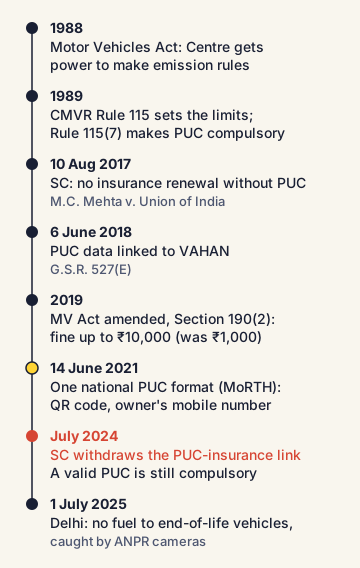
- 2017: In the long-running Delhi air pollution case (M.C. Mehta v. Union of India), the Supreme Court ordered on 10 August 2017 that insurance companies should not renew vehicle insurance without a valid PUC certificate. The insurance regulator, IRDAI, passed this on to insurers.
- 2018: A government notification (G.S.R. 527(E), 6 June 2018) linked PUC data with VAHAN, the national database of registered vehicles.
- 14 June 2021: The Ministry of Road Transport and Highways (MoRTH) notified a common PUC certificate format for the whole country. It added a QR code, made the owner's mobile number compulsory, and linked the PUC database to the National Register of vehicles.
- July 2024: The Supreme Court withdrew its 2017 condition linking PUC to third-party insurance. One reason was practical: a PUC certificate lasts six or twelve months, but insurance is renewed yearly, and many vehicles were ending up with no insurance at all. Owners must still carry a valid PUC certificate at all times.
How does the test work, step by step?
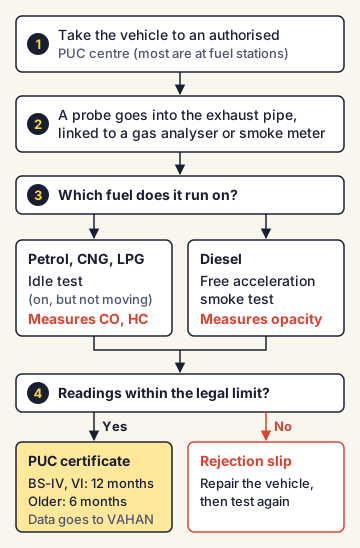
- You take your vehicle to a PUC centre authorised by the State transport department. Most are at fuel stations.
- A probe (a metal pipe) is put into the exhaust pipe and connected to a gas analyser or smoke meter.
- Petrol, CNG and LPG vehicles are tested while the engine runs at idle (switched on but not moving). The machine measures carbon monoxide (CO) and hydrocarbons (HC). For newer four-wheelers with catalytic converters, it also checks the air-fuel balance (the "lambda" value).
- Diesel vehicles get a free acceleration smoke test. The engine is quickly revved to full speed, and the machine measures how dark the smoke is. This darkness is called opacity, and it is shown as a "light absorption coefficient" (how much light the smoke blocks).
- If the readings are within limits, you get the certificate. The data goes into the national database.
- If the readings are above the limit, you get a rejection slip. You must repair the vehicle and test again. The slip can be shown at a service centre or another PUC centre.
How long is it valid?
Under Rule 115(7), the certificate is valid for 12 months for vehicles built to BS-IV or BS-VI norms, and 6 months for older vehicles. A brand-new vehicle does not need one for its first year, because it has just passed the factory tests.
What happens if you don't have one?
Driving a vehicle that breaks the rules on air pollution is an offence under Section 190(2) of the Motor Vehicles Act, 1988 (as amended in 2019):
- First offence: jail for up to 3 months, or a fine of up to ₹10,000, or both. The driver is also disqualified from holding a licence for 3 months.
- Second or later offence: jail for up to 6 months, or a fine of up to ₹10,000, or both.
Before the 2019 amendment, the fine was only ₹1,000 for a first offence. That is why the amendment is seen as a big step.
India's position and examples
Delhi-NCR uses the PUC system most strongly because its winter air is among the worst in the world:
- ANPR cameras read a vehicle's number plate automatically. The number is then checked against VAHAN, which shows the vehicle's age, fuel type and PUC status within seconds.
- Under a CAQM direction, Delhi began refusing fuel to "end-of-life" vehicles (diesel vehicles over 10 years old and petrol vehicles over 15 years old) from 1 July 2025, using ANPR cameras at fuel stations. The same cameras also flag vehicles without a valid PUC certificate.
- Delhi's age limits for vehicles come from orders of the National Green Tribunal (2015), which the Supreme Court upheld in 2018.
Commonly confused concepts
- PUC certificate vs Bharat Stage (BS) norms: BS norms set the limits a new model must meet before it can be sold. The PUC test checks a vehicle that is already on the road. BS is a factory exam; PUC is a regular check-up.
- PUC certificate vs fitness certificate: A fitness certificate checks whether a vehicle is mechanically safe (brakes, lights, body). It is compulsory every year or two for commercial vehicles, and for private vehicles after 15 years. PUC checks only exhaust pollution.
- PUC rules vs end-of-life vehicle rules: A vehicle can have a valid PUC certificate and still be banned in Delhi-NCR because of its age. Age rules and PUC rules are separate.
- PUC vs AQI: The Air Quality Index (AQI) measures how polluted the outside air is. PUC measures what comes out of one vehicle's exhaust.
Issues, criticism and the way forward
- The test is too simple. The idle test does not show how a vehicle pollutes in real traffic. It does not measure nitrogen oxides (NOx) or fine dust (PM2.5) well, which are among the most harmful pollutants. Expert bodies, including the Supreme Court-appointed EPCA, have said the diesel smoke test gives only a rough picture.
- Fake or careless testing. Some centres issue certificates without proper tests. The QR code and online database were added to stop this, but checking on the ground is still weak.
- Poor enforcement. Many vehicles run without valid certificates because traffic police cannot check every vehicle. ANPR cameras and automatic e-challans are meant to fill this gap. Some people raise questions about privacy and data use with such cameras.
- Way forward. Experts suggest remote sensing devices (roadside machines that measure exhaust from passing vehicles using light beams), stricter audits of PUC centres, adding NOx and particle checks, and linking PUC status to fuel, registration and insurance systems in a smooth way.
Concepts to Know
- Carbon monoxide (CO): A colourless, poisonous gas formed when fuel does not burn fully. It reduces the blood's ability to carry oxygen.
- Hydrocarbons (HC): Unburnt bits of fuel that come out of the exhaust. In sunlight they help form ground-level ozone, a harmful pollutant.
- Catalytic converter: A device in the exhaust pipe that turns harmful gases (CO, HC, NOx) into less harmful ones (carbon dioxide, water, nitrogen) before they leave the vehicle.
- VAHAN: The national online database of all registered vehicles in India, run by the Ministry of Road Transport and Highways. It stores details like the owner, age, fuel type and certificates of each vehicle.
- ANPR (Automatic Number-plate Recognition): A camera system that reads number plates on its own and checks them against a database.
- Bharat Stage (BS) norms: India's emission standards for new vehicles, based on European norms. India jumped from BS-IV directly to BS-VI in April 2020.
- Legal basis: Motor Vehicles Act, 1988 and Rule 115 of the Central Motor Vehicles Rules, 1989; Rule 115(7) makes PUC compulsory after one year from first registration
- Validity: 12 months for BS-IV and BS-VI vehicles; 6 months for others
- Penalty: Section 190(2), MV Act: up to 3 months jail and/or fine up to ₹10,000, plus 3-month licence disqualification (first offence)
- Petrol/CNG/LPG: idle test for CO and HC; diesel: free acceleration smoke (opacity) test
- PUC data linked to VAHAN in 2018; uniform national PUC format with QR code notified on 14 June 2021
- Supreme Court's 10 August 2017 order linking PUC to insurance was withdrawn in July 2024
- Delhi fuel denial to end-of-life vehicles using ANPR began on 1 July 2025
● Tracked since November 14, 2026 · last seen November 14, 2026 · updates as the daily brief publishes