Air Pollution Control Devices (APCDs)
Air pollution control devices, or APCDs, are machines fitted to a factory's chimney (its stack) to clean the smoke before it goes into the air. They catch tiny bits of dust, soot and ash, called particulate matter, and some of them also remove harmful gases. Think of an APCD as a filter on a kitchen chimney or a water purifier, but for factory smoke. Without them, everything a boiler or furnace burns would go straight into the air we breathe.
Why do we need them?
Industries burn coal, wood, oil or waste to make heat and power. Burning creates smoke full of fine particles and gases like sulphur dioxide. Fine particles (PM10 and PM2.5) can go deep into the lungs and even the blood, causing asthma, heart disease and early death. A single factory may seem small, but thousands of them in one region, like the National Capital Region (NCR), add up to a large share of winter smog. Laws can fix limits, but limits mean nothing unless every chimney has a device that actually cleans the smoke.
Where did the rules come from?
India's main air law is the Air (Prevention and Control of Pollution) Act, 1981. It gave Pollution Control Boards the power to give or refuse permission to industries, based on whether they control their emissions. The Environment (Protection) Act, 1986 then allowed the central government to notify exact emission standards for each type of industry, in the Environment (Protection) Rules, 1986.
In 1987, the Air Act was amended to add Section 31A, which lets a Board order the closure of a polluting unit or cut its electricity and water supply. Since February 2014, the CPCB has required the 17 categories of highly polluting industries to install online systems that continuously send stack emission data to the boards.
How do the main devices work?
Each device uses a different trick to separate dust from gas:
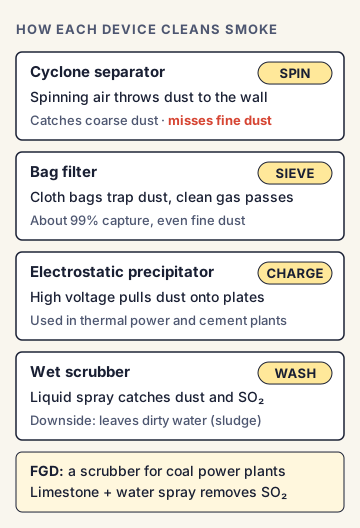
- Cyclone separator: Dirty air is made to spin very fast inside a cone-shaped chamber. Heavy particles are thrown against the wall by centrifugal force (the outward push you feel on a fast merry-go-round) and slide down into a hopper. Cheap and simple, but it catches mainly coarse (bigger) particles and misses much of the fine dust.
- Bag filter (fabric filter or baghouse): Smoke is passed through rows of long cloth bags, like a giant vacuum-cleaner bag. Dust gets stuck on the fabric while clean gas passes through. The bags are cleaned from time to time by shaking or by short blasts of air. Bag filters can remove about 99% of particles, including fine ones, but bags can tear or burn if the gas is too hot.
- Electrostatic precipitator (ESP): The smoke passes between metal plates and wires carrying very high voltage electricity. The particles pick up an electric charge and get pulled onto the oppositely charged plates, the way a rubbed balloon pulls bits of paper. The plates are then tapped (rapped) so the dust falls into hoppers. ESPs are widely used in thermal power plants and cement plants because they handle huge volumes of hot gas.
- Wet scrubber: The smoke is sprayed with water or another liquid. The liquid catches dust and can also absorb gases such as sulphur dioxide (SO₂). The downside is that it produces dirty water (sludge), which must then be treated.
- Flue gas desulphurisation (FGD): A special kind of scrubber used in coal power plants. It usually sprays a mix of limestone and water to remove SO₂ from the flue gas (the exhaust gas from burning).
A simple way to remember: cyclones spin, bag filters sieve, ESPs charge, scrubbers wash.
How are emissions measured?
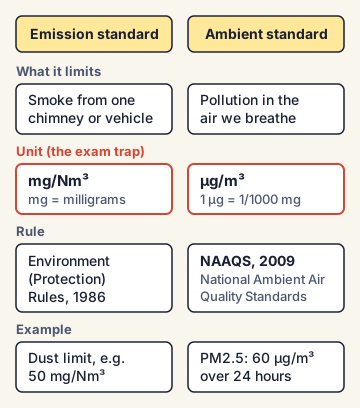
Stack emission limits in India are written in mg/Nm³: milligrams of particles in one normal cubic metre of gas. "Normal" means the gas volume is corrected to a standard temperature and pressure (usually 0°C and 1 atmosphere), so that hot and cold stacks can be compared fairly. So "50 mg/Nm³" means that every standard cubic metre of chimney gas may carry at most 50 milligrams of dust.
Factories are checked by manual stack sampling and, for big polluters, through Online Continuous Emission Monitoring Systems (OCEMS) that send live data to the CPCB and the state board.
The legal tools behind APCDs
These rules make APCDs compulsory in practice:
- Section 21, Air Act: No industry in an air pollution control area can set up or run without the consent (permission) of the State Board. Consent comes with conditions, such as installing specified control equipment.
- Section 22, Air Act: No industry may release pollutants above the standards fixed by the Board.
- Section 31A, Air Act: The Board can order closure, prohibition or regulation of a unit, or stop its electricity and water supply.
- Section 5, Environment (Protection) Act, 1986: The central government (and bodies it authorises) can give binding directions, including closure.
- Section 18(1)(b), Air Act: The CPCB can give directions to State Boards. This is the route used when the CPCB tells SPCBs to act against non-compliant units.
India's position and Indian examples
- 17 categories of highly polluting industries: A list identified by the CPCB, including thermal power plants, cement, iron and steel, sugar, distilleries, fertilisers, refineries, aluminium, copper, zinc, pulp and paper, and others. They face the strictest monitoring.
- Colour categories: Industries are grouped as Red, Orange, Green and White based on a pollution score. Red category units are the most polluting and need the closest checks.
- Thermal power plants: In December 2015, the Ministry of Environment, Forest and Climate Change (MoEFCC) notified India's first limits on SO₂, nitrogen oxides and mercury for coal power plants. This needed FGD units. The deadline was first December 2017, but it has been extended several times, and in 2025 most plants were exempted from installing FGD.
- Delhi-NCR: The CAQM uses its legal powers to set tighter limits for NCR industries than the national rules, because the region's winter pollution is severe. It also pushes industries to switch to cleaner fuels like piped natural gas (PNG).
Commonly confused concepts
- Emission standards vs ambient air quality standards: Emission standards limit what comes out of one chimney or vehicle, measured in mg/Nm³. Ambient standards (the National Ambient Air Quality Standards, NAAQS, 2009) limit pollution in the open air we breathe, measured in µg/m³ (micrograms, one-thousandth of a milligram). For example, the NAAQS limit for PM2.5 is 60 µg/m³ over 24 hours and 40 µg/m³ as an annual average.
- APCD vs OCEMS: An APCD cleans the smoke. OCEMS only measures the smoke and reports the numbers. A factory needs both: one to control pollution and one to prove it.
- ESP vs bag filter: Both catch fine dust. An ESP uses electric charge and suits very large, hot gas flows (power plants). A bag filter uses cloth and is very efficient even for fine dust, but the bags need regular replacement.
- Scrubber vs FGD: FGD is a type of scrubber designed specially to remove sulphur dioxide from power-plant gas. A general wet scrubber may target dust or several gases.
- Consent to Establish vs Consent to Operate: "Consent to Establish" is taken before building a factory. "Consent to Operate" is taken before starting production, and it is renewed from time to time. APCD conditions are written into both.
Issues, criticism and the way forward
- Cost for small units: Many NCR industries are micro, small or medium enterprises (MSMEs). A good bag filter or ESP can cost a large share of their capital. Industry groups say some sectors find very tight limits hard to meet.
- Installed but switched off: Running an APCD uses electricity. Some units install the device but switch it off to save money when no one is checking. Continuous online monitoring is meant to catch this, but sensors can be tampered with or go offline.
- Weak enforcement capacity: State Boards often have too few staff to inspect thousands of units. Deadlines are repeatedly missed and extended.
- Shortage of experts and suppliers: When a large region must comply at once, equipment makers and testing agencies cannot keep up, causing delays.
- Way forward suggested by experts and regulators: shift to cleaner fuels such as PNG; give low-cost loans or subsidies to MSMEs for APCDs; strengthen OCEMS with tamper-proof systems and third-party audits; use closure only after fair notice, but enforce it firmly once deadlines pass; and build regional (airshed-level) planning so that all states around Delhi act together.
Concepts to Know
- Particulate matter (PM): Tiny solid or liquid bits floating in air, such as dust, soot and smoke. PM10 is 10 micrometres or smaller; PM2.5 is 2.5 micrometres or smaller (about 30 times thinner than a human hair).
- Stack: The tall chimney of a factory or power plant through which exhaust gases are released.
- Centrifugal force: The outward push felt by anything moving in a circle, like water flying off a spinning wet umbrella.
- Show-cause notice: An official letter asking a person or company to explain why action should not be taken against them, before any penalty is imposed.
- Consent (under pollution laws): Official permission from a State Pollution Control Board to set up or run an industry, given with conditions to control pollution.
- Retrofitting: Adding new equipment to an old machine or plant to improve it, instead of building a new one.
- Main devices: cyclone (centrifugal, coarse dust), bag filter (fabric, about 99% capture), ESP (high-voltage charge), wet scrubber (liquid, dust and gases), FGD (removes SO₂)
- Stack emission unit: mg/Nm³ (milligrams per normal cubic metre); ambient air unit: µg/m³
- Air (Prevention and Control of Pollution) Act, 1981: Section 21 (consent), Section 22 (standards), Section 31A (closure and cutting power or water, added in 1987), Section 18(1)(b) (CPCB directions to SPCBs)
- Environment (Protection) Act, 1986: Section 5 (directions, including closure)
- CPCB direction of February 2014: 17 categories of highly polluting industries to install online continuous monitoring
- Thermal power plant SO₂, NOx and mercury norms: notified December 2015; deadlines extended several times
- NAAQS 2009: PM2.5 limit 60 µg/m³ (24-hour), 40 µg/m³ (annual)
● Tracked since October 31, 2026 · last seen October 31, 2026 · updates as the daily brief publishes