Police Custody vs Judicial Custody
Remand under Section 187 BNSS
When the police arrest someone, they often cannot finish the investigation in 24 hours. So they ask a magistrate for permission to keep the person longer. This permission is called remand. The magistrate can send the person to police custody (the person stays with the police, who can question them) or to judicial custody (the person goes to jail and is under the court's control).
The rules for remand are in Section 187 of the Bharatiya Nagarik Suraksha Sanhita (BNSS), 2023, which replaced Section 167 of the old Code of Criminal Procedure (CrPC), 1973.
Why does remand exist?
Two needs pull in opposite directions. The police may genuinely need time to question a suspect, recover stolen goods or find other accused persons. But a person held by the police is at risk of pressure, threats or even torture. Remand solves this by putting a judge between the police and the person. Think of it like a school monitor who can keep a student back after class only with the principal's written permission, and only for a fixed time.
Where did it come from?
The idea of a magistrate checking police detention goes back to the colonial-era criminal procedure codes. The CrPC of 1973 put it in Section 167. The Constitution added a stronger base through Article 22(2) (production within 24 hours) and Article 21 (no one can lose personal liberty except by a fair procedure set by law).
In 2023, Parliament passed three new criminal laws: the Bharatiya Nyaya Sanhita (BNS), the Bharatiya Nagarik Suraksha Sanhita (BNSS) and the Bharatiya Sakshya Adhiniyam (BSA). They came into force on 1 July 2024. Section 187 BNSS now carries the remand rules.
How does it work, step by step?
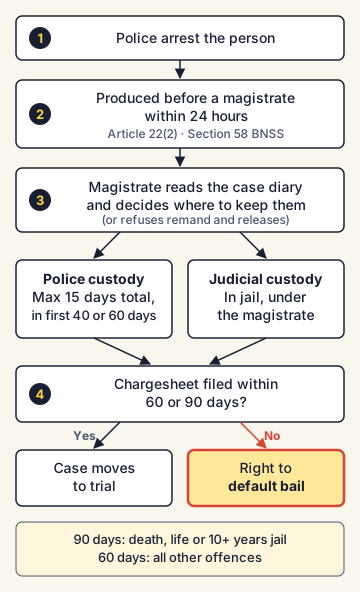
- Arrest. The police arrest a person, for example under Section 35 BNSS (arrest without warrant; old Section 41 CrPC). They must tell the person the grounds of arrest (Section 47 BNSS).
- 24-hour limit. Under Section 58 BNSS and Article 22(2), the person must be produced before a magistrate within 24 hours of the arrest, not counting travel time to the court.
- Request for remand. If the investigation cannot be completed in 24 hours and the accusation looks well-founded, the officer sends the case diary to the nearest Judicial Magistrate and produces the accused (Section 187(1)).
- Magistrate decides. The magistrate looks at the case diary and the grounds and decides whether to allow more detention, and where: police custody or judicial custody. The magistrate can also refuse remand and release the person.
- First production in person. The accused must be produced in person the first time. For police custody, the accused must also be produced in person every later time, as long as they stay with the police. Only extensions of judicial custody can be done in person or through audio-video electronic means (video conferencing) (Section 187(4)).
How long can a person be kept?
All these periods are counted from the day the magistrate first orders remand, and that day itself counts.
- Total detention before a chargesheet: the magistrate can order detention for a total of at most 90 days for offences punishable with death, life imprisonment, or imprisonment of 10 years or more, and at most 60 days for all other offences.
- Police custody: at most 15 days in total for the whole case. Under BNSS, these 15 days can be given "in whole or in parts", but only during the first 40 days of the 60-day period, or the first 60 days of the 90-day period. Police custody is counted inside the 60 or 90 days, not added to them.
- Default bail: if the police do not file the chargesheet (their final report) within the 60 or 90 days, the accused gets a right to be released on bail, as long as they apply for it and are ready to give bail. This is called default bail or statutory bail.
Police custody vs judicial custody: the difference
This is a favourite exam trap.
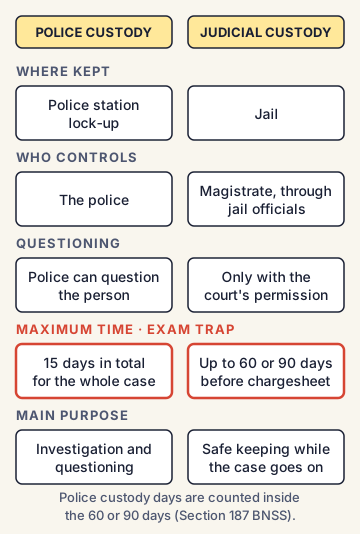
- Where the person is kept: police custody means the police station lock-up; judicial custody means jail.
- Who controls the person: in police custody, the police; in judicial custody, the magistrate (through jail officials).
- Questioning: in police custody, the police can question the person; in judicial custody, only with the court's permission.
- Maximum time: police custody is 15 days in total; overall custody before a chargesheet can go up to 60 or 90 days, with police custody counted inside this.
- Main purpose: police custody is for investigation and questioning; judicial custody is for safe keeping while the case goes on.
What have the courts said?
- CBI v. Anupam J. Kulkarni (1992): The Supreme Court said police custody could be given only within the first 15 days after the first remand. After that, only judicial custody was allowed.
- V. Senthil Balaji v. State (2023): The Supreme Court said the 15 days of police custody need not all fall in the first 15 days; they can be spread over the whole 60 or 90-day period. It felt Anupam Kulkarni needed a fresh look by a larger bench. The BNSS wording now openly allows police custody "in whole or in parts", but only within the first 40 or 60 days, not over the whole 60 or 90 days.
- Sanjay Dutt v. State (1994) and M. Ravindran v. Intelligence Officer, DRI (2020): Default bail is an "indefeasible" right (a right that cannot be taken away) once the time limit ends and the accused applies for it. If the accused applies before the chargesheet is filed, the police cannot defeat the right by filing the chargesheet later.
- Enforcement Directorate v. Kapil Wadhawan (2023): The day the magistrate first orders remand is counted when calculating the 60 or 90 days.
- Sujit Das v. Union of India (2026): Before ordering remand, magistrates must record the actual time when the person's liberty was curtailed, and may refuse remand if the earlier detention was unreasonable, even within 24 hours.
Special laws change the time limits
Some laws for serious crimes give the police more time:
- NDPS Act, 1985 (drugs), Section 36A(4): the 90-day limit becomes 180 days for certain offences, and a Special Court can extend it up to one year on a report from the Public Prosecutor.
- UAPA, 1967 (terrorism), Section 43D(2): police custody up to 30 days, and total detention of 90 days that a court can extend to 180 days on the Public Prosecutor's report.
India's position and Indian examples
Remand decisions happen thousands of times every day in magistrate courts. Prison Statistics India 2022 (National Crime Records Bureau) showed that about three out of four prisoners in Indian jails were undertrials, meaning people whose trial is not over. To reduce this, Section 479 BNSS says a first-time offender who has spent one-third of the maximum possible sentence as an undertrial must be released by the court on bond (for others the limit is one-half, as in the old Section 436A CrPC). This does not apply to offences punishable with death or life imprisonment.
Commonly confused concepts
- Arrest vs remand: Arrest is done by the police. Remand is an order of a magistrate that allows custody to continue after 24 hours.
- Default bail vs regular bail: Regular bail depends on the court's judgement about the case (how serious it is, whether the accused may run away). Default bail is a right that arises only because the police missed the time limit for filing a chargesheet.
- Remand under Section 187 BNSS vs preventive detention: Remand is about a person accused of a crime that already happened. Preventive detention (Article 22(3) to 22(7), laws like the National Security Act, 1980) holds a person to stop a possible future act, and does not need a magistrate's remand.
- Section 58 BNSS vs Section 187 BNSS: Section 58 sets the 24-hour limit before production. Section 187 decides what can happen after that.
Issues, criticism and the way forward
- Mechanical remand: Critics point out that magistrates often grant remand without reading the case diary closely. Courts have repeatedly said remand is a judicial act that needs real application of mind.
- Split police custody: Some legal experts worry that allowing police custody in parts over 40 or 60 days lets the police pull a person back for questioning again and again. Others argue it helps when new facts come up later in the investigation.
- Hidden detention: Showing a later time of arrest on paper, as in the Sujit Das case, defeats the 24-hour rule. The D.K. Basu (1997) guidelines, now partly in law, require an arrest memo with date and time, signed by a witness.
- Way forward: Experts suggest CCTV in police stations (ordered in Paramvir Singh Saini v. Baljit Singh, 2020), recording the real time of first detention, better legal aid at the remand stage, and regular review of undertrial cases.
Concepts to Know
- Magistrate: A judge of a lower criminal court. A Judicial Magistrate decides on remand and bail in most cases.
- Case diary: A daily record that the police officer keeps of every step taken in an investigation. The magistrate reads it to decide whether more custody is needed.
- Chargesheet (final report): The document the police file in court at the end of an investigation, listing the accused, the evidence and the offences. Once it is filed, the trial process can begin.
- Undertrial: A person kept in jail while their trial is still going on. They have not been found guilty.
- Bail: Release of an accused person from custody while the case goes on, usually with a promise (bond) to come back to court when called.
- Remand rules: Section 187 BNSS, 2023 (earlier Section 167 CrPC, 1973); BNSS in force from 1 July 2024
- 24-hour production: within 24 hours of arrest, excluding travel time; Article 22(2) and Section 58 BNSS (earlier Section 57 CrPC)
- Production: in person every time for police custody; in person or by video only for judicial custody extensions (Section 187(4))
- All periods below are counted from the date of the first remand order (that day included)
- Police custody: maximum 15 days in total, in whole or in parts, within the first 40 days (60-day cases) or first 60 days (90-day cases)
- Total pre-chargesheet detention: 90 days (offences punishable with death, life or 10+ years); 60 days (other offences)
- Default bail if chargesheet not filed in time: an indefeasible right (Sanjay Dutt, 1994; M. Ravindran, 2020)
- CBI v. Anupam J. Kulkarni (1992): police custody only in first 15 days; questioned in V. Senthil Balaji (2023)
- NDPS Act Section 36A(4): 180 days, extendable to 1 year; UAPA Section 43D(2): 30 days police custody, 90 days extendable to 180 days
- Section 479 BNSS: first-time offenders must be released on bond after one-third of the maximum sentence as undertrial
● Tracked since November 18, 2026 · last seen November 18, 2026 · updates as the daily brief publishes