Pastoralism in India
Transhumance and Pastoral Communities
Pastoralism is a way of life in which people live mainly by raising livestock, such as cattle, buffalo, sheep, goats, camels and yaks, that graze on natural pastures. Instead of growing fodder on their own farms, pastoralists take their animals to wherever grass and water are available. Many move with the seasons over long, fixed routes.
India has one of the world's largest and most varied pastoral populations, spread from the cold deserts of Ladakh to the dry plains of Rajasthan and the scrub forests of Tamil Nadu.
Why does pastoralism exist?
Large parts of India are too dry, too cold, too steep or too rocky for regular farming. Rain may come only for a few months, or snow may cover the land for half the year. But grass still grows in these lands for some part of the year. Pastoralism is the smartest way to use such land: the animals turn grass that humans cannot eat into milk, meat, wool and manure. By moving, the herders avoid overusing any one place, and the grass gets time to grow back.
What are the types of pastoral movement?
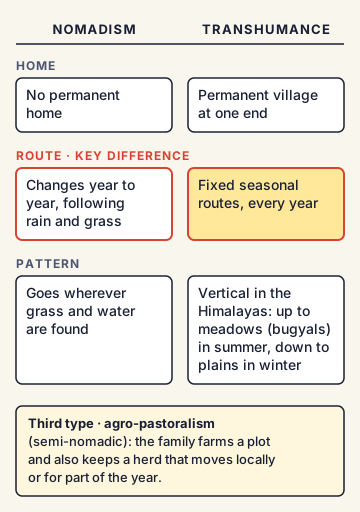
- Nomadic pastoralism: the whole family moves with the herd and has no permanent home. Movement follows rain and grass, and may change from year to year.
- Transhumance: the herders move their animals along fixed seasonal routes between two or more places, and often have a permanent village at one end. In the Himalayas this movement is vertical: up to high-altitude meadows (called bugyals in Uttarakhand) in summer, and down to the foothills and plains in winter.
- Agro-pastoralism (semi-nomadic): the family farms a plot of land and also keeps a herd that moves locally or for part of the year.
Who are India's pastoral communities?
There are many, and each has its own animals and routes. A few well-known ones:
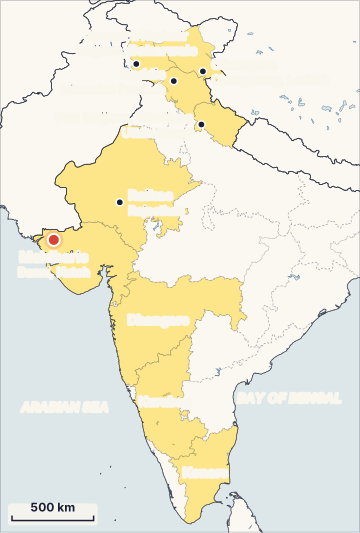
- Jammu and Kashmir: Gujjars and Bakarwals (buffalo, sheep and goats). They were given Scheduled Tribe status in J&K in 1991.
- Ladakh: Changpas of the Changthang plateau, who herd yaks and the goats that give pashmina wool.
- Himachal Pradesh: Gaddis (sheep and goats), along with Kinnauras and others. Gaddis are a Scheduled Tribe in the State.
- Uttarakhand: Bhotiyas and the forest-dwelling Van Gujjars (buffalo herders).
- Rajasthan: Raikas (Rebaris), famous camel and sheep breeders. They are listed as an Other Backward Class (OBC), not a Scheduled Tribe.
- Gujarat: Maldharis of the Banni grasslands in Kutch, who keep the Banni buffalo.
- Maharashtra and Karnataka: Dhangars and Kurubas (sheep and goats on the Deccan plateau).
- Tamil Nadu: Konars (Idaiyars), Kurumba Gounders and others who keep native cattle breeds like Bargur and Pulikulam.
According to the League for Pastoral Peoples, a research group, about 46 castes or communities in India have a specialised pastoral identity.
How many pastoralists are there?
For over a century, nobody knew. India's livestock census, held since 1919, counted animals but never counted herders as a separate group. Estimates ranged from about 13 million to about 20 million people. The 21st Livestock Census (fieldwork from late 2024 into 2025) was the first to collect data on pastoralists and their animals separately. For comparison, the 20th Livestock Census (2019) counted 535.78 million livestock in India.
How do pastoralists help the land and the economy?
- Milk, meat and wool: much of India's goat and sheep meat and wool comes from herds that graze in the open.
- Native breeds: pastoralists have bred many of India's hardy native animal breeds, able to survive heat, drought and poor fodder. As of August 2026, the ICAR-National Bureau of Animal Genetic Resources had registered 258 indigenous breeds (262 in total).
- Manure for farms: in a practice called sheep or goat penning, farmers invite herders to keep their flock overnight on a harvested field. The droppings fertilise the soil, and the farmer pays the herder in grain or cash.
- Grassland care: controlled grazing keeps grass short, reduces dry fuel for fires, spreads seeds and keeps open grasslands from turning into thick scrub. This supports grassland wildlife.
- Traditional ecological knowledge: herders know where water lies in drought months, which plants heal animals, and where wild animals move. This knowledge is useful for conservation.
What does the law say?
There is no single law for pastoralists. Different laws touch different parts of their life.
- Forest Rights Act, 2006, Section 3(1)(d): recognises community rights of grazing, "both settled or transhumant", and the "traditional seasonal resource access of nomadic or pastoralist communities".
- Wild Life (Protection) Act, 1972: in a wildlife sanctuary, the Chief Wild Life Warden may "regulate, control or prohibit" the grazing or movement of livestock (Section 33(d)). In a national park, no grazing of any livestock is allowed at all (Section 35(7)).
- State forest laws (such as the Indian Forest Act, 1927 and the Tamil Nadu Forest Act, 1882) treat cattle entering closed forests as trespass and allow fines.
- Common lands: village grazing lands (called gauchar, charagah or poramboke in different states) are managed under state land revenue laws.
India's position and examples
- Banni grasslands, Gujarat: the Maldharis took their claim for community forest rights to the National Green Tribunal (NGT). In July 2019 the NGT ordered the grassland's boundaries to be marked, and in May 2021 it ordered all encroachments removed within six months and upheld the Maldharis' community rights under the Forest Rights Act.
- Tamil Nadu: in March 2022, the Madras High Court, hearing a public interest petition, banned cattle grazing in forest areas of the state. The scope of the order was later narrowed, but pastoral groups say it still blocks many traditional grazing areas.
- Global recognition: the UN General Assembly declared 2026 the International Year of Rangelands and Pastoralists (resolution of 15 March 2022, proposed by Mongolia). The Food and Agriculture Organization (FAO) leads its implementation.
Commonly confused concepts
- Nomadism vs transhumance: Nomads have no fixed home and may change routes. Transhumant herders follow fixed seasonal routes and usually have a home village.
- Pastoralist vs Scheduled Tribe: Some pastoral groups are Scheduled Tribes (like Gaddis in Himachal, Gujjars and Bakarwals in J&K). Many others, like the Raikas and the Konars, are not. Their legal rights can differ because of this.
- Grazing in a sanctuary vs a national park: In a sanctuary, grazing can be regulated or allowed by the Chief Wild Life Warden. In a national park, it is completely banned.
- Grazing right vs land ownership: A grazing right under the Forest Rights Act is a right to use the land for grazing. It does not make the herder the owner of the land.
- Rangeland vs grassland vs pasture: Rangeland is any natural land grazed by animals (grassland, scrub, desert, alpine meadow). Grassland is land where grasses are the main plants. Pasture usually means grazing land used by a village or managed for livestock.
Issues, criticism and the way forward
- Shrinking commons: India's official area of permanent pastures and grazing land fell from about 12.0 million hectares (1980-81) to 10.2 million hectares (2007-08), as land was encroached or used for other purposes.
- Exclusion by conservation rules: grazing bans in forests and protected areas cut off routes and water points. Critics say conservation that keeps herders out can turn into "conservation by exclusion".
- Wildlife conflict and disease: conservationists worry that large herds can overgraze, compete with wild herbivores and spread livestock diseases to wildlife. Herders reply that well-managed grazing can help grasslands.
- Weak rights recognition: grazing rights under the Forest Rights Act are rarely granted, partly because herders move across many Gram Sabha areas.
- Invasive plants and climate change: invasive shrubs (such as Prosopis juliflora in Banni) take over grasslands, while erratic rain and heat make fodder less reliable.
- Social change: young people leave herding for other work, and services like schools, health care and veterinary care rarely reach mobile families.
- Way forward suggested by experts: count pastoralists properly (as the 21st Livestock Census began to do); recognise grazing and route rights under the Forest Rights Act; include herders in bodies like State Wildlife Boards and grazing plans; protect common lands from encroachment; provide mobile veterinary and health services; and use traditional knowledge alongside wildlife science.
Concepts to Know
- Transhumance: Regular seasonal movement of herders and their animals along fixed routes, such as up to mountain meadows in summer and down to plains in winter.
- Traditional Ecological Knowledge (TEK): Knowledge about land, water, plants, animals and weather that a community builds and passes down over many generations.
- Common property resources (commons): Land or resources, like village pastures, ponds and forests, that are used by the whole community and not owned by one person.
- Other Traditional Forest Dwellers (OTFDs): Non-tribal people who can claim forest rights under the Forest Rights Act if they have depended on forests for 75 years.
- Livestock census: A countrywide count of animals (cattle, buffalo, sheep, goats and others), held about every five years by the central government.
- Invasive species: A plant or animal brought from outside that spreads fast and harms the local plants and animals.
- Estimated pastoral population: about 13-20 million (no official count before the 21st Livestock Census)
- Livestock census held since 1919; 21st census (2024-25) the first to count pastoralists; 20th census (2019): 535.78 million livestock
- About 46 castes or communities with a specialised pastoral identity
- FRA 2006 Section 3(1)(d): grazing (settled or transhumant) and seasonal resource access of nomadic or pastoralist communities
- WPA 1972: Section 33(d) (Chief Wild Life Warden may regulate, control or prohibit grazing in sanctuaries); Section 35(7) (no grazing in national parks)
- Gujjars and Bakarwals: ST in J&K since 1991; Raikas/Rebaris: OBC in Rajasthan
- NGT on Banni: demarcation order (July 2019); encroachment removal within six months (May 2021)
- Madras High Court ban on cattle grazing in forests: March 2022
- UN International Year of Rangelands and Pastoralists: 2026 (UNGA resolution of 15 March 2022; proposed by Mongolia; FAO lead agency)
- Permanent pastures and grazing land: about 12.0 mha (1980-81) → 10.2 mha (2007-08)
- ICAR-NBAGR registered breeds (August 2026): 262, including 258 indigenous
● Tracked since November 16, 2026 · last seen November 16, 2026 · updates as the daily brief publishes