Other Effective Area-based Conservation Measures (OECMs)
Other Effective Area-based Conservation Measures, or OECMs, are places that protect nature well even though they are not officially declared protected areas. Their main purpose may be something else: a sacred grove, an army training area, a well-managed community forest, a heritage site, or a city biodiversity park. But because of the way they are managed, wildlife and ecosystems survive and thrive there for a long time. OECMs let countries count these places towards global conservation targets.
Why do OECMs exist?
For a long time, only formal protected areas, like national parks, were counted as "conserved". But a lot of nature in the world survives outside them, often because local communities, religious groups, the defence forces or private owners look after the land. Ignoring these places had two problems. First, they got no recognition or support. Second, governments tried to meet targets only by creating new parks, which sometimes pushed local people out. OECMs give credit to these other conservation success stories.
Where did the idea come from?
- 2010: The term first appeared in Aichi Biodiversity Target 11, adopted at CBD COP10 in Nagoya, Japan. It asked countries to conserve 17% of land and 10% of coastal and marine areas through "protected areas and other effective area-based conservation measures". But the term was not defined.
- 2018: At CBD COP14 in Sharm el-Sheikh, Egypt, countries adopted Decision 14/8, which gave OECMs an official definition, guiding principles and criteria.
- 2019: IUCN's World Commission on Protected Areas published technical guidance on how to identify OECMs.
- 2022: The Kunming-Montreal GBF made OECMs one of the main ways to reach the 30x30 target (Target 3).
The official definition (CBD Decision 14/8)
An OECM is "a geographically defined area other than a Protected Area, which is governed and managed in ways that achieve positive and sustained long-term outcomes for the in situ conservation of biodiversity, with associated ecosystem functions and services and where applicable, cultural, spiritual, socio-economic, and other locally relevant values." In simple words: a clearly marked area, not a protected area, that is run in a way that keeps nature healthy in its natural place for the long term.
How is an OECM identified?
A site must pass four simple tests:
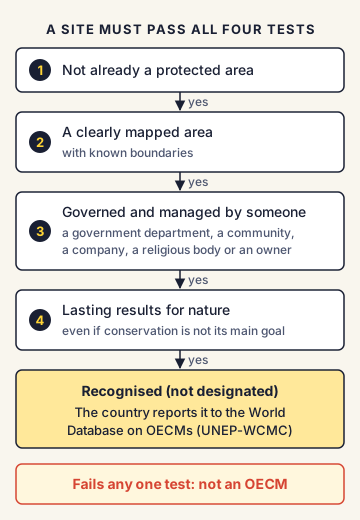
- It is not already a protected area.
- It is a clearly mapped area with known boundaries.
- It is governed and managed by someone: a government department, a community, a company, a religious body or a private owner.
- It delivers lasting results for nature, whether or not conservation is its main goal.
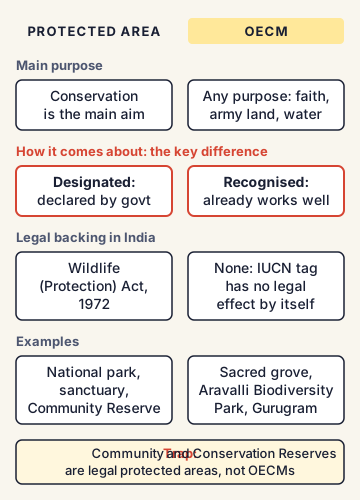
The key difference from a protected area is the idea of "recognised, not designated". A government designates (declares) a protected area mainly for conservation. An OECM already exists and already works well; the country only recognises it and reports it. Countries report their OECMs to the World Database on OECMs, kept by UNEP-WCMC (the UN Environment Programme's World Conservation Monitoring Centre) on the Protected Planet platform.
Types of OECMs
Experts usually describe three kinds:
- Primary conservation: conservation is the main aim, but the site is not a formal protected area (for example, a community-run reserve).
- Secondary conservation: conservation is one aim among others (for example, a watershed protected for clean drinking water).
- Ancillary conservation: conservation is a by-product of a different purpose (for example, land around a military base or a sacred grove protected for religious reasons).
India's position and Indian examples
India has a long tradition of community-protected nature that fits the OECM idea well: sacred groves (like the devrai of Maharashtra and the kavu of Kerala), Bishnoi community lands in Rajasthan, community forests in the Northeast, and village ponds. Some key milestones:
- On 2 February 2022 (World Wetlands Day), the Aravalli Biodiversity Park in Gurugram, Haryana was declared India's first OECM site. It was once a mining area and was restored into a city forest by citizens, ecologists and the city's civic body. The proposal was sent to IUCN by the National Biodiversity Authority (NBA) in December 2020.
- In 2022, the Ministry of Environment, Forest and Climate Change (MoEFCC), the National Biodiversity Authority and UNDP published Criteria and Guidelines for Identifying OECMs in India, and a compendium of possible sites, ranging from farm landscapes to green campuses and industrial estates.
- OECMs matter for India because its legal protected area network covers only about 5.3% of its geographical area (1,014 protected areas as of November 2023). Reaching 30% through new national parks alone is not practical in a crowded country, so recognising community and other conserved lands is a key route.
Commonly confused concepts
- OECM vs Protected Area: A protected area is declared mainly for conservation and is usually backed by a law (in India, the Wildlife (Protection) Act, 1972). An OECM is not a protected area; it is recognised because it already conserves nature, whatever its main purpose.
- OECM vs Community Reserve / Conservation Reserve: India's Community Reserves and Conservation Reserves were added to the Wildlife (Protection) Act through the 2002 amendment (in force from 2003). They are legal protected areas, not OECMs.
- OECM vs KBA: A KBA is a site that is scientifically important for nature. An OECM is a site that is effectively managed for nature. A KBA may or may not be protected; an OECM is, by definition, being conserved.
- OECM vs Eco-Sensitive Zone (ESZ): An ESZ is a buffer belt around a national park or sanctuary where harmful activities are controlled under the Environment (Protection) Act, 1986. It is a regulatory zone, not an OECM.
Issues, criticism and the way forward
- Risk of "paper conservation": Critics fear countries may label weakly managed areas as OECMs just to reach 30% on paper. The new 30x30 report makes the same warning about counting hectares instead of real results.
- No legal protection in India: An OECM tag from IUCN brings no legal, financial or management rules by itself. A recognised site can still be damaged by development if no law protects it.
- Rights and consent: Many OECMs are managed by indigenous peoples and local communities. Experts insist that recognition must happen with their free, prior and informed consent and should strengthen, not take away, their control.
- Monitoring: Proving "long-term positive outcomes" needs regular data on species and habitats, which many sites do not have.
- Way forward: Experts suggest clear national criteria, strong community involvement, funding and incentives for OECM managers, and regular monitoring so that only truly effective sites are counted.
Concepts to Know
- In situ conservation: Saving plants and animals in their natural home, such as a forest or wetland. The opposite is ex situ conservation, such as a zoo or seed bank.
- Aichi Biodiversity Targets: Twenty global nature targets for 2011 to 2020, adopted at CBD COP10 in Nagoya, Aichi Prefecture, Japan, in 2010. Most were not fully met, which led to the Kunming-Montreal GBF.
- Sacred grove: A patch of forest that a local community protects for religious reasons, often dedicated to a local deity, where cutting trees or hunting is forbidden by tradition.
- UNEP-WCMC: The UN Environment Programme's World Conservation Monitoring Centre, in Cambridge, UK. It keeps the global databases of protected areas and OECMs.
- Term first used in Aichi Target 11 (CBD COP10, Nagoya, 2010): 17% land and 10% marine.
- Defined by CBD Decision 14/8 at COP14, Sharm el-Sheikh, Egypt, November 2018.
- Counted towards GBF Target 3 (30x30) along with protected areas and indigenous and traditional territories.
- India's first OECM: Aravalli Biodiversity Park, Gurugram, declared on 2 February 2022 (World Wetlands Day); proposal sent by the National Biodiversity Authority.
- MoEFCC, NBA and UNDP published Criteria and Guidelines for Identifying OECMs in India (2022).
- OECMs are "recognised, not designated"; the IUCN tag has no legal effect by itself.
● Tracked since October 08, 2026 · last seen October 08, 2026 · updates as the daily brief publishes