Key Biodiversity Areas (KBAs)
A Key Biodiversity Area, or KBA, is a site that is very important for the survival of nature on a global scale. It may be a forest, a wetland, a coral reef, a mountain slope or a river stretch. A site becomes a KBA when it meets scientific criteria, for example, it holds a large share of the world's population of a threatened species.
You can think of KBAs as a "priority map" that tells governments and companies: "These are the places on Earth that matter most for wildlife; protect them first."
Why do we need KBAs?
Countries have limited money, land and staff for conservation. They cannot protect every place equally. If they protect the wrong places, for example, empty land that is easy to declare protected, the total area may grow but species still disappear. KBAs solve this problem by pointing to the exact places where protection gives the biggest benefit to nature. They also warn companies, banks and planners where building a mine, dam or road would cause the most damage.
Where did the idea come from?
The idea grew out of older bird-focused work. In the 1970s, conservation groups began defining Important Bird Areas (IBAs), now called Important Bird and Biodiversity Areas. BirdLife International led this work across the world. Later, similar site lists were made for plants, freshwater life and butterflies, and the Alliance for Zero Extinction (AZE) listed sites holding the last population of a highly threatened species.
Each group used its own method, which caused confusion. So in 2016, the International Union for Conservation of Nature (IUCN) published one common rulebook: the Global Standard for the Identification of Key Biodiversity Areas. The same year, a group of conservation organisations formed the KBA Partnership to identify and look after KBAs together. It now has 13 member organisations, including BirdLife International and IUCN.
How is a site chosen as a KBA?
The 2016 Standard has 11 criteria grouped into 5 categories. A site needs to meet just one criterion to qualify:
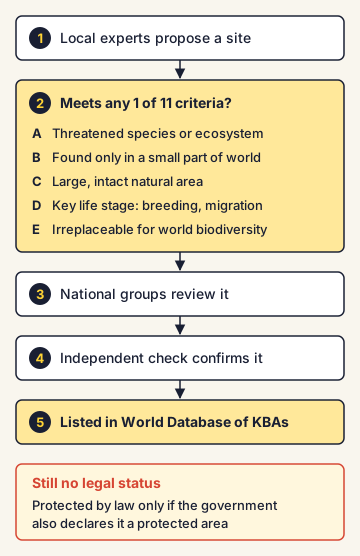
- A: Threatened biodiversity. The site holds a significant share of the world population of a threatened species or a threatened ecosystem.
- B: Geographically restricted biodiversity. The site holds species or ecosystems found in only a small part of the world.
- C: Ecological integrity. The site is a large, intact natural area, for example, untouched forest with its full set of animals.
- D: Biological processes. The site is critical for a key life stage, such as a breeding ground, a place where huge numbers of birds gather, a stop on a migration route, or a refuge in bad seasons.
- E: Irreplaceability. Scientific analysis shows that losing this site would greatly reduce the world's chances of saving its biodiversity.
The criteria apply on land, in fresh water and in the sea, and cover all kinds of species except micro-organisms. Local experts usually propose a site. National groups then review it, and an independent check confirms whether it meets the Standard. Approved sites go into the World Database of Key Biodiversity Areas, which grew out of BirdLife International's bird database.
The key numbers
The first global review of KBAs was published in February 2026. It found:
- 16,596 KBAs worldwide as of 2024, covering about 22.1 million sq km.
- KBAs are important for 18,365 species, including plants, birds, mammals, fish, insects and fungi.
- 63% of sites qualify because they hold globally threatened species, and 48% because of biological processes such as large gatherings or migration.
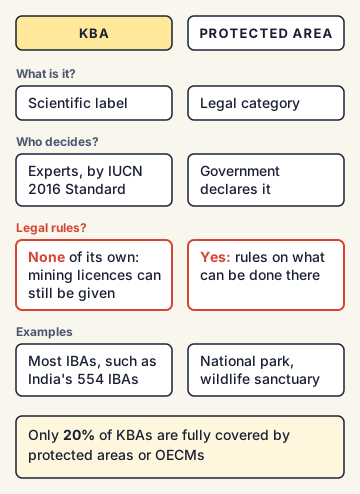
- Only 20% of KBAs are fully covered by protected areas or OECMs, and 62% overlap fully or partly with them.
- The biggest threats are over-use of natural resources such as logging, fishing and hunting (about 41% of sites) and farming expansion (about 41%). Land-based KBAs lost on average 8.2% of their tree cover between 2001 and 2020.
Are KBAs protected by law?
No. Being a KBA is a scientific label, not a legal status. A KBA gets legal protection only if the government also declares it a protected area (such as a national park) or it is covered by some other law. This is why KBAs are often called "the places that should be protected" rather than "the places that are protected".
How are KBAs used?
Governments use KBAs to choose new protected areas and to plan land use. The UN's Sustainable Development Goals (SDGs) use the share of KBAs covered by protected areas as an indicator for SDG 14 (life below water) and SDG 15 (life on land). The GBF's Target 3 asks countries to give priority to "areas of particular importance for biodiversity", and KBAs are the main tool for finding such areas. Banks, investors and companies use KBA maps to check the nature risk of a project before funding it.
India's position and Indian examples
In India, the Bombay Natural History Society (BNHS) is BirdLife International's partner. BNHS and BirdLife have identified 554 Important Bird and Biodiversity Areas in India, covering about 1.94 lakh sq km, which is about 6% of India's land area. These IBAs form the backbone of India's KBA list. Many of India's richest KBAs lie in the Western Ghats, the Eastern Himalaya and the Andaman and Nicobar Islands, which are parts of global biodiversity hotspots.
Many IBAs lie outside India's legal protected area network, which covers only about 5.3% of the country's geographical area (1,014 protected areas as of November 2023).
Commonly confused concepts
- KBA vs Protected Area: A protected area (national park, wildlife sanctuary) is a legal category declared by a government, with rules on what can be done there. A KBA is a scientific label that says a site is globally important; it has no legal rules of its own.
- KBA vs Biodiversity Hotspot: A biodiversity hotspot (concept by Norman Myers, 1988; refined by Conservation International) is a very large region, such as the whole Western Ghats and Sri Lanka, that has at least 1,500 endemic plant species and has lost at least 70% of its original natural vegetation. A KBA is a much smaller, specific site. One hotspot may contain hundreds of KBAs.
- KBA vs IBA: An IBA is chosen only for birds. A KBA can be chosen for any species group or ecosystem. Most IBAs are now counted as KBAs, but not all KBAs are IBAs.
- KBA vs Ramsar Site: A Ramsar site is a wetland that a country formally lists under the Ramsar Convention (1971). A KBA is not tied to any treaty.
Issues, criticism and the way forward
- No legal teeth: Because a KBA has no legal status, a government can still give mining or oil licences inside it. The new report shows exactly this happening in the Amazon, Cambodia and Western Australia.
- Data gaps: Many countries, especially in Asia and Africa, have not fully assessed their sites. Insects, fungi and freshwater life are poorly studied, so the KBA map is incomplete.
- Poor management: Fewer than half of monitored KBAs have a management plan, and only about one-third have strong conservation action on the ground.
- Rights of local people: Indigenous groups worry that listing their lands as KBAs could lead to "fortress conservation", where people are pushed out. Experts say KBA protection should work through community-led conservation and OECMs, with free, prior and informed consent.
- Way forward: Experts suggest that governments give priority to KBAs when expanding protected areas, keep mining and drilling out of them, include KBA screening in Environmental Impact Assessments, and fund national KBA assessments.
Concepts to Know
- Biodiversity: The variety of all living things in a place: different species, the genes within them, and the ecosystems they form.
- Threatened species: A species that the IUCN Red List places in one of three categories facing a high risk of dying out: Vulnerable, Endangered or Critically Endangered.
- Endemic species: A species found naturally in only one place in the world and nowhere else, for example, the Nilgiri tahr in the Western Ghats.
- Mining concession / oil and gas block: A piece of land or sea that the government has given to a company for a fixed period to search for or take out minerals, oil or gas.
- IUCN (International Union for Conservation of Nature): A global body, set up in 1948 and based in Gland, Switzerland, whose members are governments and NGOs. It publishes the Red List of threatened species and sets global conservation standards.
- Global Standard for the Identification of KBAs published by IUCN in 2016.
- 11 criteria in 5 categories: A (threatened biodiversity), B (geographically restricted), C (ecological integrity), D (biological processes), E (irreplaceability).
- KBA Partnership: 13 conservation organisations, including BirdLife International and IUCN.
- First global review (February 2026): 16,596 KBAs, 22.1 million sq km, 18,365 species; only 20% fully covered by protected areas or OECMs.
- KBA is a scientific label with no legal status of its own.
- India: 554 Important Bird and Biodiversity Areas identified by BNHS and BirdLife International (about 6% of India's land area).
● Tracked since October 08, 2026 · last seen October 08, 2026 · updates as the daily brief publishes