One Rank One Pension (OROP)
One Rank One Pension, or OROP, is a rule for paying pensions to retired soldiers, sailors and airmen. It says that two people who retired at the same rank after the same length of service should get the same pension, no matter when they retired. So a soldier who retired in 1995 and one who retired in 2020, both as a Havildar after 24 years, should get roughly equal pensions.
Why does it exist?
In India, pensions are calculated from the last salary a person drew. Salaries go up over time, mainly when a new Pay Commission revises them. So a person who retired 25 years ago, when salaries were low, gets a much smaller pension than someone of the same rank who retired recently. This gap hurts soldiers more than civilians.
Most soldiers retire young, often in their late 30s or early 40s, because the forces need young and fit people. So they live on a pension for many more years than a civilian employee does, and the gap keeps widening. OROP was meant to close this gap.
Where did it come from?
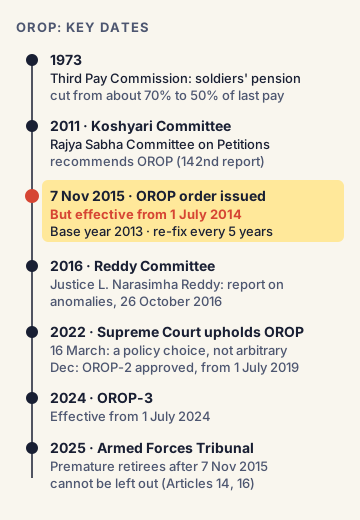
The grievance goes back to 1973. Based on the Third Pay Commission, the government reduced the pension of soldiers below officer rank from about 70% of their last basic pay to 50%, while civilian pensions were raised to 50%. Ex-servicemen demanded "one rank one pension" for decades after that. In December 2011, the Rajya Sabha Committee on Petitions, headed by Bhagat Singh Koshyari (called the Koshyari Committee), presented its 142nd report.
It strongly recommended OROP. It defined OROP as a uniform pension for the same rank and the same length of service, regardless of the date of retirement, with any future increase in pension rates passed on automatically to past pensioners. The government accepted the principle in 2014 and issued the order on 7 November 2015, with benefits counted from 1 July 2014.
How does it work?
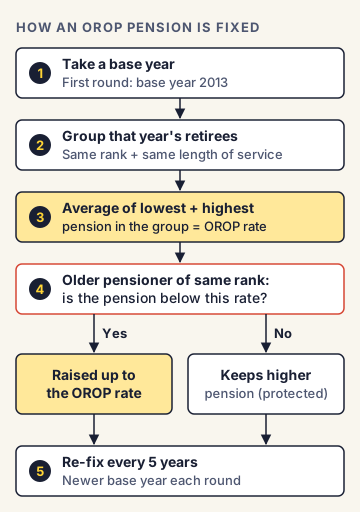
- The government takes a base year. For the first round, the base year was 2013.
- For each rank and each length of service, it looks at the pensions of people who retired in that base year.
- It takes the average of the lowest and the highest pension in that group.
- Every past pensioner of that rank and service length whose pension is lower than this average is raised to the average. Those already getting more than the average keep their higher pension (their pension is "protected").
- Pensions are re-fixed every five years using a newer base year.
A simple example: think of a school where teachers who joined in different years get very different salaries for the same post. Every five years, the school checks what a newly retired teacher of each post earns and raises older retirees' pensions to that level.
How has it been revised?
- OROP-1: effective 1 July 2014, base year 2013.
- OROP-2: effective 1 July 2019. The Union Cabinet approved it in December 2022, covering about 25.13 lakh pensioners and family pensioners, at an extra annual cost of about ₹8,450 crore.
- OROP-3: effective 1 July 2024, covering about 19.65 lakh beneficiaries, with an annual cost of about ₹6,703 crore.
What did the committees and courts say?
- Justice L. Narasimha Reddy Committee: A one-member judicial committee set up to look at problems (anomalies) in implementing OROP. It submitted its report on 26 October 2016.
- Supreme Court (16 March 2022): In Indian Ex-Servicemen Movement v. Union of India, a bench of Justices D.Y. Chandrachud, Surya Kant and Vikram Nath upheld the government's OROP policy. It said OROP is a policy decision, it is not arbitrary, and the government's definition did not have to match the Koshyari Committee's definition. It directed the government to re-fix pensions from 1 July 2019.
- Arrears case (2023): The Supreme Court directed the government to clear about ₹28,000 crore in pending OROP dues (arrears) in phases, with the last instalment due by 28 February 2024.
- Armed Forces Tribunal (31 January 2025): The 2015 order had left out personnel who took premature (early) retirement after 7 November 2015. The principal bench of the Armed Forces Tribunal struck this exclusion down, saying it violated the right to equality under Articles 14 and 16 of the Constitution.
India's position
OROP is paid to retired personnel of the Army, Navy and Air Force and their families (family pensioners). Defence pensions are paid through a digital system called SPARSH (System for Pension Administration (Raksha)), which credits pensions directly to over 34 lakh pensioners. Defence pensions are a large and growing cost: about ₹1.71 lakh crore in Budget 2026-27, roughly 22% of the defence budget.
Commonly confused concepts
- OROP vs Pay Commission: A Pay Commission revises salaries and pensions for all central government employees, usually once in about ten years. OROP is a special rule only for armed forces pensioners that equalises pensions across retirement dates every five years.
- OROP vs Old Pension Scheme (OPS) vs National Pension System (NPS): OPS and NPS are about how a pension is funded (OPS: a fixed pension paid by the government; NPS: a pension from a fund built by the employee's and government's contributions). Armed forces personnel are not under NPS; they continue to get a defined pension. OROP is about making sure pensions of the same rank are equal across time.
- OROP vs Seva Nidhi: Agniveers who exit after four years are not pensioners at all, so OROP does not apply to them. They get the Seva Nidhi lump sum instead.
- OROP vs Non-Functional Upgradation (NFU): NFU is a rule that gives an officer the pay of a higher grade after some years even without a promotion. It is about salary while serving, not pension after retirement.
Issues, criticism and the way forward
- Cost: OROP raised the pension bill sharply. A large pension bill leaves less money for buying modern weapons. This cost concern was one of the reasons given for the Agnipath scheme.
- Definition dispute: Many veterans argue that the government's version (average of minimum and maximum, revision every five years) is not "true" OROP, which they say needs automatic and yearly equalisation. The Supreme Court left this to the government as a policy matter.
- Anomalies: Some ranks and long-serving soldiers have complained that their pensions became lower than those of juniors or people with less service. The Reddy Committee was formed to look into such issues.
- Delays: Revisions due in 2019 and arrears were paid only after long delays and court orders.
- Way forward: Experts suggest timely five-yearly revisions, settling anomalies quickly, and planning a long-term budget for defence pensions so that modernisation and veterans' welfare can both be funded.
Concepts to Know
- Pension: A regular monthly payment made to a person after they retire, usually for the rest of their life, and to their family after their death (called family pension).
- Pay Commission: A body the central government sets up, usually every ten years, to recommend changes in the salaries and pensions of its employees.
- Arrears: Money that was due earlier but has not yet been paid.
- Base year: The year whose figures are used as the reference point for a calculation.
- Armed Forces Tribunal (AFT): A special court-like body set up under the Armed Forces Tribunal Act, 2007 to decide service disputes of the armed forces, such as pension, promotion and discipline.
- Committee on Petitions: A committee of Parliament that examines petitions (written requests) from the public on matters of public interest.
- Grievance began with the Third Pay Commission (1973): soldiers' pension cut from about 70% to 50% of last pay
- Koshyari Committee (Rajya Sabha Committee on Petitions, 142nd Report): presented 19 December 2011
- OROP order: 7 November 2015, effective from 1 July 2014; base year 2013
- Method: average of the minimum and maximum pension of 2013 retirees of the same rank and service length; revision every 5 years
- Justice L. Narasimha Reddy Committee report: 26 October 2016
- Supreme Court upheld OROP policy: 16 March 2022 (Indian Ex-Servicemen Movement v. Union of India)
- OROP-2 (from 1 July 2019): about ₹8,450 crore a year, about 25.13 lakh beneficiaries
- OROP-3 (from 1 July 2024): about ₹6,703 crore a year, about 19.65 lakh beneficiaries
- AFT (31 January 2025): premature retirees after 7 November 2015 cannot be excluded
● Tracked since October 04, 2026 · last seen October 04, 2026 · updates as the daily brief publishes