Non-Tariff Barriers (NTBs)
Types and the WTO Framework
Updated 16 Oct 2026: Added the SPS Agreement's three standard-setting bodies, the rule on stricter standards, and China's health-approval barriers to Indian exports.
A non-tariff barrier (NTB) is any trade hurdle, other than an import tax, that makes it harder or costlier to sell goods in another country. Examples are quotas (limits on quantity), import licences, strict product standards, testing and certification rules, labelling rules and slow customs procedures. A tariff raises the price of an imported good directly. An NTB works more quietly, by adding paperwork, delay or extra cost. Today, for most exporters, these hidden hurdles cost more than tariffs.
Why do such measures exist?
Many of these rules have good reasons. A country wants to stop unsafe food, harmful chemicals, pests that can destroy crops, and dangerous electrical goods from coming in. So it sets standards and asks for tests. The problem starts when such rules are made stricter than needed, applied unequally, or changed suddenly, mainly to protect domestic producers.
Think of a school canteen that says only snacks "approved by the canteen committee" can be sold at a school fair, and then approves only its own snacks. The rule looks like a quality check, but it works as a block on competition.
NTM or NTB: what is the difference?
International bodies use the neutral term non-tariff measure (NTM) for every policy measure, other than ordinary customs tariffs, that can affect trade. An NTM may be perfectly fair, like a food safety rule. It is called a non-tariff barrier (NTB) when it is used in a way that unfairly restricts or discriminates against imports. So every NTB is an NTM, but not every NTM is an NTB.
Where did the idea come from?
After the Second World War, countries signed the General Agreement on Tariffs and Trade (GATT), 1947. Over many rounds of talks, average tariffs fell sharply. As tariffs fell, countries began using other tools to protect their markets, so NTBs became more important.
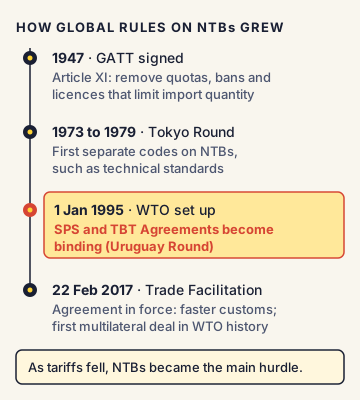
- Article XI of GATT asks countries to generally remove quantitative restrictions (quotas, bans and licences used to limit the quantity of imports).
- The Tokyo Round (1973 to 1979) produced the first separate codes on some NTBs, such as technical standards.
- The Uruguay Round created the World Trade Organization (WTO) on 1 January 1995. With it came binding agreements on NTBs, including the Agreement on the Application of Sanitary and Phytosanitary Measures (SPS), the Agreement on Technical Barriers to Trade (TBT), and agreements on import licensing, customs valuation, pre-shipment inspection and rules of origin.
- The WTO Trade Facilitation Agreement, which aims to speed up customs clearance, came into force on 22 February 2017. It was the first multilateral agreement concluded in the WTO's history.
What are the main types?
The United Nations Conference on Trade and Development (UNCTAD), working with other agencies including the WTO and the World Bank, groups NTMs into 16 chapters, A to P. The ones students should know:
- Technical measures:
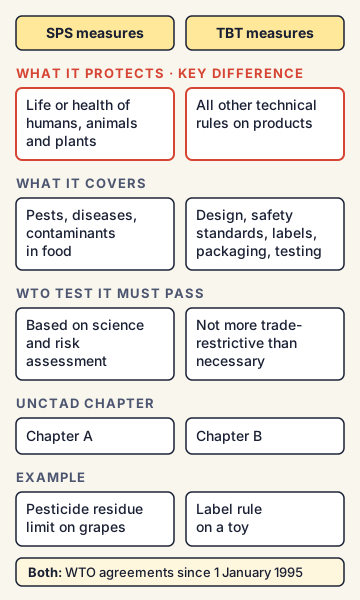
- Chapter A, Sanitary and Phytosanitary (SPS) measures: rules to protect human, animal and plant life or health. Examples: limits on pesticide residue in food, quarantine for plants, rules on animal diseases.
- Chapter B, Technical Barriers to Trade (TBT): product standards, technical specifications, labelling and packaging rules, and testing and certification to check them.
- Chapter C, pre-shipment inspection and other formalities: checks before goods are shipped, and customs paperwork.
- Non-technical measures:
- Contingent trade-protective measures (Chapter D): anti-dumping duties, countervailing duties and safeguard measures.
- Quantity controls (Chapter E): non-automatic import licences, quotas and bans.
- Price controls and extra charges (Chapter F), subsidies (Chapter L), government procurement rules (Chapter M) and rules of origin (Chapter O).
- Export-related measures (Chapter P): for example, export bans or export taxes.
How do WTO rules control them?
The WTO does not ban standards. It sets conditions so that standards are not misused:
- Non-discrimination: the same rule must apply to domestic and imported goods, and to imports from all WTO members.
- Not more trade-restrictive than necessary: under the TBT Agreement, a rule must not restrict trade more than needed to meet its goal, such as safety.
- Science-based: under the SPS Agreement, health measures must be based on scientific evidence and risk assessment. Countries are encouraged to follow international standards, such as those of the Codex Alimentarius Commission for food.
- The SPS Agreement recognises three standard-setting bodies, often called the "three sisters": the Codex Alimentarius Commission (food safety), the World Organisation for Animal Health (WOAH), earlier called the OIE (animal health), and the International Plant Protection Convention (IPPC) (plant health).
- A measure that follows their standards is presumed to meet WTO rules. A country may set a stricter standard than the international one, but it must justify it with science or a risk assessment.
- Transparency: countries must notify new draft rules to the WTO so that others can comment. Other countries can raise "specific trade concerns" in the SPS and TBT committees.
- Exceptions: Article XX of GATT allows measures needed to protect human, animal or plant life or health, or to conserve natural resources, as long as they are not disguised protection. Article XXI allows measures for national security.
- If talks fail, a country can take a case to the WTO's dispute settlement system.
How big are NTBs today?
A joint UNCTAD and World Bank study found that NTMs affect about 77% of world trade. In agriculture, their effect on average is equal to about a 21% tariff. A May 2026 UNCTAD report found that NTMs now raise export costs more than tariffs for about 88% of countries, and that least developed countries lose around 10% of their exports to G20 markets because of them.
India's position and Indian examples
- India's own measures: India uses Quality Control Orders (QCOs), issued under the Bureau of Indian Standards (BIS) framework. A QCO makes a BIS standard compulsory, so a product cannot be made, sold or imported without BIS certification. QCO coverage grew from about 70 products in 2016 to nearly 790 by 2025. India also uses food standards of the Food Safety and Standards Authority of India (FSSAI), import licensing by the Directorate General of Foreign Trade (DGFT), and testing rules for telecom equipment.
- Criticism from partners: The US Trade Representative's 2025 report on foreign trade barriers listed India's growing BIS standards and QCOs, and its import licensing rules, among its concerns. US exporters also object to India's dairy certificate rules and limits on GM food.
- Rollback: In late 2025, after a high-level government review, India withdrew QCOs on a number of raw materials and intermediate goods, such as certain chemicals and polymers. Small manufacturers had complained that the QCOs raised input costs.
- Hurdles India faces abroad: Indian exporters face strict pesticide residue limits on rice, spices and tea in some markets, US Food and Drug Administration import refusals, and new rules like the EU's Carbon Border Adjustment Mechanism (CBAM), which India says works like a trade barrier.
- China's slow approvals: India has long said that NTBs, not tariffs, are the main block on its exports to China. Slow registration, inspection and plant and animal health clearances hold back Indian generic medicines, bovine meat (buffalo meat), and fruits and vegetables. This is one reason India runs a very large trade deficit with China.
Commonly confused concepts
- Tariff vs NTB: A tariff is a tax on imports, clear and easy to measure. An NTB is a rule or procedure that blocks or slows trade without being a tax.
- SPS vs TBT: SPS measures protect life or health from risks like pests, diseases and contaminants in food. TBT measures cover all other technical rules, such as product design, safety standards and labelling. A pesticide residue limit on grapes is SPS; a label rule on a toy is TBT.
- Quota vs tariff-rate quota: A quota fixes the maximum quantity that can come in. A tariff-rate quota lets a fixed quantity in at a low tariff and charges a higher tariff on anything beyond it.
- Anti-dumping duty vs safeguard duty: An anti-dumping duty targets goods sold abroad below their normal price by specific exporters. A safeguard duty is a temporary protection against a sudden surge of imports, even when the trade is fair.
- NTB vs non-tariff measure: The measure is neutral; it becomes a barrier only when it unfairly restricts trade.
Issues, criticism and the way forward
- Hard to measure and hard to challenge: Unlike a tariff rate, the cost of a testing rule or a slow licence is not written down. This makes NTBs hard to compare and negotiate.
- Hits small firms hardest: Testing, certification and paperwork cost about the same for a small and a big firm, so small exporters and MSMEs (micro, small and medium enterprises) suffer more.
- The quality-versus-protection debate: Supporters of India's QCOs say they keep cheap, unsafe goods out and raise quality. Critics say too many QCOs on raw materials raise costs for Indian manufacturers and invite complaints from trade partners.
- Way forward: Experts suggest aligning national standards with international ones, mutual recognition agreements (each country accepting the other's test reports), more accredited testing labs, digital customs (single-window systems), clear timelines before new rules start, and dedicated NTB chapters in trade deals.
Concepts to Know
- Tariff: A tax charged on goods when they are imported into a country.
- Market access: How easily a foreign firm can sell its goods or services in a country.
- Certification: An official check that a product meets a set standard, often shown by a mark such as the BIS "ISI" mark.
- Dumping: Selling goods in another country at a price lower than the price at home, or lower than the cost of making them.
- Codex Alimentarius: A set of international food standards set by a joint body of the Food and Agriculture Organization (FAO) and the World Health Organization (WHO).
- Mutual recognition agreement (MRA): A deal under which two countries accept each other's tests and certificates, so products need not be tested twice.
- GATT 1947, Article XI: general elimination of quantitative restrictions; Article XX: general exceptions; Article XXI: security exceptions
- Tokyo Round (1973 to 1979): first codes on NTBs, such as technical standards
- WTO set up on 1 January 1995 with the SPS and TBT Agreements
- SPS "three sisters" (international standard-setters): Codex Alimentarius (food safety), WOAH, earlier OIE (animal health), IPPC (plant health)
- WTO Trade Facilitation Agreement in force: 22 February 2017
- UNCTAD classification of NTMs: 16 chapters (A to P); A = SPS, B = TBT, C = pre-shipment inspection and formalities, D = contingent protection, E = licences, quotas and bans
- NTMs affect about 77% of world trade (UNCTAD and World Bank)
- India's QCOs: about 70 products in 2016 to nearly 790 by 2025; several QCOs on inputs withdrawn in late 2025
- 16 Oct 2026Added the SPS Agreement's three standard-setting bodies, the rule on stricter standards, and China's health-approval barriers to Indian exports.
● Tracked since February 20, 2026 · last seen October 16, 2026 · updates as the daily brief publishes