Negotiating Groups in UN Climate Talks
G77 and China, LMDCs and Other Blocs
Updated 17 Nov 2026: Updated the G77 count to 134 members as of 2026 and added Rwanda as the G77 chair for 2027.
At UN climate conferences, nearly 200 countries negotiate together. No single country, except a very large one, has much voice alone. So countries with similar interests join negotiating groups (also called blocs or coalitions) and speak with one voice. Knowing who sits in which group helps you understand why a climate deal looks the way it does.
Why do these groups exist?
UN climate decisions are taken by consensus. This means a decision passes only when no country formally objects. There is no voting. In such a system, a small island nation of 10,000 people has the same formal power to object as a big country. But to shape the text, a country needs allies, expert negotiators and the ability to attend many parallel meetings at once.
Small and poor countries cannot send large teams. By joining a group, they share the workload and gain bargaining power. You can think of it like workers forming a union before talking to the company.
Where did they come from?
The groups grew out of older UN politics.
- The Group of 77 (G77) was formed on 15 June 1964, at the end of the first UN Conference on Trade and Development (UNCTAD) in Geneva. Seventy-seven developing countries signed a joint declaration, which gave the group its name. India was one of the founders.
- When the UN Framework Convention on Climate Change (UNFCCC) was signed in 1992, the G77 became the main voice of developing countries in climate talks. China is not a formal G77 member but works with it, so the group is called "G77 and China".
- As talks became more complex, smaller groups formed inside and across the G77 to push specific interests. AOSIS formed in 1990, BASIC in 2009, and AILAC and the LMDC in 2012.
How does the 1992 divide shape the groups?
The UNFCCC split countries into lists called Annexes.
- Annex I countries were the rich industrialised countries of 1992 (OECD members) plus "economies in transition" like Russia and East European states. They were expected to cut emissions first.
- Annex II is a smaller list (the OECD members of 1992) that must also give money and technology to developing countries.
- Non-Annex I countries are developing countries, including India and China.
This divide comes from the principle of Common but Differentiated Responsibilities (CBDR): everyone must act on climate, but those who polluted more in the past should do more and pay more. Most fights between groups are really fights over how strongly this divide should still apply.
The main developing-country groups (membership as per the UNFCCC's official list of active negotiating groups, 2025):
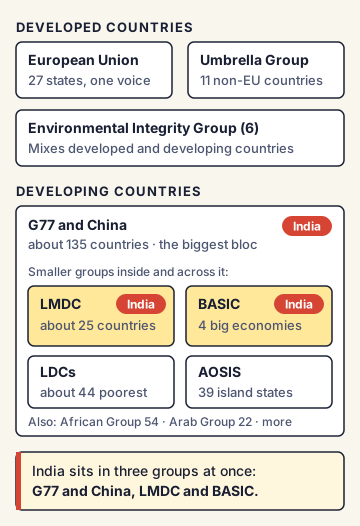
- G77 and China: the largest group. As of November 2026, the G77's own official list has 134 member countries (the UNFCCC's list counts 136 parties, including one observer authorised to attend). It speaks on broad issues like finance. Its chair rotates every year among three regions: Africa, Asia-Pacific, and Latin America and the Caribbean. In 2026 the chair is Uruguay. In September 2026, the group chose Rwanda to chair it in 2027.
- Like-Minded Developing Countries (LMDC): about 25 countries, including India, China, Saudi Arabia, Indonesia, Malaysia, Pakistan, Egypt, Iran, Bolivia, Cuba and Venezuela. It held its first formal meeting in Beijing in October 2012. It strongly defends CBDR and the "firewall" between developed and developing countries. It speaks through spokespersons who change issue by issue.
- BASIC: Brazil, South Africa, India and China. These four large emerging economies formed the group in 2009, just before the Copenhagen summit (COP15).
- African Group of Negotiators (AGN): all 54 African countries. It focuses on adaptation, finance and Africa's special needs.
- Least Developed Countries (LDCs): about 44 of the world's poorest countries (like Bangladesh, Nepal and many African nations). They seek adaptation money and loss and damage support.
- Alliance of Small Island States (AOSIS): 39 small island and low-lying coastal states, formed in 1990. Rising seas threaten their existence, so they push for the most ambitious targets, like limiting warming to 1.5°C.
- Arab Group: 22 Arab states, chaired by Saudi Arabia. Many are oil producers and resist fast fossil fuel phase-outs.
- AILAC (Independent Association of Latin America and the Caribbean): 8 middle-income Latin American countries (such as Colombia, Chile, Peru and Panama), formed in 2012. It often takes a middle position between rich and poor countries.
- ALBA: 5 left-leaning Latin American countries (Bolivia, Cuba, Dominica, Nicaragua, Venezuela).
- Landlocked Developing Countries (LLDCs): 32 countries with no coastline. It is the newest official group, added in June 2025.
The main developed-country groups
- European Union (EU): 27 member states that negotiate as one bloc. The country holding the EU Council presidency speaks for it, supported by the European Commission.
- Umbrella Group: a loose group of non-EU developed countries: Australia (coordinator), Canada, Iceland, Israel, Japan, Kazakhstan, New Zealand, Norway, Ukraine, the United Kingdom and the United States.
- Environmental Integrity Group (EIG): a small mixed group of 6: Switzerland (chair), Mexico, South Korea, Liechtenstein, Monaco and Georgia. It was formed in 2000. It is unusual because it mixes developed and developing countries.
How does this play out in a negotiation?
Usually the big groups state their position first. Then smaller groups add their special concerns. One country can belong to several groups at once. For example, India is in the G77 and China, the LMDC and BASIC. Bangladesh is in the G77, the LDCs and the LMDC. Overlapping memberships help build bridges between positions. Informal cross-group coalitions also form. The High Ambition Coalition and the Cartagena Dialogue bring together progressive developed and developing countries.
India's position and role
India usually works through three groups:
- In the LMDC, India defends CBDR, equity and the right of developing countries to grow, and opposes any blurring of the developed-developing divide.
- In BASIC, India coordinates with other big emerging economies, which together have strong bargaining power.
- In the G77 and China, India joins the wider developing-world demand for climate finance from rich countries under Article 9 of the Paris Agreement.
India often opposes "unilateral trade measures" such as the European Union's Carbon Border Adjustment Mechanism (CBAM). India argues these shift the cost of climate action onto developing countries.
Commonly confused concepts
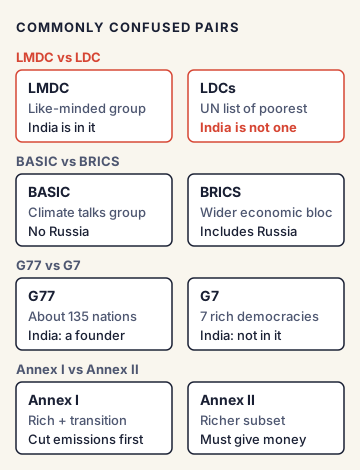
- G77 vs G20 vs G7: The G77 is a UN-based group of developing countries (134 members on its official list, as of 2026). The G20 is a forum of 19 major economies plus the EU and the African Union, on economic issues. The G7 is a club of seven rich democracies. India is in the G77 and G20, not the G7.
- LMDC vs LDC: The LMDC (Like-Minded Developing Countries) is a political group that includes big economies like China and India. The LDCs (Least Developed Countries) are a UN category of the poorest countries, based on income and other criteria. India is in the LMDC but is not an LDC.
- BASIC vs BRICS: BASIC (Brazil, South Africa, India, China) is a climate negotiating group. BRICS (Brazil, Russia, India, China, South Africa, plus newer members) is a wider political and economic grouping. Russia is in BRICS but not BASIC.
- Annex I vs Annex II: Annex I is the larger list of industrialised countries and economies in transition. Annex II is only the richer subset that must provide finance.
- AOSIS vs SIDS: SIDS (Small Island Developing States) is a UN category of countries. AOSIS is the negotiating alliance that represents most of them in climate talks.
Issues, criticism and the way forward
- The old divide is blurring. China is now the largest emitter in the world, and some developing countries are richer than some Annex I countries. Developed countries argue that big emerging economies should also pay into climate finance. Developing countries reply that historical emissions and per-person emissions still matter, and India's per-person emissions are far below the world average.
- Splits inside the G77. Small islands want fast cuts in fossil fuel use. Oil-producing Arab states resist this. This can weaken the developing world's common voice.
- Consensus can slow everything. Since one objection can block a decision, outcomes are often weak compromises.
- Unequal capacity. Poor countries send small teams and cannot follow every parallel meeting, so groups depend on a few expert negotiators.
- Big players leaving. The United States left the Paris Agreement in January 2026 and has also given notice to leave the UNFCCC itself. This changes how the Umbrella Group and other developed countries negotiate.
- Way forward: Experts suggest more support for negotiators from poor countries, clearer rules on finance so trust can grow, and using cross-group coalitions to bridge the developed-developing gap.
Concepts to Know
- UNFCCC (United Nations Framework Convention on Climate Change): The main world treaty on climate change, agreed in 1992. Its yearly meeting is called the COP (Conference of the Parties).
- Consensus: A way of deciding where a proposal passes only if no member formally objects. It is different from voting, where the majority wins.
- CBDR (Common but Differentiated Responsibilities): The principle that all countries must act on climate change, but rich countries that polluted more in the past must do more and help poorer ones.
- OECD (Organisation for Economic Co-operation and Development): A club of mostly rich countries that share economic data and policy ideas.
- Firewall: A strict separation between the duties of developed and developing countries in climate treaties. The LMDC wants to keep it.
- Carbon Border Adjustment Mechanism (CBAM): A charge the European Union puts on imports like steel and aluminium, based on the carbon released while making them.
- G77 founded: 15 June 1964, at UNCTAD-I, Geneva; India is a founding member; China works with it as "G77 and China"
- G77 and China: 134 members on the G77's official list (2026); chair in 2026: Uruguay; chair in 2027: Rwanda
- LMDC: about 25 countries including India and China; first formal meeting in Beijing, October 2012
- BASIC: Brazil, South Africa, India, China; formed 2009
- AOSIS: 39 members, formed 1990; AGN: 54 African countries; Arab Group: 22; AILAC: 8 (formed 2012); ALBA: 5; LLDCs: 32 (newest group, June 2025)
- EIG: 6 members (Switzerland, Mexico, South Korea, Liechtenstein, Monaco, Georgia), formed 2000
- Umbrella Group: 11 non-EU developed countries, coordinated by Australia
- UNFCCC lists 16 active negotiating groups (2025)
- India belongs to G77 and China, LMDC and BASIC
- UN climate decisions are taken by consensus, not by vote
- 17 Nov 2026Updated the G77 count to 134 members as of 2026 and added Rwanda as the G77 chair for 2027.
● Tracked since November 14, 2026 · last seen November 19, 2026 · updates as the daily brief publishes