Climate Finance Accounting
How Climate Money Is Counted
Updated 15 Nov 2026: Added the two-year climate finance work programme on Article 9.1, set up at COP30 in Belém in 2025.
Climate finance is money that helps countries cut greenhouse gas emissions (mitigation) or cope with the effects of climate change (adaptation). Climate finance accounting is the set of rules used to decide what counts as climate finance and how much each rupee or dollar is worth when it is reported. Because there is no single agreed rule book, the same flow of money can be shown as large by one side and small by the other. This is why the "how much did rich countries really pay?" fight returns at almost every UN climate summit.
Why does counting matter so much?
Under the climate treaties, developed countries promised to send money to developing countries. A promise is only useful if both sides can check whether it was kept. Think of a family where an elder brother promised to pay a younger sibling's college fees. If he counts a loan he expects back, or money he only "arranged" from a friend, as his own payment, the sibling will feel cheated. Climate finance works the same way: the answer depends on what you are allowed to count.
Where did the promise come from?
The duty to pay has a long history in the climate talks:
- UNFCCC, 1992: The UN Framework Convention on Climate Change says developed countries listed in its Annex II will provide "new and additional" financial resources to developing countries (Article 4.3), and help the most vulnerable meet adaptation costs (Article 4.4).
- Copenhagen, 2009 (COP15): Developed countries promised in the Copenhagen Accord to mobilise USD 100 billion a year by 2020. The Accord was only a political statement, not a formal COP decision.
- Cancún, 2010 (COP16): The USD 100 billion goal was written into a formal COP decision (decision 1/CP.16). The same meeting set up the Green Climate Fund and the Standing Committee on Finance (SCF).
- Paris, 2015 (COP21): The Paris Agreement's Article 9 restated the duty to pay, and the decision adopting it extended the USD 100 billion goal to 2025. It also asked countries to set a new goal above that floor before 2025.
- Baku, 2024 (COP29): Countries agreed the New Collective Quantified Goal (NCQG): at least USD 300 billion a year by 2035, with developed countries taking the lead, inside a larger call for USD 1.3 trillion a year from all sources.
- Belém, 2025 (COP30): Countries set up a two-year work programme on climate finance. It looks at Article 9.1 of the Paris Agreement, but "in the context of Article 9 as a whole". Developing countries had asked for a three-year programme on Article 9.1 alone. Developed countries wanted all of Article 9 included, so that private money and a wider group of payers stay part of the talks.
What does Article 9 of the Paris Agreement say?
Students should know its main paragraphs, because the 2026 fight is about them:
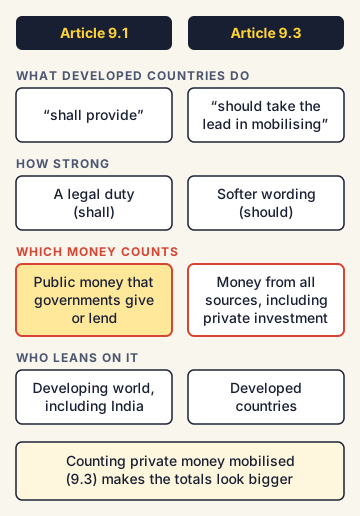
- Article 9.1: Developed countries "shall provide" financial resources to help developing countries with mitigation and adaptation. "Shall" makes this a duty, continuing their duty under the 1992 Convention.
- Article 9.2: Other countries are "encouraged" to provide support voluntarily. This is how countries like China can give money without being obliged to.
- Article 9.3: Developed countries "should" take the lead in mobilising climate finance from a wide variety of sources, including private money.
- Article 9.5: Developed countries must report every two years on the finance they plan to give in future.
- Article 9.7: Developed countries must report every two years on the support they actually provided and mobilised through public action.
Developing countries say 9.1 ("provide", mainly public money) is the core duty. Developed countries tend to point to 9.3 ("mobilise", from all sources), which lets private money count too. This difference in wording is the root of the counting fight.
How is climate finance counted in practice?
The main official tally comes from the OECD (Organisation for Economic Co-operation and Development, a Paris-based club of mostly rich countries). It adds up four streams:
- Bilateral public finance: money from one government to another, for example from a donor's aid agency to a developing country.
- Multilateral public finance: the share of money from bodies like the World Bank or climate funds that can be credited to developed countries.
- Climate-related export credits: officially backed loans or guarantees that help a developing country buy goods from the donor country.
- Private finance mobilised: private investment that public money from a developed country is said to have attracted.
By this count, developed countries gave and mobilised USD 115.9 billion in 2022, the first year the USD 100 billion goal was met, two years late. The OECD then reported USD 132.8 billion for 2023 and USD 136.7 billion for 2024 (report of May 2026). In 2022, about 80% of the total was public money, and about 69% of public climate finance was in the form of loans.
Why do developing countries question these numbers?
Critics point to several counting choices that make totals look bigger than the help that actually arrives:
- Loans at face value: A loan of USD 100 that must be repaid with interest is counted as USD 100, the same as a gift of USD 100. The real help is only the cheaper part of the loan.
- Generous labels (Rio markers): Since 1998 the OECD's aid committee uses "Rio markers" to tag projects. A project whose main aim is climate is marked "principal", and one where climate is a secondary aim is marked "significant". Each donor chooses what share of a "significant" project to count, and some count large shares or even the full value.
- Relabelled aid: The 1992 treaty speaks of "new and additional" money, but there is no agreed baseline. A school or road grant can be relabelled as climate finance, so aid for other needs may just be renamed.
- Commitments vs disbursements: Some figures count money promised (committed), not money actually paid out (disbursed).
- Private money mobilised: It is hard to prove that a private investment happened because of public money, so this part is easy to over-claim.
What is the "grant equivalent" method?
It is a fairer way of valuing a loan. Instead of counting the full loan, you count only the "gift" part: how much cheaper the loan is than a normal market loan. A loan at near-zero interest over 40 years has a large grant element, while a loan at near-market rates has almost none. The OECD has used grant equivalents for measuring overall official aid (ODA) since 2018 data, but the climate finance totals still count loans at face value.
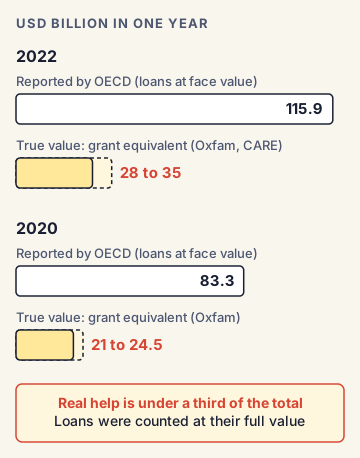
Using this method, the aid groups Oxfam and CARE estimated the "true value" of climate finance at only USD 28 to 35 billion in 2022, against the reported USD 115.9 billion. An earlier Oxfam estimate put the true value for 2020 at USD 21 to 24.5 billion, against a reported USD 83.3 billion.
India's position and Indian examples
India has been one of the sharpest critics of the official counts:
- In November 2015, just before Paris, the Department of Economic Affairs in India's Ministry of Finance released a discussion paper titled "Climate Change Finance, Analysis of a Recent OECD Report: Some Credible Facts Needed". The OECD had estimated USD 62 billion of climate finance for 2014. India's paper argued that the only credible figure was about USD 2.2 billion, the money actually paid out by special climate funds, and pointed to double counting and mislabelling.
- India says the Paris Agreement does not allow the burden of paying to shift onto developing countries, and that public, grant-based money should be the core of any goal.
- India's 2015 climate pledge (its Intended Nationally Determined Contribution) gave a preliminary estimate that it would need at least USD 2.5 trillion (at 2014-15 prices) between 2015 and 2030 for its climate actions, mostly financed so far from its own budget.
- At COP31, India backed a standalone Climate Finance Work Programme and said it would work with the G77 and China, the Like-Minded Developing Countries (LMDC) group and BASIC (Brazil, South Africa, India and China).
Who checks the numbers inside the UN system?
The UNFCCC's Standing Committee on Finance (SCF), set up in 2010 at Cancún, publishes a Biennial Assessment and Overview of Climate Finance Flows every two years. The sixth one was presented at COP29 in 2024, and a seventh is due in 2026. From 2024, countries also report under the Paris Agreement's Enhanced Transparency Framework (Article 13) through Biennial Transparency Reports, with the first ones due by 31 December 2024. These reports make data more open but do not settle the definition question.
Commonly confused concepts
- Climate finance provided vs mobilised: "Provided" is public money that a government itself gives or lends. "Mobilised" is other money, usually private, that public action is said to have attracted. Article 9.1 is about providing; Article 9.3 is about mobilising.
- Face value vs grant equivalent: Face value counts the full amount of a loan. Grant equivalent counts only the gift part of the loan.
- Committed vs disbursed: Committed is money promised for a project. Disbursed is money actually paid out.
- Climate finance vs ODA: Official Development Assistance (ODA) is all concessional aid from rich countries for development. Climate finance overlaps with ODA, which is why critics fear that climate money is just old aid with a new label.
- USD 100 billion goal vs NCQG: The first was a 2020 to 2025 goal set in 2009 and 2010. The NCQG is the newer goal set in 2024: at least USD 300 billion a year by 2035.
- Mitigation finance vs adaptation finance: Mitigation finance pays for cutting emissions (solar parks, electric buses). Adaptation finance pays for coping with impacts (flood walls, drought-tolerant seeds). Most climate finance has gone to mitigation (about 60% in 2022).
Issues, criticism and the way forward
- No agreed definition: The UNFCCC still has no common definition of climate finance. The first Global Stocktake (2023) noted that this makes it impossible to track progress consistently.
- Debt burden: Heavy reliance on loans adds to debts in poor countries that are already paying high interest. Critics say the money "helps" while also pulling repayments back to lenders.
- Too little for the poorest: Low-income countries received only about 10% of climate finance in 2022, and adaptation remains underfunded.
- The developed-country view: Developed countries argue that public budgets are limited, that private investment is essential to reach the trillions needed, and that large emerging economies should also contribute.
- Way forward suggested by experts: a common definition agreed under the UNFCCC; reporting both face value and grant equivalent; counting disbursements alongside commitments; a clear baseline to prove money is "new and additional"; and more grants for adaptation and for the poorest countries.
Concepts to Know
- Mitigation: Actions that reduce the release of greenhouse gases, such as replacing coal power with solar power.
- Adaptation: Actions that help people live with climate change effects that cannot be avoided, such as building flood walls or planting heat-tolerant crops.
- Concessional loan: A loan given on easier terms than the market, for example at a low interest rate or with a long time to repay.
- Export credit: A loan or guarantee backed by a government to help a foreign buyer purchase goods from that government's own country.
- OECD: The Organisation for Economic Co-operation and Development, a group of 38 mostly high-income countries based in Paris. It collects data on aid given by its members.
- Annex II countries: The list of rich countries in the 1992 climate treaty that took on the duty to provide money and technology to developing countries.
- COP: The Conference of the Parties, the yearly meeting of all countries that have joined the UN climate treaty.
- UNFCCC 1992: Article 4.3 ("new and additional" finance), Article 4.4 (adaptation help for vulnerable countries)
- USD 100 billion a year by 2020: Copenhagen Accord 2009 (political), formalised at Cancún 2010 (decision 1/CP.16); extended to 2025 at Paris 2015
- Paris Agreement Article 9.1 "shall provide" (developed countries); 9.2 others "encouraged"; 9.3 "should take the lead in mobilising"; 9.5 and 9.7 biennial reporting
- OECD totals: USD 115.9 billion (2022, goal first met), USD 132.8 billion (2023), USD 136.7 billion (2024)
- 2022: about 69% of public climate finance was loans; about 60% of all climate finance went to mitigation
- Oxfam and CARE "true value" (grant equivalent): USD 28 to 35 billion for 2022
- Rio markers: introduced by the OECD's Development Assistance Committee in 1998; "principal" and "significant" scores
- India's Ministry of Finance paper (November 2015): only about USD 2.2 billion credible climate finance
- Standing Committee on Finance: set up at COP16, Cancún, 2010; publishes the Biennial Assessment
- Climate finance work programme: set up at COP30, Belém, 2025; runs two years; covers Article 9.1 "in the context of Article 9 as a whole"
- 15 Nov 2026Added the two-year climate finance work programme on Article 9.1, set up at COP30 in Belém in 2025.
● Tracked since November 13, 2026 · last seen November 15, 2026 · updates as the daily brief publishes