NDC Synthesis Report (UNFCCC)
How the UN Adds Up National Climate Pledges
The NDC Synthesis Report is a report prepared by the UNFCCC secretariat (the UN's climate office, based in Bonn, Germany). It collects the climate plans of all countries, called Nationally Determined Contributions or NDCs, and adds them up. The result tells the world one simple thing: if every country does what it has promised, how much will global greenhouse gas emissions go up or down?
It is like a teacher adding up every student's promised marks to see if the class will reach its target average.
Why does it exist?
Under the Paris Agreement (2015), there is no global cap that is shared out among countries. Each country decides its own target. This "bottom-up" design got almost every country to join. But it creates a problem: nobody knows whether all these separate promises together are enough. The synthesis report fills this gap. It compares the total of all pledges with what science says is needed, so countries can see the shortfall and raise their ambition.
Where did it come from?
The idea started before the Paris Agreement was even signed.
- In 2014, at the climate conference in Lima (COP20), countries asked the secretariat, through decision 1/CP.20, to prepare a report on the "aggregate effect" (the combined effect) of the climate plans countries were sending in. These early plans were called INDCs, Intended Nationally Determined Contributions.
- The first report came out in late October / 1 November 2015, just before the Paris conference. It covered plans from 147 Parties submitted by 1 October 2015.
- After Paris, an update in May 2016 covered 161 INDCs from 189 Parties.
- In 2021, the secretariat released an interim report in February and a full one before the Glasgow conference (COP26), covering 164 NDCs from 191 Parties.
- At Glasgow, countries adopted decision 1/CMA.3, which asked the secretariat to update the synthesis report every year and make it available at each yearly meeting of the Paris Agreement's members (the CMA). Since then, a new edition comes out each year, usually in October, ahead of the annual climate conference.
How does it work?
The process runs in a few steps:
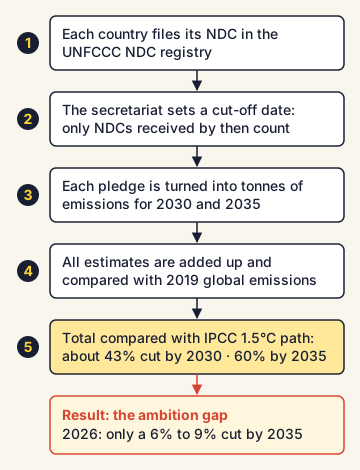
- Every country records its NDC in the official NDC registry kept by the UNFCCC.
- The secretariat sets a cut-off date. Only NDCs received by that date are counted.
- For each NDC, experts convert the promise into an estimated emissions level for key years such as 2030 and 2035. A promise like "cut emissions intensity by 45%" has to be turned into an actual quantity of gases, using expected economic growth.
- These estimates are added up and compared with the 2019 level of global emissions, which is used as the starting point.
- The total is then compared with the pathways described by the IPCC (Intergovernmental Panel on Climate Change, the UN's scientific body on climate).
Unconditional vs conditional pledges
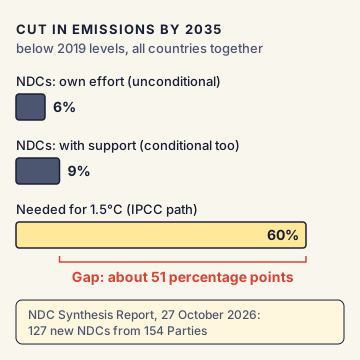
Many developing countries split their NDC into two parts. The unconditional part is what they will do with their own resources. The conditional part is extra action they will take only if they receive international finance, technology or capacity-building support. The report therefore gives two numbers: one for unconditional pledges only, and a larger one if conditional pledges are also met. The gap between the two shows how much climate action depends on money and help from richer countries.
The benchmark: what does science ask for?
The IPCC's Sixth Assessment Synthesis Report (2023) says that to limit warming to 1.5°C with no or limited overshoot, global greenhouse gas emissions must fall about 43% by 2030 and 60% by 2035, compared with 2019 levels. The first Global Stocktake decision at COP28 in Dubai (2023) repeated these figures. Every synthesis report is measured against this yardstick.
What have recent editions found?
The numbers below show how the picture has changed. Note that each edition covers a different set of countries, so the headline figures are not directly comparable.
- 2024 edition (28 October 2024, 168 NDCs from 195 Parties): full implementation of all latest NDCs would cut emissions about 5.9% below 2019 levels by 2030.
- 2025 edition (28 October 2025): covered 64 new NDCs, about 30% of global emissions, and projected about a 17% cut below 2019 by 2035 for those countries. An update in November 2025, covering 113 Parties and about 69% of 2019 emissions, projected about 12% below 2019 by 2035.
- 2026 edition (27 October 2026): 127 new NDCs from 154 Parties; about 6% below 2019 by 2035 (unconditional) and 9% with conditional pledges.
India's position and Indian examples
India's NDCs are part of what the report counts. In its updated NDC of August 2022, India promised to reduce the emissions intensity of its GDP by 45% by 2030 from 2005 levels, to get about 50% of its installed electricity capacity from non-fossil sources by 2030, and to create an additional carbon sink of 2.5 to 3 billion tonnes of carbon dioxide equivalent through forests.
In March 2026, the Union Cabinet approved India's next NDC for 2031–2035, with a 47% cut in emissions intensity by 2035 (from 2005 levels) and 60% non-fossil installed electricity capacity by 2035. India's target is an intensity target, not a cap on total emissions. India's long-term goal is net zero by 2070. India's stand in climate talks is that pledges must follow equity and common but differentiated responsibilities and respective capabilities (CBDR-RC), and that developed countries must provide finance for the conditional part of developing countries' plans.
Commonly confused concepts
- NDC Synthesis Report vs UNEP Emissions Gap Report: The synthesis report is made by the UNFCCC secretariat and adds up only what countries have promised in their NDCs. The Emissions Gap Report is made by the UN Environment Programme (UNEP), published every year since 2010. It also looks at current policies (what countries are actually doing) and measures the "gap" between where emissions are heading and where they should be.
- Synthesis report vs Global Stocktake: The synthesis report is a yearly technical summary of pledges. The Global Stocktake (Article 14 of the Paris Agreement) is a full review of collective progress held every five years (first one concluded at COP28, 2023), ending in a political decision by countries.
- NDC vs Biennial Transparency Report (BTR): An NDC is a promise about the future. A BTR, under the Enhanced Transparency Framework (Article 13), is a report on what a country has actually done, sent every two years.
- Unconditional vs conditional: Unconditional means "we will do it ourselves"; conditional means "we will do it if we get support".
Issues, criticism and the way forward
- Ambition gap: A cut of 6% to 9% by 2035 is far below the 60% the IPCC pathway asks for. The world is heading for warming well above 1.5°C.
- Pledges are not actions: The report counts promises, not real policies. If countries fail to implement, actual emissions will be even higher.
- Missing or late NDCs: Many countries miss the deadlines, so each edition covers only part of world emissions. This makes year-to-year comparison hard.
- Uncertain conversions: Turning intensity targets or "below business-as-usual" targets into exact emission numbers depends on assumptions about growth, so results come with wide ranges.
- Finance gap: The conditional part depends on climate finance from developed countries. Developing countries, including India, argue that slow and insufficient finance holds back ambition.
- Way forward: Experts and the UNFCCC call for stronger next-round NDCs, faster implementation of existing ones, economy-wide targets covering all gases, and delivery of the new climate finance goal agreed at COP29 (Baku, 2024).
Concepts to Know
- Greenhouse gases (GHGs): Gases such as carbon dioxide, methane and nitrous oxide that trap heat in the atmosphere and warm the Earth.
- Emissions intensity of GDP: The amount of greenhouse gases released for each unit of economic output (each rupee of GDP). It can fall even when total emissions rise, if the economy grows faster than emissions.
- Net zero: A state where the greenhouse gases a country releases are balanced by the gases it removes from the air, for example through forests, so the net addition is zero.
- COP and CMA: The COP (Conference of the Parties) is the yearly meeting of all members of the UNFCCC. The CMA is the meeting of the members of the Paris Agreement, held at the same time.
- Carbon sink: Anything that absorbs more carbon dioxide than it releases, such as forests and oceans.
- Overshoot: When warming goes above a limit like 1.5°C for some time before being brought back down by removing carbon from the air.
- Prepared by: UNFCCC secretariat (Bonn, Germany)
- First mandated by decision 1/CP.20 (Lima, COP20, 2014); first report in late October / 1 November 2015 covering 147 Parties
- Made an annual report by decision 1/CMA.3 (Glasgow, 2021)
- Baseline year used for comparison: 2019
- IPCC 1.5°C pathway: about 43% cut by 2030 and 60% by 2035 below 2019 levels (AR6 Synthesis Report, 2023)
- 2024 edition: 168 NDCs, 195 Parties; about 5.9% below 2019 by 2030
- 2025 edition: 64 new NDCs; about 17% below 2019 by 2035; November 2025 update: about 12%
- 2026 edition: 127 NDCs, 154 Parties; 6% (unconditional) / 9% (with conditional) below 2019 by 2035
- India's NDC for 2035: 47% emissions intensity cut (vs 2005) and 60% non-fossil installed power capacity; net zero by 2070
● Tracked since October 27, 2026 · last seen October 27, 2026 · updates as the daily brief publishes