National Statistical Commission (NSC)
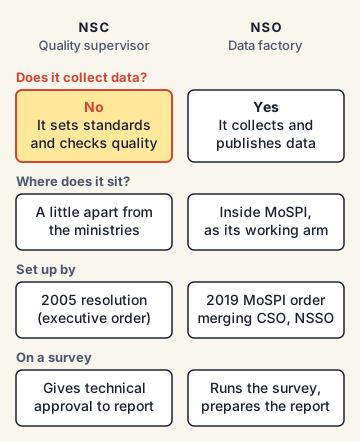
The National Statistical Commission, or NSC, is India's top advisory body for official statistics. Its job is to make sure that the numbers the government publishes, such as GDP, inflation and unemployment, are collected by sound methods, follow common standards and can be trusted by everyone. It does not collect data itself. Think of it as the "quality supervisor" that watches over the data factory run by MoSPI and other ministries.
Why does India need such a body?
Official data is used for almost every big decision. The RBI uses inflation data to set interest rates, the Finance Commission uses population and income data to share money with states, and investors use GDP data to decide where to put money. If people suspect that the numbers are bent to suit the government of the day, all these decisions lose their base.
So a country needs a body that stands a little apart from the ministries and checks that data is produced honestly, on time and by fixed rules. Experts call this the independence or credibility of official statistics.
Where did it come from?
In the late 1990s, India's statistical system was seen as weak and badly coordinated. Different ministries produced data in different ways, and many states lagged behind.
- January 2000: The government set up a commission headed by Dr. C. Rangarajan, a former RBI Governor, to review the whole statistical system. It is known as the Rangarajan Commission (formally, it was also called the National Statistical Commission).
- 2001: The Rangarajan Commission submitted its report. Its key idea was a permanent National Commission on Statistics, created by law, that would be the "nodal and empowered body" for all core statistics of the country. It suggested setting it up first through a government order and later giving it legal backing.
- 1 June 2005: The government passed a resolution (an executive order, not a law) to set up the NSC.
- 12 July 2006: The NSC started working.
The same 2005 resolution created the post of Chief Statistician of India (CSI), who acts as the Secretary of the NSC. Pronab Sen was the first Chief Statistician.
What are "core statistics"?
Core statistics are the most important national numbers, the ones that show the health of the economy and society. Examples are GDP, price indices like CPI, industrial production, employment and the population figures. The Rangarajan Commission said these numbers must be produced and released free from government pressure, because they matter to the whole nation.
Who is in the NSC?
The NSC is a small body:
- A part-time Chairperson, an eminent statistician or economist
- Four part-time Members, experts in fields such as statistics, economics and data
- The Chief Executive Officer of NITI Aayog as an ex officio member (a member because of the post he or she holds)
- The Chief Statistician of India as its Secretary
The Chairperson has the rank of a Minister of State, and the Members have a rank equal to a Secretary to the Government of India. Members are appointed by the government for a fixed term, usually three years. As of November 2026, the Chairperson is Saibal Chattopadhyay, a former Director of IIM Calcutta. The Appointments Committee of the Cabinet approved his appointment in June 2026 for three years. He took over from Rajeeva Laxman Karandikar, who had chaired the NSC since 2022.
What does the NSC do?
Its main functions are:
- Identify core statistics of national importance and decide which ones need priority
- Set standards: evolve common concepts, definitions, classifications and methods, so that every ministry and state measures things the same way
- Coordinate statistical work across central ministries and state governments
- Oversee quality: review surveys, methods and data releases, and advise the government on the statistical system
- Act for the old NSSO Governing Council: the technical oversight of the national sample surveys, which a Governing Council used to handle, was handed to the NSC
In practice, survey reports of the National Sample Survey are placed before the NSC for technical approval before they are released.
The 2019 episode: why independence matters
In December 2018, the NSC approved the report of the Periodic Labour Force Survey (PLFS) for 2017-18, the first big jobs survey of its kind. The report was not released at once. On 28 January 2019, the acting Chairperson P.C. Mohanan and member J.V. Meenakshi resigned. They said the Commission was being sidelined: an approved report was held back, and they were not consulted on decisions like the GDP back series and the new Economic Census.
The government said the report was still a draft. This episode became a textbook case in the debate on whether India's statistical bodies have enough independence.
Efforts to give the NSC legal status
- December 2019: MoSPI released a draft National Statistical Commission Bill, 2019 for public comments. It proposed making the NSC a statutory body for core statistics, with a National Statistical Fund and a statistical audit wing. Critics said the draft still kept the NSC mostly advisory and gave the Central government the final word. The Bill has not been passed.
- December 2025: Parliament's Standing Committee on Finance recommended giving the NSC full statutory powers, making it the nodal and autonomous body for all core statistical activities, able to set methods and data sources for government agencies and even private data firms.
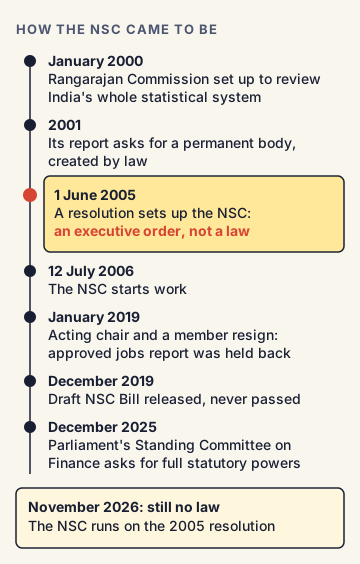
As of November 2026, the NSC still works under the 2005 executive resolution.
India's position and international links
India follows the UN Fundamental Principles of Official Statistics, ten principles first adopted by the UN Statistical Commission in 1994 and endorsed by the UN General Assembly in January 2014. They include professional independence, equal access to data for everyone and confidentiality of individual answers. India also subscribes to the IMF's Special Data Dissemination Standard (SDDS), which sets rules on how often and how quickly key data must be released.
Many countries give their statistics body legal independence. For example, the UK Statistics Authority was created by a 2007 law.
Commonly confused concepts
- NSC vs NSO: The NSO (National Statistical Office) is the working arm inside MoSPI that actually collects and publishes data. The NSC is the advisory and oversight body that sets standards and checks quality.
- NSC (2006) vs Rangarajan Commission (2000): The Rangarajan Commission was a one-time review panel that wrote a report in 2001. The NSC is the permanent body set up in 2005-06 on its advice.
- NSC vs Standing Committee on Statistics (SCoS): The SCoS was a 14-member expert panel set up in July 2023 under Pronab Sen to advise on survey methods. It was dissolved in September 2024 because its work overlapped with a new Steering Committee for National Sample Surveys, which was chaired by the then NSC Chairperson. Neither committee is the NSC itself.
- Executive body vs statutory body: A statutory body is created by an Act of Parliament (for example, SEBI). An executive body is created by a government order or resolution. The NSC is an executive body, which is why experts say it can be weakened easily.
- Collection of Statistics Act, 2008 vs NSC: The 2008 Act gives the government legal power to collect data from businesses and households and keeps individual answers confidential. It does not create the NSC.
Issues, criticism and the way forward
- No legal backing: Because it was made by a resolution, the NSC cannot force ministries or states to follow its standards. Its powers can be changed by another government order.
- Advisory, not binding: The NSC can approve or advise, but the final decision on releasing data rests with the government, as the 2019 PLFS episode showed.
- Delayed and withheld data: The 2017-18 consumption survey was not released, and the 7th Economic Census results were delayed for years. Such gaps hurt trust in official numbers.
- Weak state systems: Many states lack trained staff and money for statistics, so district and state data is patchy.
- New data, new risks: Big data, administrative records and AI can give faster numbers, but they need clear rules on privacy, quality and the use of synthetic data.
- The way forward: Experts and parliamentary committees suggest a law giving the NSC statutory status, a fixed release calendar for all core data, open publication of methods, statistical audits, and stronger support for state statistics offices.
Concepts to Know
- Official statistics: Numbers produced by government agencies about the economy and society, such as GDP, inflation, jobs and population.
- Ex officio member: A person who becomes a member of a body because of the post they hold, not by separate appointment. The NITI Aayog CEO sits on the NSC this way.
- Resolution (executive order): A decision of the government published in the official Gazette. It does not need Parliament's approval, and the government can change it on its own.
- GDP back series: Older GDP figures recalculated using a new method and base year, so that old and new years can be compared fairly.
- Survey vs census: A survey asks a sample (a selected part) of people or businesses. A census tries to count every single one.
- Rangarajan Commission: set up in January 2000, chaired by Dr. C. Rangarajan; report in 2001
- NSC set up by a government resolution dated 1 June 2005; started work on 12 July 2006
- Composition: part-time Chairperson, 4 part-time Members, NITI Aayog CEO (ex officio), Chief Statistician of India (Secretary)
- Chairperson has the rank of a Minister of State; Members have the rank of a Secretary to the Government of India
- Chairperson as of November 2026: Saibal Chattopadhyay (appointed June 2026, three-year term), succeeding Rajeeva Laxman Karandikar (chair from 2022)
- First Chief Statistician of India: Pronab Sen
- January 2019: acting chair P.C. Mohanan and member J.V. Meenakshi resigned over the withheld PLFS 2017-18 report
- Draft NSC Bill, 2019 released for comments; not enacted
- December 2025: Standing Committee on Finance recommended full statutory status for the NSC
- UN Fundamental Principles of Official Statistics: adopted 1994 (UN Statistical Commission), endorsed by the UN General Assembly in January 2014
● Tracked since November 06, 2026 · last seen November 06, 2026 · updates as the daily brief publishes