Administrative Data in Official Statistics
Administrative data is information that the government collects while running its normal work, not through a special survey. When you file a tax return, register a company, get a vehicle registered or join a provident fund, the government records some details. These records are administrative data. Official statistics are the numbers the government publishes about the economy and society, like GDP, inflation and jobs. Today, countries including India are using more and more administrative data to make these statistics faster and more accurate.
Why does it matter?
Traditionally, India measured its economy mainly through sample surveys. Officials visit a small number of households or firms, ask questions, and then estimate the picture for the whole country. Surveys are useful but have limits:
- They are slow and costly. A large survey can take years to plan, run and publish.
- They cover only a sample, so small or new types of business may be missed.
- People may forget or misreport when answering a survey.
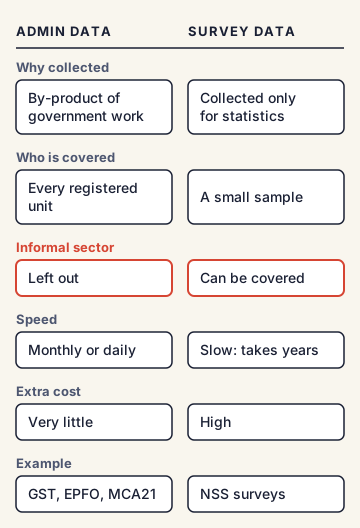
Administrative data is already being collected, so it costs little extra. It often covers every registered unit, not just a sample. And it can be available every month, or even every day. Think of it like a school: a survey is like asking 50 students how many days they came to class, while administrative data is the attendance register that already has every student's record.
Where did it come from?
India's modern statistical system was built after Independence, with the Indian Statistical Institute and the National Sample Survey (NSS) started in 1950, largely through the work of P.C. Mahalanobis. For decades, surveys were the backbone. The shift towards administrative data came in steps:
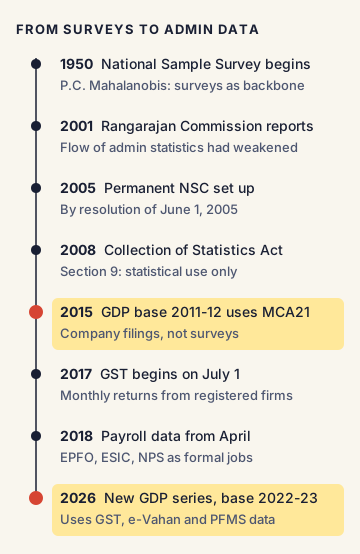
- Rangarajan Commission (2000 to 2001): A National Statistical Commission chaired by Dr. C. Rangarajan, set up in January 2000, reviewed India's statistical system and reported in August 2001. It found that the flow of administrative statistics from ministries and states had weakened. It recommended a permanent statistical body.
- National Statistical Commission (NSC), 2005: Based on that advice, the government resolved on June 1, 2005 to set up a permanent NSC to set priorities and standards for official statistics.
- Collection of Statistics Act, 2008: Gave a legal framework for collecting statistics and strict rules on keeping individual information secret.
- MCA21 in GDP (2015): When India moved its GDP base year to 2011-12 in January 2015, it began using the MCA21 database, where companies file their accounts electronically with the Ministry of Corporate Affairs. This was a big step from survey-based to administrative data for the corporate sector.
- Payroll data (2018): From April 2018, the government began publishing monthly data on new subscribers to the Employees' Provident Fund Organisation (EPFO), Employees' State Insurance (ESIC) and the National Pension System (NPS), as a measure of formal jobs.
- GST data: Since GST began on July 1, 2017, almost every registered business files regular returns. This created a huge, monthly, nationwide record of sales and purchases.
- New GDP series (2026): MoSPI released a new GDP series with base year 2022-23 on February 27, 2026. It uses administrative data such as GST data, the e-Vahan vehicle registration portal and the Public Financial Management System (PFMS).
How does it work in practice?
Using administrative data for statistics usually follows these steps:
- Access: The statistics office gets the data from the department that collects it, under an agreement or a legal rule.
- Cleaning: Records are checked for errors, duplicates and missing values.
- Anonymising: Names and identity numbers are removed or masked, so no single person or firm can be identified.
- Matching to statistical concepts: Tax categories are mapped to economic categories. For example, GST "outward supplies" by service providers are mapped to sectors like transport, hotels or IT.
- Combining with surveys: Administrative data covers the formal, registered economy well. Surveys are still needed for the informal sector and households.
- Publishing: Only combined figures (totals, averages, indices) are released.
India's position and examples
- GST data is now used in GDP estimates and in MoSPI's new Index of Services Production (ISP), a monthly measure of output in the formal services sector. MoSPI released an approach paper on the ISP in April 2026, with trial indices from July 2026 and 2024-25 as the base year. It relies heavily on GST outward supply data from GSTN.
- The legal rules on GST data: Section 158 of the Central Goods and Services Tax (CGST) Act, 2017 says that details in returns and statements filed under GST must not be disclosed, except in listed cases (such as prosecution, or to governments for carrying out the Act). Section 158A, added through the Finance Act, 2023, allows sharing of certain GST information with other notified systems, but only with the consent of the taxpayer concerned.
- The Collection of Statistics Act, 2008 (Section 9) says information collected for statistics must be used for statistical purposes only and must not be published in a way that identifies the person or firm who gave it.
- Data protection: The Digital Personal Data Protection (DPDP) Act, 2023 became operational through rules notified on November 13, 2025. It protects personal data, but allows the government to exempt certain agencies for reasons such as security and public order.
- Right to privacy: In Justice K.S. Puttaswamy v. Union of India (2017), a nine-judge bench of the Supreme Court held that privacy is a fundamental right under Article 21. Any government use of personal data must therefore have a legal basis, a legitimate aim and be proportionate.
Commonly confused concepts
- Administrative data vs survey data: Administrative data is a by-product of running government programmes and covers everyone who is registered. Survey data is collected specially for statistics, from a sample, and can cover the unregistered (informal) part of the economy.
- Statistical use vs enforcement use: Statistical use means the data is used only to make combined numbers, like GDP. Enforcement use means the data is used to investigate or act against specific people or firms. The same GST database may be requested for both, but the legal safeguards are very different. MoSPI's request is statistical; NATGRID's request is for investigation.
- NSO vs NSC: The National Statistical Office (NSO), under MoSPI, produces official statistics such as GDP and CPI. The National Statistical Commission (NSC) is an advisory body that sets standards and priorities.
- GSTN vs GST Council: The GST Network (GSTN) is the technology company that runs the GST portal and holds the data. The GST Council is the constitutional body that makes decisions about GST rules.
Issues, criticism and the way forward
- Better and faster statistics: Supporters argue that using GST data fully would give India quicker, more detailed and more reliable data on services, states and sectors, which is vital for policy. It could also reduce the reliance on old benchmarks and estimates.
- Confidentiality and trust: Taxpayers share data with the tax department because the law promises to keep it secret. If it is widely shared, businesses may lose trust, and some may file less honestly. Officials in the GST system have flagged that bulk sharing for statistics lacks a clear legal basis.
- Purpose limitation: Data collected for one purpose (tax) being used for another (statistics or investigation) needs clear legal limits. Experts suggest clear rules on what data, for what purpose, with what anonymisation and for how long.
- Coverage gaps: GST data covers only registered businesses. Small businesses below the registration threshold and the informal sector are left out, so surveys remain essential.
- Data quality: Tax data is shaped by tax rules. Errors, fake invoices and changes in rates or rules can distort statistics if not handled carefully.
- Way forward: Commonly suggested steps include a clear legal framework for statistical access to administrative data, anonymised or aggregated sharing, secure "data labs" where analysts can work on data without taking it out, and independent oversight by a strengthened National Statistical Commission.
Concepts to Know
- Official statistics: Numbers published by the government about the economy and society, such as GDP, inflation, jobs and industrial output.
- Sample survey: A study that collects information from a small, carefully chosen group and uses it to estimate the picture for the whole population.
- GDP (Gross Domestic Product): The total value of all final goods and services produced in a country in a year.
- Base year: The reference year against which a statistical series is measured. It is updated from time to time so the series reflects the current economy.
- Anonymisation: Removing names, identity numbers and other details so that a record cannot be linked back to a particular person or firm.
- GSTR-3B and GSTR-9: GST returns. GSTR-3B is a monthly (or quarterly) summary of a business's sales, purchases and tax paid. GSTR-9 is the annual return.
- Informal sector: Small, unregistered businesses and workers who are not part of tax or social security records.
- National Sample Survey started in 1950; P.C. Mahalanobis was its key architect
- Rangarajan Commission: set up January 2000, report August 2001; NSC set up by resolution of June 1, 2005
- Collection of Statistics Act, 2008: Section 9 limits use of collected information to statistical purposes
- GDP base 2011-12 (released January 2015) used the MCA21 corporate database
- Payroll data (EPFO, ESIC, NPS) published since April 2018
- New GDP series, base 2022-23, released February 27, 2026, using GST, e-Vahan and PFMS data
- Index of Services Production: approach paper April 2026; trial indices from July 2026; base year 2024-25
- CGST Act: Section 158 (no disclosure of taxpayer information, with exceptions); Section 158A (consent-based sharing, added by Finance Act, 2023)
- Puttaswamy (2017): privacy is a fundamental right under Article 21
- DPDP Rules notified November 13, 2025
● Tracked since October 07, 2026 · last seen October 07, 2026 · updates as the daily brief publishes