National Policy for Rare Diseases (NPRD), 2021
A rare disease is a health condition that affects only a very small number of people. Many rare diseases are genetic, start in childhood, last for life and can be fatal. Treatment, where it exists, is often extremely costly. The National Policy for Rare Diseases (NPRD), 2021 is the central government's plan to help patients with rare diseases get diagnosis, treatment and financial support. It was approved by the Ministry of Health and Family Welfare on March 30, 2021.
Why does it exist?
Each rare disease affects few people, but there are thousands of them. So together they affect a large number of people. In India, rare diseases are estimated to affect 70 to 90 million people. Yet:
- Doctors often do not recognise them, so diagnosis can take years.
- Only a small share of rare diseases have any approved treatment.
- Medicines for them, called orphan drugs, are very costly because companies sell them to very few patients. A year's treatment can cost crores of rupees.
Without government help, most families simply cannot afford treatment. The policy tries to fill this gap.
What is a "rare disease"?
The World Health Organization (WHO) describes a rare disease as one that affects 1 or fewer people per 1,000. Different countries use different numbers. The NPRD notes that India has no standard definition yet, and that more research is needed to decide one suited to India. Globally there are about 7,000 to 8,000 rare diseases. Fewer than 5% have any treatment, and about 80% are genetic in origin.
Where did it come from?
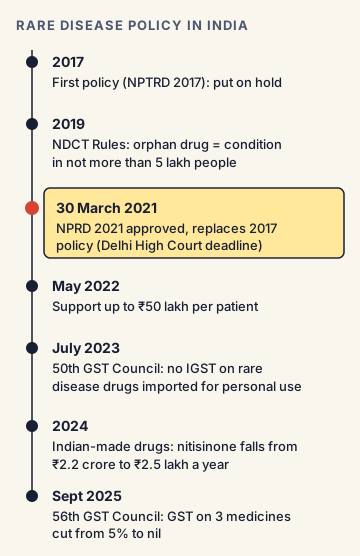
- 2017: The government first framed a National Policy for Treatment of Rare Diseases, 2017. It ran into problems with funding and implementation and was put on hold for review.
- Court pressure: Families of children with rare diseases went to court. The Delhi High Court pushed the government to finalise a policy, setting a deadline of March 30, 2021.
- March 30, 2021: The NPRD, 2021 was approved, replacing the 2017 policy.
- May 2022: The government provided for financial support of up to ₹50 lakh per patient for treatment of notified rare diseases.
How does it work? The three groups
The policy sorts rare diseases into three groups based on the type of treatment:
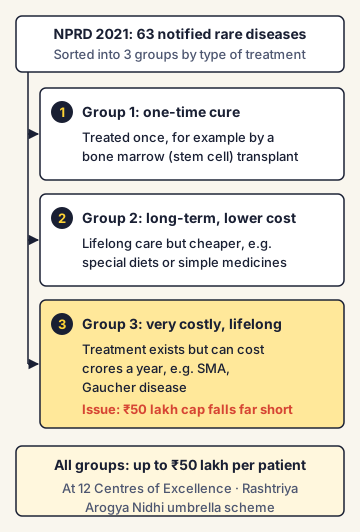
- Group 1: Diseases that can be treated with a one-time cure, such as certain disorders treatable by a bone marrow (haematopoietic stem cell) transplant.
- Group 2: Diseases that need long-term or lifelong treatment but at a relatively lower cost, such as some that can be managed with special diets or simple medicines.
- Group 3: Diseases for which a treatment exists, but it is very costly and lifelong, and choosing which patients will benefit is difficult. Examples include spinal muscular atrophy (SMA) and some lysosomal storage disorders such as Gaucher disease.
The key parts of the policy
- Financial support: Up to ₹50 lakh per patient for treatment at a recognised Centre of Excellence, under the umbrella scheme of Rashtriya Arogya Nidhi.
- Centres of Excellence (CoEs): Leading government hospitals (such as AIIMS New Delhi and PGIMER Chandigarh) recognised for diagnosis and treatment. 12 CoEs have been identified so far.
- Notified diseases: 63 rare diseases are covered, on the advice of the Central Technical Committee for Rare Diseases.
- Crowdfunding: A digital platform lets individuals and companies donate voluntarily for patients' treatment.
- Screening and prevention: Genetic testing, counselling and newborn screening to detect diseases early.
- Research and local production: Encouraging Indian research and manufacturing of orphan drugs to cut costs.
India's position and examples
- Cheaper Indian-made drugs (2024): Indian companies began making four rare-disease drugs: nitisinone (for tyrosinemia type 1), eliglustat (Gaucher disease), trientine (Wilson's disease) and cannabidiol oral solution (Lennox-Gastaut and Dravet syndromes). Costs fell sharply. For example, a year of nitisinone fell from about ₹2.2 crore to ₹2.5 lakh.
- Tax relief: In July 2023, the 50th GST Council exempted from IGST the medicines and Food for Special Medical Purposes (FSMP) used for rare diseases listed under the NPRD, when imported for personal use. Basic customs duty on such imports for personal use was also exempted. In September 2025, the 56th GST Council cut GST on three medicines for cancer and rare diseases from 5% to nil.
- Orphan drug rules: The New Drugs and Clinical Trials Rules, 2019 define an orphan drug as one meant for a condition that affects not more than 5 lakh people in India. The rules allow faster approval and fee waivers for such drugs.
- Sickle cell disease: It is covered separately by the National Sickle Cell Anaemia Elimination Mission, launched on July 1, 2023.
Commonly confused concepts
- Rare disease vs orphan drug: A rare disease is the illness. An orphan drug is a medicine developed for a rare disease. It is called "orphan" because, without special incentives, drug companies would not "adopt" it.
- NPRD 2021 vs NPTRD 2017: The 2017 policy (National Policy for Treatment of Rare Diseases) was the first attempt and was put on hold. The 2021 policy replaced it with the three-group system and the CoE-based funding model.
- India's orphan drug threshold vs the US: India uses 5 lakh people (NDCT Rules, 2019). The United States, under its Orphan Drug Act, 1983, uses fewer than 2 lakh (200,000) people in the US.
- GST exemption vs customs duty exemption: Customs duty is charged when goods enter India. IGST is the GST charged on imports. Relief for rare disease drugs has come through both, but each is decided separately: customs duty by the central government, GST rates on the recommendation of the GST Council.
Issues, criticism and the way forward
- The funding cap: ₹50 lakh is far below the cost of lifelong treatment for many Group 3 diseases, which can run to crores every year. Patient groups have asked for sustained, recurring funding.
- Unspent funds and delays: Reports and court hearings have pointed to slow release of funds and delays in starting treatment at CoEs.
- Access and distance: CoEs are in a few big cities, so patients from distant states must travel far for care.
- Narrow tax relief: The GST exemption applies mainly to imports for personal use and to listed diseases only. Industry and patient groups have asked for wider relief covering all rare disease drugs and supplies through hospitals.
- Low awareness and diagnosis: Many doctors are not trained to spot rare diseases. More genetic testing and newborn screening are needed.
- Way forward: Commonly suggested steps include a dedicated, recurring rare disease fund, more CoEs across regions, wider local manufacturing of orphan drugs, a clear Indian definition of rare disease and a national patient registry.
Concepts to Know
- Genetic disease: A disease caused by a change (mutation) in a person's genes, often passed down from parents.
- Orphan drug: A medicine made for a rare disease, which companies would not normally develop because there are few buyers.
- Food for Special Medical Purposes (FSMP): Specially made foods for patients who cannot eat normal food because of their disease, for example people with certain metabolic disorders.
- Centre of Excellence (CoE): A top hospital chosen and equipped to diagnose and treat a particular group of diseases.
- IGST (Integrated GST): The GST charged on supplies between states and on imports into India.
- Rashtriya Arogya Nidhi: A central scheme that gives money to poor patients for treatment of serious diseases at government hospitals.
- NPRD, 2021 approved on March 30, 2021, replacing the NPTRD, 2017
- WHO description: 1 or fewer per 1,000 people; India has no standard definition
- 7,000 to 8,000 rare diseases globally; fewer than 5% have treatment; about 80% genetic
- Estimated 70 to 90 million people affected in India
- Three groups: Group 1 (one-time cure), Group 2 (long-term, lower cost), Group 3 (very costly, lifelong)
- Financial support up to ₹50 lakh per patient (Rashtriya Arogya Nidhi umbrella scheme); 12 CoEs; 63 notified rare diseases
- 50th GST Council (July 2023): IGST exemption on rare disease drugs and FSMP imported for personal use
- 56th GST Council (September 2025): three cancer/rare disease medicines cut from 5% GST to nil
- NDCT Rules, 2019: orphan drug = condition affecting not more than 5 lakh people in India; US Orphan Drug Act, 1983: fewer than 200,000 people
● Tracked since February 28, 2026 · last seen October 07, 2026 · updates as the daily brief publishes