National Commission for Safai Karamcharis (NCSK)
The National Commission for Safai Karamcharis (NCSK) is a national body that looks after the welfare of safai karamcharis, meaning sanitation workers such as sweepers, sewer cleaners and manual scavengers. It studies their problems, checks whether government schemes and laws for them are working, hears their complaints, and advises the government on what to do. It works under the Union Ministry of Social Justice and Empowerment.
Why does it exist?
Sanitation workers are among the poorest and most ignored workers in India. Most come from communities that faced caste discrimination for generations. Their problems include unsafe work, low and irregular pay, contract jobs with no security, and social stigma. A separate national body was needed to speak for them and keep pressure on governments to protect them.
Where did it come from?
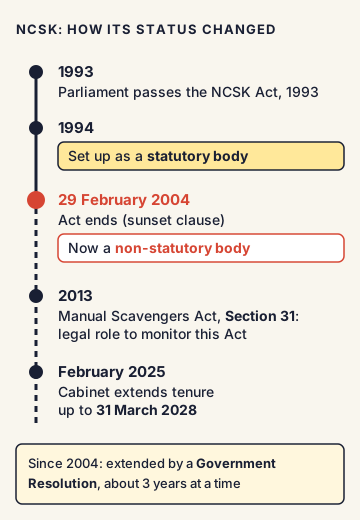
- 1993: Parliament passed the National Commission for Safai Karamcharis Act, 1993.
- 1994: The Commission was set up under this Act as a statutory body (a body created by a law of Parliament).
- The Act had a sunset clause, meaning it was meant to last only for a fixed period. It was extended twice through amendments, but finally ceased to have effect on 29 February 2004.
- Since 2004: The Commission continues as a non-statutory body. Its life is extended from time to time by a Government Resolution, usually for three years at a time.
- Latest extension: In February 2025, the Union Cabinet extended its tenure by three years, up to 31 March 2028, at a cost of about ₹50.91 crore.
Who is in the Commission?
The NCSK has:
- A Chairperson, who has the rank of a Union Minister of State
- A Vice-Chairperson
- Five Members, of whom at least one must be a woman
What does it do?
Its general functions include:
- Recommending to the Central Government specific programmes to remove inequality in status, facilities and opportunities for safai karamcharis
- Studying and evaluating schemes for their social and economic rehabilitation
- Looking into complaints about non-implementation of these schemes, and about service conditions, wages and safety
- Taking up matters on its own (suo motu) when it learns of problems
- Sending reports to the Central Government
Its special role under the 2013 Act
The Prohibition of Employment as Manual Scavengers and their Rehabilitation Act, 2013 gives the NCSK a legal role through Section 31. Under it, the NCSK must:
- Monitor how the 2013 Act is being implemented
- Enquire into complaints about violations of the Act, and send its findings with recommendations to the authorities concerned
- Advise the Central and State Governments on implementing the Act properly
- Take suo motu notice of cases where the Act is not being implemented
Under Section 31(2), it can call for information on these matters from any government, local body or other authority. So even though the Commission itself is non-statutory, its work under the 2013 Act has a clear legal base. The 2025 extension notice also says it will keep performing its Section 31(1) functions.
How does it work in practice?
When a sewer death is reported, the NCSK can ask the state and the district administration for a report. It checks whether a case was filed against the employer and whether the family got compensation. It visits sites, holds review meetings with states and reports its findings to the Ministry. It also keeps a running count of sewer and septic tank deaths based on reports from districts, police, state governments, the media and civil society groups.
India's related institutions
- National Safai Karamcharis Finance and Development Corporation (NSKFDC): A company under the Ministry of Social Justice and Empowerment, set up in 1997, that gives loans and runs schemes for sanitation workers. It is the implementing agency of the NAMASTE scheme.
- National Commission for Scheduled Castes (NCSC): A constitutional body under Article 338. Since most sanitation workers belong to Scheduled Castes, its work often overlaps with the NCSK.
Commonly confused concepts
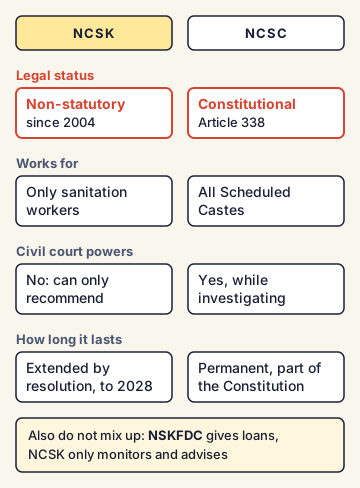
- NCSK vs NCSC: The NCSC is a constitutional body (Article 338) for all Scheduled Castes. The NCSK is a non-statutory body (since 2004) only for sanitation workers. The NCSC has the powers of a civil court while investigating; the NCSK does not.
- NCSK vs NSKFDC: The NCSK is a watchdog and adviser. The NSKFDC is a finance company that gives loans and runs schemes. One monitors; the other funds.
- Statutory vs non-statutory body: A statutory body is created by a law of Parliament (like the NCSK between 1994 and 2004). A non-statutory body is created by a government decision (resolution) and can be ended or changed by another decision.
Issues, criticism and the way forward
- No teeth: As a non-statutory body, the NCSK can only recommend. It cannot punish employers or force states to pay compensation.
- Temporary life: It survives on three-year extensions, which makes long-term planning hard. Many groups demand that it be made a permanent statutory or even constitutional body.
- Weak data: The NCSK itself says it has no legal duty to keep a full national database of deaths and has no dedicated portal. Its numbers depend on what states and the media report.
- Limited resources: With a small staff, it cannot visit or follow up on every case across India.
- Way forward: Experts suggest giving the NCSK statutory status again, powers like a civil court, a proper national death and compensation registry, and a time limit for states to act on its recommendations.
Concepts to Know
- Safai karamchari: A Hindi term meaning sanitation worker. It includes sweepers, sewer cleaners, septic tank cleaners and manual scavengers.
- Sunset clause: A clause in a law that makes the law end automatically on a fixed date unless Parliament extends it.
- Government Resolution: An official decision of the government, published in the Gazette, that can set up or extend a body without a new law.
- Suo motu: Latin for "on its own". It means a body takes up a matter without waiting for anyone to file a complaint.
- Set up in 1994 under the National Commission for Safai Karamcharis Act, 1993
- Act ceased on 29 February 2004; since then a non-statutory body extended by Government Resolutions
- Tenure extended in February 2025 up to 31 March 2028 (cost about ₹50.91 crore)
- Composition: Chairperson (rank of Union Minister of State), Vice-Chairperson and 5 Members, including at least 1 woman
- Nodal ministry: Ministry of Social Justice and Empowerment
- Section 31 of the 2013 Manual Scavengers Act: monitor the Act, enquire into complaints, advise governments, take suo motu notice
● Tracked since October 20, 2026 · last seen October 20, 2026 · updates as the daily brief publishes