NAMASTE Scheme
National Action for Mechanised Sanitation Ecosystem
NAMASTE stands for National Action for Mechanised Sanitation Ecosystem. It is a central government scheme that aims to make sanitation work in cities safe and dignified. Its main goal is zero deaths in sewer and septic tank cleaning. It does this by moving from human-entry cleaning to machine-based cleaning, and by giving workers training, safety gear, health insurance and help to start their own sanitation businesses.
Why does it exist?
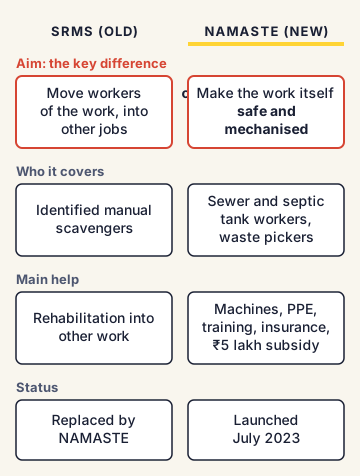
Even after the 2013 Act, people kept dying in sewers and septic tanks. The government's older scheme, the Self-Employment Scheme for Rehabilitation of Manual Scavengers (SRMS), focused on moving identified manual scavengers into other jobs. But it did not deal with the much larger group of sewer and septic tank workers who still do dangerous cleaning every day. NAMASTE was designed for these workers. It replaced SRMS.
Where did it come from?
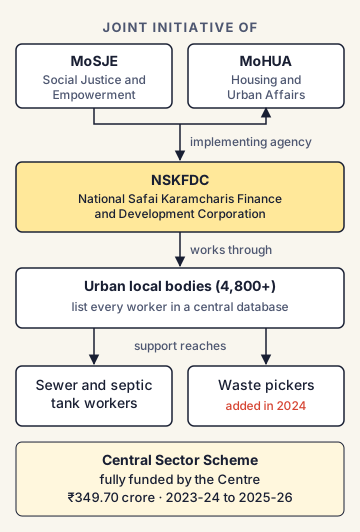
NAMASTE is a joint initiative of the Ministry of Social Justice and Empowerment (MoSJE) and the Ministry of Housing and Urban Affairs (MoHUA). It runs as a Central Sector Scheme (fully funded by the Centre) for three years, 2023-24 to 2025-26, with an outlay of ₹349.70 crore. It was launched in July 2023. The National Safai Karamcharis Finance and Development Corporation (NSKFDC) is its implementing agency. In 2024, its scope was widened to include waste pickers working in solid waste management.
Who does it cover?
- Sewer and Septic Tank Workers (SSWs) working in urban local bodies (municipal corporations, municipalities and other town bodies)
- Waste pickers (added in 2024): people who collect and sort waste for recycling
- The scheme aimed to cover all of the more than 4,800 urban local bodies by 2025-26.
How does it work, step by step?
- Profiling: Urban local bodies identify and list every sewer and septic tank worker in their area. Each worker gets a record in a central database.
- Training: Workers get training in safe cleaning methods and in using machines.
- Safety gear: Workers receive Personal Protective Equipment (PPE) kits, such as gas masks, gloves, boots and harnesses.
- Emergency units: Cities set up Emergency Response Sanitation Units (ERSUs). These are trained teams with safety devices to handle hazardous cleaning and rescue in emergencies.
- Health insurance: Workers and their families are covered under Ayushman Bharat - Pradhan Mantri Jan Arogya Yojana (AB-PMJAY), which gives health cover up to ₹5 lakh per family per year.
- Livelihood help: Workers can get a capital subsidy of up to ₹5 lakh and loans to buy sanitation vehicles and machines. This helps them become "sanipreneurs" (sanitation entrepreneurs) who run their own cleaning businesses.
- Awareness: Campaigns to inform people and local bodies about safe practices and the ban on hazardous cleaning.
Progress so far
As of August 2025, official figures showed:
- 84,902 sewer and septic tank workers validated across the country
- 45,871 PPE kits given to workers
- 54,140 beneficiaries covered under AB-PMJAY or state health schemes
- 354 safety device kits given to ERSUs
- On World Environment Day (5 June) 2025, the government launched a Waste Picker Enumeration App to profile 2.5 lakh waste pickers.
Commonly confused concepts
- NAMASTE vs SRMS: SRMS (Self-Employment Scheme for Rehabilitation of Manual Scavengers) aimed to take identified manual scavengers out of the work and into other jobs. NAMASTE aims to make sanitation work itself safe and mechanised for those who continue in it. NAMASTE replaced SRMS.
- NAMASTE vs Swachh Bharat Mission: Swachh Bharat Mission (2014) focuses on building toilets and keeping India clean. NAMASTE focuses on the workers who clean sewers and septic tanks.
- NAMASTE (scheme) vs the 2013 Act (law): The Act bans hazardous cleaning and punishes violators. NAMASTE is a scheme that gives the tools, training and money to make the ban possible in practice.
- Central Sector Scheme vs Centrally Sponsored Scheme: A Central Sector Scheme is fully paid for and run by the Centre (like NAMASTE). A Centrally Sponsored Scheme is shared between the Centre and states.
Issues, criticism and the way forward
- Under-counting: By September 2024, many urban local bodies had reported zero or very few sewer workers, which experts say is unrealistic. MoHUA itself estimated about 1 lakh such workers in cities.
- Caste composition: About 92% of profiled workers belong to SC, ST or OBC communities, showing that the work remains caste-linked.
- Slow business support: Very few workers have actually received capital subsidies. "Sanipreneurs" also find it hard to get bank loans and compete with contractors who use cheap, unsafe manual labour.
- Urban only: The scheme covers only cities, while deaths also happen in villages and small towns. There have been proposals to extend it to rural areas.
- Deaths continue: Safety gear alone does not save lives if contractors still send workers in without it.
- Way forward: Full mechanisation, strict action against contractors, honest profiling, quicker subsidies, and extending the scheme to rural areas.
Concepts to Know
- Mechanised sanitation: Cleaning sewers and septic tanks with machines such as suction trucks, jetting machines and robots, so that no human needs to enter.
- Urban Local Body (ULB): The local government of a town or city, such as a municipal corporation or municipality.
- Personal Protective Equipment (PPE): Safety items like masks, gloves, boots and suits that protect a worker's body.
- Capital subsidy: Money the government gives to reduce the cost of buying equipment or vehicles for a business. The worker does not have to repay this part.
- Full name: National Action for Mechanised Sanitation Ecosystem
- Joint initiative of MoSJE and MoHUA; implementing agency: NSKFDC
- Central Sector Scheme; period 2023-24 to 2025-26; outlay ₹349.70 crore; launched July 2023
- Replaced the Self-Employment Scheme for Rehabilitation of Manual Scavengers (SRMS)
- Waste pickers added in 2024
- Capital subsidy up to ₹5 lakh for sanitation vehicles and equipment
- Health cover through AB-PMJAY
- By August 2025: 84,902 workers validated; 45,871 PPE kits delivered
● Tracked since March 17, 2026 · last seen October 20, 2026 · updates as the daily brief publishes