Multilateral Development Banks (MDBs)
A Multilateral Development Bank (MDB) is a bank owned by many countries together, which lends money for development in poorer and middle-income countries. Its loans pay for roads, power plants, schools, hospitals, flood walls and much more. The World Bank, the Asian Development Bank (ADB), the Asian Infrastructure Investment Bank (AIIB) and the New Development Bank (NDB) are all MDBs. Because rich countries stand behind them, MDBs can borrow cheaply and lend on better terms than an ordinary bank.
Why do MDBs exist?
Poor countries need huge amounts of long-term money for big projects. Private banks often refuse such loans, or charge very high interest, because the risk feels too high and the payback takes decades. MDBs fill this gap. They also bring technical advice, high project standards, and a kind of "seal of approval" that makes private investors more willing to join.
Where did they come from?
The first MDB was born at the Bretton Woods Conference of 1944, held in the USA near the end of the Second World War. It created the International Bank for Reconstruction and Development (IBRD), the original part of the World Bank, to rebuild war-hit Europe and then to fund development. Later, regions created their own banks:
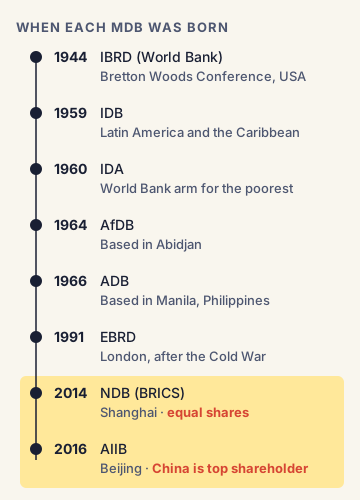
- Inter-American Development Bank (IDB): 1959, for Latin America and the Caribbean
- International Development Association (IDA): 1960, the World Bank's arm for the poorest countries
- African Development Bank (AfDB): 1964, based in Abidjan
- Asian Development Bank (ADB): 1966, based in Manila, the Philippines
- European Bank for Reconstruction and Development (EBRD): 1991, based in London, set up after the Cold War to help former communist countries
- New Development Bank (NDB): agreement signed at the 6th BRICS Summit in Fortaleza, Brazil, on 15 July 2014; headquarters in Shanghai; the founding members (Brazil, Russia, India, China, South Africa) hold equal shares; its first president was K.V. Kamath of India
- Asian Infrastructure Investment Bank (AIIB): started in 2016, based in Beijing
How does an MDB raise money?
Member countries put in capital (ownership money) in two forms:
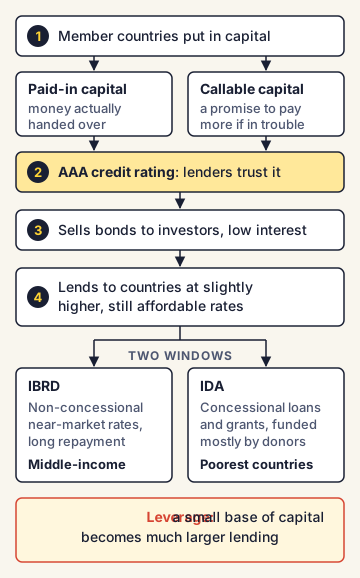
- Paid-in capital: money the countries actually hand over.
- Callable capital: a promise that countries will pay more if the bank ever gets into serious trouble. It is like a guarantor signing your loan form: the guarantor pays nothing today, but lenders trust you more because of the signature.
Because of this backing, most big MDBs have the top AAA credit rating. They sell bonds to investors around the world at low interest, and then lend that money to countries at slightly higher, but still affordable, rates. In this way, a small amount of capital from governments turns into a much larger amount of lending. This is called leverage.
Two kinds of lending
MDBs usually have two "windows":
- Non-concessional (market-based) loans: for middle-income countries, at close to market rates but with long repayment periods. The IBRD does this.
- Concessional loans and grants: very cheap loans or free money for the poorest countries. IDA does this. The money for this window comes mostly from donor contributions, which are topped up every few years.
MDBs and climate finance
MDBs are one of the biggest channels for climate money. According to their joint report published in September 2025, MDBs gave a record $137 billion of climate finance in 2024, about 10% more than in 2023. Of this, $85.1 billion went to low- and middle-income countries. They also helped draw in private money, called mobilised private finance, of about $33 billion for these countries.
The reform push: "bigger and better" MDBs
Many experts say MDBs lend too cautiously compared with the size of today's problems, like climate change and pandemics. Two key reviews shaped the debate:
- G20 Independent Review of MDB Capital Adequacy Frameworks (July 2022): said MDBs could safely lend more from the same capital. It suggested counting part of callable capital, using hybrid capital (a kind of long-term investment that works partly like a loan and partly like ownership), and taking measured extra risk.
- G20 Independent Expert Group (IEG), 2023: set up under India's G20 Presidency and co-convened by N.K. Singh and Lawrence Summers. Its report proposed a "triple agenda": (1) add global challenges such as climate to the MDBs' core mission of ending poverty, (2) triple sustainable lending to about $390 billion a year by 2030 (about $300 billion non-concessional and $90 billion concessional), and (3) create new ways for investors to expand MDB lending.
India's position and Indian examples
India is a founding member of the World Bank and one of its largest borrowers over the decades. India stopped borrowing from IDA after fiscal year 2014 (it "graduated" because its income rose), and now borrows from the IBRD. India is the second-largest shareholder in the AIIB after China and its largest borrower. India is a founding member of the NDB and of the ADB. India has used MDB loans for metro rail, rural roads, solar parks, health systems and flood control.
India pushed for MDB reform during its 2023 G20 Presidency, and generally argues that MDBs should lend more, more cheaply, and give developing countries a bigger voice in decisions.
Commonly confused concepts
- MDB vs IMF: The IMF (International Monetary Fund) is not a development bank. It lends for short-term balance-of-payments crises (when a country cannot pay for imports or repay foreign debt), and checks economic policies. MDBs fund long-term projects and programmes.
- World Bank vs World Bank Group: "World Bank" usually means just IBRD and IDA. The World Bank Group also includes the IFC (lends to private companies), MIGA (insurance against political risk) and ICSID (settles investment disputes).
- Multilateral vs bilateral finance: Multilateral money comes from a bank owned by many countries. Bilateral money comes from one government to another, for example a Japanese loan for an Indian metro.
- AIIB vs NDB: AIIB (Beijing, 2016) has many members from around the world, and China holds the largest share. NDB (Shanghai) was set up by the five BRICS founders with equal shares.
- Climate funds vs MDBs: The Green Climate Fund and the Global Environment Facility are funds under the UN climate system that mostly give grants and cheap loans. MDBs are banks that mostly lend.
Issues, criticism and the way forward
- Too slow and too complex: Small and poor countries say MDB and climate-fund paperwork is heavy and takes years. Small island governments may have only a few officers to handle it.
- Voice and votes: Votes are linked to shareholding, so rich countries control most decisions. Developing countries want a larger say.
- Debt worries: Many poor countries already struggle to repay debt. Critics say more loans, instead of grants, can push them deeper into debt.
- Too cautious with capital: Reviewers argue MDBs can lend much more without losing their AAA rating. MDBs reply that their rating is what keeps their own borrowing cheap.
- Shrinking donor support: Cuts by some rich donors put pressure on concessional windows like IDA.
- Way forward: Experts suggest putting in place the G20 capital reforms, using hybrid capital and risk-sharing, mutual reliance among lenders (accepting one another's checks), more local-currency lending, and drawing in more private money with guarantees.
Concepts to Know
- Credit rating (AAA): A grade that tells lenders how safe it is to lend to someone. AAA is the highest grade, so borrowers with it pay the lowest interest.
- Bond: A paper that a government or company sells to borrow money. The buyer gets interest and gets the money back at the end.
- Concessional loan: A loan that is cheaper than the market, with very low interest and a long time to repay.
- Leverage: Using a small base of your own money to raise and lend a much larger amount.
- Balance of payments: The record of all money flowing into and out of a country for trade, loans and investment.
- Mobilised private finance: Private investors' money that joins a project because a public lender (like an MDB) took part first.
- IBRD created at the Bretton Woods Conference, 1944; IDA set up in 1960
- IDB 1959; AfDB 1964 (Abidjan); ADB 1966 (Manila); EBRD 1991 (London)
- NDB: agreement signed 15 July 2014 at Fortaleza (6th BRICS Summit); HQ Shanghai; first president K.V. Kamath; equal shares among the five founders
- AIIB: began 2016, HQ Beijing; India is the second-largest shareholder and largest borrower
- India graduated from IDA after FY2014
- MDB climate finance 2024: record $137 billion; $85.1 billion to low- and middle-income countries (joint MDB report, September 2025)
- G20 Capital Adequacy Framework review: July 2022
- G20 IEG (India's G20 Presidency, 2023): co-conveners N.K. Singh and Lawrence Summers; "triple agenda"; triple sustainable lending to about $390 billion a year by 2030
● Tracked since May 04, 2026 · last seen November 13, 2026 · updates as the daily brief publishes