Money Supply Measures in India
M0, M1, M2 and M3
Money supply is the total amount of money available in an economy at a given time. It is not just the notes and coins in people's pockets. It also includes the money people keep in bank accounts, because they can spend it easily. The RBI measures money supply in layers, from the narrowest (only the most spendable money) to the broadest (including long-term deposits). These layers are called monetary aggregates, and the main ones in India are M0, M1, M2 and M3.
Why measure money at all?
Money is like fuel for the economy. If too much money chases the same amount of goods, prices rise; this is inflation. If there is too little money, people and businesses cannot spend or invest, and growth slows. So the RBI tracks how fast money is growing. Very fast growth in money can warn of rising inflation in the months ahead.
Where did these measures come from?
The RBI has published money supply figures for decades:
- 1977: The RBI's Second Working Group on Money Supply recommended four measures, called M1, M2, M3 and M4. The RBI used these from 1977 to 1998.
- 1998: A Working Group on Money Supply chaired by Dr. Y. V. Reddy revised the system. It said money supply should be measured from the balance sheet of the banking sector. It created new aggregates, sometimes written as NM0, NM1, NM2 and NM3 ("N" for new). It also created three wider liquidity aggregates, L1, L2 and L3.
- One big change in 1998: post office deposits were removed from money supply. The reason was that the post office savings bank is not part of the banking sector.
What is each measure? (from narrowest to broadest)
- M0, Reserve Money (also called base money or high-powered money): Currency in circulation + bankers' deposits with the RBI + "other" deposits with the RBI. This is money created directly by the RBI. It is called "high-powered" because banks build many more loans and deposits on top of it.
- M1, Narrow Money: Currency with the public + demand deposits with the banking system + "other" deposits with the RBI. Demand deposits are current account balances and the part of savings deposits that can be withdrawn any time. M1 is the money that can be spent right away.
- M2: M1 + short-term time deposits of residents (fixed deposits with a maturity of up to and including one year) + certificates of deposit issued by banks. It sits between narrow and broad money.
- M3, Broad Money: M2 + long-term time deposits of residents + call and term borrowings of banks from non-bank sources. In simple words: M3 = M1 + all time deposits with banks. M3 is the measure the RBI and most analysts watch most closely.
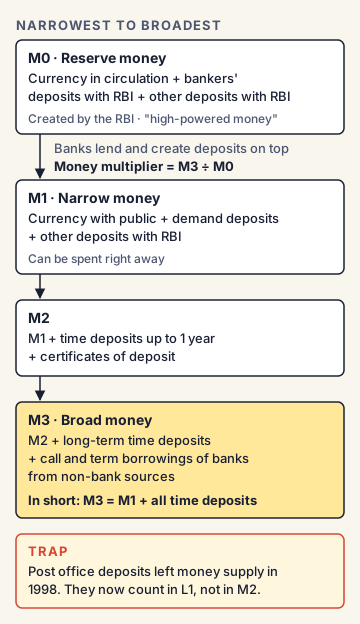
A simple way to picture this: M1 is the cash in your wallet plus your current account. M3 adds your fixed deposits too. Fixed deposits cannot be spent instantly, but you can break them if needed, so they still count as money in a broad sense.
The liquidity aggregates (L1, L2, L3)
These go beyond banks:
- L1 = NM3 + all deposits with post office savings banks (excluding National Savings Certificates)
- L2 = L1 + term deposits with and certain borrowings by financial institutions (like development banks)
- L3 = L2 + public deposits of non-banking financial companies (NBFCs)
How does M0 become M3? The money multiplier
When the RBI creates ₹100 of reserve money, banks do not just keep it. They lend part of it. The borrower spends it, and it gets deposited again in some bank, which lends part of it again. This chain creates many more rupees of deposits from the original ₹100. The money multiplier is the ratio M3 ÷ M0. It depends mainly on two things:
- Cash Reserve Ratio (CRR): the share of deposits banks must keep with the RBI. A higher CRR leaves less to lend, so the multiplier falls.
- Currency-deposit ratio: how much cash people prefer to hold compared with bank deposits. If people hold more cash, less money goes back into banks, and the multiplier falls.
How has the RBI used money supply in policy?
The role of M3 has changed over time:
- 1985 to 1998, monetary targeting: The Sukhamoy Chakravarty Committee (1985) recommended that the RBI target the growth of M3 to control inflation, with reserve money as the operating target. The RBI followed this "flexible monetary targeting" approach. But the link between money growth and inflation weakened as the financial system changed.
- 1998 to 2016, multiple indicator approach: From April 1998, the RBI stopped relying on one target and watched many indicators: interest rates, credit, exchange rate, output, inflation and money.
- 2016 onwards, flexible inflation targeting: The RBI now directly targets CPI inflation (4%, with a 2% to 6% band). Interest rates, mainly the repo rate, are the main tool. Money growth is still watched as one useful signal, but it is no longer the target.
India's position and examples
The RBI publishes data on reserve money every week and on money supply (M3) every fortnight, in its Weekly Statistical Supplement. When people rushed to hold cash during COVID-19 or after big changes like demonetisation in 2016, the currency part of money supply moved sharply, which showed up in these figures. In 2026, rating agencies and banks have pointed to sustained above-trend growth in M3 as one sign of inflation pressure.
Commonly confused concepts
- Narrow money (M1) vs broad money (M3): M1 has only money that can be spent at once (cash and demand deposits). M3 adds time deposits (fixed deposits). M3 is always larger than M1.
- Old M2 vs new M2: The old M2 (before 1998) was M1 plus post office savings deposits. The new M2 is M1 plus short-term bank time deposits (up to one year). Post office deposits are no longer part of M2.
- Old M4 vs L1: The old M4 was M3 plus all post office deposits (excluding National Savings Certificates). Today, a similar idea appears as the liquidity aggregate L1, built on NM3.
- Reserve money (M0) vs currency in circulation: Currency in circulation is only notes and coins. Reserve money also includes banks' deposits with the RBI.
- Money supply vs liquidity in the banking system: Money supply (M3) measures money held by the public. Banking system liquidity measures the surplus or shortage of funds that banks have, which the RBI manages daily through the LAF.
Issues, criticism and the way forward
- Weak link to inflation: Money growth no longer predicts inflation as reliably as before, because of new financial products and changing payment habits. That is why the RBI moved away from monetary targeting.
- Digital payments: UPI and digital wallets let people hold less cash and spend money faster. This changes the currency-deposit ratio and the speed at which money moves (velocity of money), making the old measures harder to read.
- Shadow banking: NBFCs and mutual funds now play a big role in lending. Their activity is not fully in M3, so some experts argue for giving more attention to wider liquidity measures like L3.
- Way forward: Experts suggest using money supply as one of many signals, alongside credit growth, interest rates and inflation expectations, and updating the measures as new forms of money (such as the digital rupee) grow.
Concepts to Know
- Demand deposits: Bank deposits you can withdraw any time without notice, such as current account balances and most savings account money.
- Time deposits: Bank deposits locked for a fixed period, such as fixed deposits. You earn more interest but cannot withdraw freely without a penalty.
- Certificate of deposit (CD): A short-term, tradable deposit receipt that banks issue to raise money from big investors.
- Call money: Very short-term (usually overnight) loans between banks and some institutions to manage their daily cash needs.
- Velocity of money: How many times one rupee changes hands in a year. If money moves faster, the same amount of money supports more spending.
- Operating target: The short-term variable a central bank directly tries to control (today, the overnight interest rate) to reach its final goal (inflation).
- Second Working Group on Money Supply (1977): M1, M2, M3, M4, used from 1977 to 1998
- Working Group on Money Supply chaired by Dr. Y. V. Reddy (1998): new aggregates NM0, NM1, NM2, NM3 and liquidity aggregates L1, L2, L3; post office deposits removed from money supply
- M0 (reserve money) = currency in circulation + bankers' deposits with RBI + other deposits with RBI
- M1 = currency with public + demand deposits with banks + other deposits with RBI
- M2 = M1 + short-term time deposits of residents (up to and including 1 year)
- M3 = M2 + long-term time deposits + call/term borrowings from non-bank sources (in short, M1 + time deposits)
- Money multiplier = M3 ÷ M0; falls when CRR or the currency-deposit ratio rises
- Chakravarty Committee (1985): monetary targeting with M3 as the intermediate target; multiple indicator approach from April 1998; flexible inflation targeting from 2016
● Tracked since October 05, 2026 · last seen October 05, 2026 · updates as the daily brief publishes