Menstrual Health and Hygiene Management in India
Menstrual health means that a girl or woman can manage her monthly period safely, with dignity and without missing school, work or daily life. It needs much more than a sanitary pad. It needs clean and private toilets with water, a way to throw away used products safely, correct information, freedom from shame and access to a doctor when something feels wrong. The practical side of this, inside schools and homes, is called Menstrual Hygiene Management (MHM).
Why does it matter?
When a school has no working girls' toilet, no water and no pad, many girls stay at home during their periods. Missing four or five days a month adds up to weeks of lost classes in a year. Some girls drop out after reaching puberty. Using unclean cloth again and again can also cause infections.
Silence and taboos make it worse: girls are often told not to enter the kitchen or temple, or not to talk about periods at all. So menstrual health is linked to education, health, gender equality and dignity at the same time.
How big is the gap?
The National Family Health Survey-5 (NFHS-5, 2019-21) asked women aged 15 to 24 how they protect themselves during periods. About 77% used a hygienic method (sanitary napkins, locally made napkins, tampons or menstrual cups), up from about 58% in NFHS-4 (2015-16). But the gap between places is large: about 90% in urban areas against about 73% in rural areas.
Around half of young women still reported using cloth (cloth can be safe if washed and dried properly, but it often is not, because of privacy and taboos). These two figures add up to more than 100% because a woman could name more than one method, for example both pads and cloth.
How did India's policy develop?
Step by step:
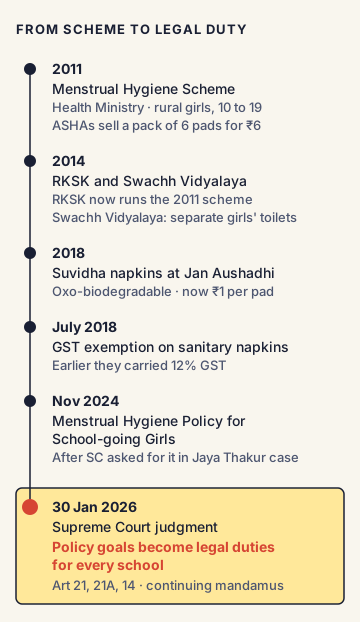
- Menstrual Hygiene Scheme (2011): started by the Union Health Ministry for adolescent girls (10 to 19 years) in rural areas. ASHA workers sold a pack of six sanitary napkins for ₹6 in total (₹6 for the whole pack, not for each napkin). The scheme now runs under the Rashtriya Kishor Swasthya Karyakram (RKSK), the national adolescent health programme launched in 2014.
- Swachh Bharat and Swachh Vidyalaya (2014): pushed for separate toilets for girls in government schools.
- Suvidha napkins (2018): oxo-biodegradable sanitary napkins sold at Jan Aushadhi Kendras (government low-cost medicine shops). They now cost ₹1 per pad.
- GST exemption (July 2018): sanitary napkins were made exempt from GST. Earlier they carried 12% GST.
- Menstrual Hygiene Policy for School-going Girls (November 2024): approved by the Union Health Ministry after the Supreme Court asked for a national policy in the Jaya Thakur case. It aims to bring menstrual hygiene into the school system, change harmful social norms and manage menstrual waste in an eco-friendly way. States were asked to prepare action plans.
- Supreme Court judgment (30 January 2026): turned these policy goals into legal duties for every school.
What did the Supreme Court say?
The case began as a public interest petition filed in 2022 by Dr. Jaya Thakur, asking for free sanitary pads for girls in Classes 6 to 12 and separate toilets in schools. A bench of Justices J.B. Pardiwala and R. Mahadevan delivered the judgment. The Court read menstrual health into Article 21 (life with dignity, health, privacy and bodily autonomy), Article 21A (right to education) and Article 14 (equality, in its substantive sense, which means real equality in daily life and not just the same rules on paper). Its main directions:
- Toilets: every school, urban or rural, government or private, must have working gender-segregated toilets with usable water, privacy and access for children with disabilities, and handwashing with soap.
- Pads: free oxo-biodegradable sanitary napkins meeting the ASTM D-6954 standard, kept easily reachable, preferably through vending machines near toilets.
- MHM corners: spare innerwear, spare uniforms and disposable bags in every school.
- Disposal: a safe, eco-friendly disposal system under the Solid Waste Management Rules, and a covered bin in each toilet, cleaned regularly.
- Awareness: NCERT and SCERTs (the national and state bodies that prepare school syllabus and textbooks) to add gender-responsive lessons on menstruation and puberty; all teachers to be trained; the Jan Aushadhi napkins and the child helpline of the NCPCR (National Commission for Protection of Child Rights) to be widely publicised.
- Monitoring: District Education Officers to inspect schools, preferably once a year, and take anonymous student feedback. A private school that does not comply can lose its recognition (its official permission to run) under Section 18 of the RTE Act (the Right of Children to Free and Compulsory Education Act, 2009). For government schools, the State government itself is held responsible.
The Court kept the case open under a continuing mandamus, which means it keeps checking compliance through later hearings instead of closing the case.
What makes MHM actually work?
Experts often describe five building blocks: (1) products that are safe and affordable; (2) WASH, which means water, sanitation (toilets) and hygiene (soap); (3) disposal through covered bins, incinerators or proper waste collection; (4) information for girls, boys, teachers and parents; and (5) health services for pain or problems. If even one block fails, the system fails. A pad is of little use if the toilet has no water or no door that locks.
Commonly confused concepts
- Menstrual hygiene vs menstrual health: hygiene is about products, water and cleanliness. Health is wider: it also covers information, pain, medical care, mental well-being and freedom from stigma.
- Menstrual Hygiene Scheme (2011) vs Menstrual Hygiene Policy for School-going Girls (2024): the scheme is a Health Ministry programme supplying subsidised pads to adolescent girls. The policy is a national framework for menstrual hygiene in schools.
- Biodegradable vs oxo-biodegradable: a fully biodegradable product breaks down naturally. An oxo-biodegradable plastic has additives that make it break into small pieces faster when exposed to air and light; critics say it can still leave microplastics.
- Menstrual leave vs menstrual hygiene in schools: menstrual leave is about paid leave for working women and is a separate policy debate. The 2026 judgment is about facilities in schools.
Issues, criticism and the way forward
- Working, not just built: many schools have toilets that are locked, broken or without water. Surveys count toilets, but girls need them to be usable every day.
- Regular supply: pad supply often breaks because of delays in buying, storage or funds. A monthly need needs a monthly supply chain.
- Waste problem: used pads with plastic layers are hard to dispose of. Burning them in poor-quality incinerators can release harmful smoke. Covered bins and regular collection are basic first steps.
- Taboo and silence: without information for boys, teachers and parents, girls may still feel too ashamed to use the facilities.
- Funding and accountability: the duties fall on States, which need budgets, staff for cleaning and maintenance, and a clear officer responsible in each school.
- Way forward: suggestions include funding cleaning and water as running costs (not one-time building costs), tracking supply through school data systems, listening to girls through anonymous feedback, and offering choice of products, including reusable ones, with proper guidance.
Concepts to Know
- WASH: short for Water, Sanitation and Hygiene. It means clean water, toilets and handwashing facilities.
- ASHA: Accredited Social Health Activist, a woman health worker chosen from the village who links families to the health system.
- Continuing mandamus: a court order that keeps a case open so the court can keep checking that the government follows its directions.
- Gender-segregated toilets: separate toilets for girls and for boys.
- Taboo: a social rule that stops people from talking about or doing something, often because of shame or belief.
- Dr. Jaya Thakur v. Government of India: judgment on 30 January 2026 (2026 INSC 97); bench of Justices J.B. Pardiwala and R. Mahadevan; PIL filed in 2022
- Rights relied on: Article 21 (life with dignity), Article 21A (education), Article 14 (equality)
- Menstrual Hygiene Scheme: 2011, rural adolescent girls aged 10 to 19; pack of six napkins for ₹6 in total; now under RKSK (2014)
- Suvidha napkins at Jan Aushadhi Kendras: ₹1 per pad
- GST on sanitary napkins: exempt since July 2018 (earlier 12%)
- Menstrual Hygiene Policy for School-going Girls approved: November 2024
- NFHS-5 (2019-21): about 77% of women aged 15 to 24 use a hygienic method; about 90% urban vs about 73% rural
● Tracked since November 17, 2026 · last seen November 17, 2026 · updates as the daily brief publishes