Lithium
Properties, Sources and Extraction Methods
Lithium is a soft, silvery-white metal and the lightest metal on Earth. It is so light that it floats on water. Its special power is that it stores a lot of electricity in very little weight, which makes it the key ingredient of the rechargeable batteries in mobile phones, laptops and electric vehicles (EVs). Because the world is moving from petrol and coal towards batteries and clean power, lithium is sometimes called "white gold".
Why is lithium so important?
A battery works by moving tiny charged particles (ions) from one side to the other. Lithium ions are very small and light and move easily, so a lithium battery packs more energy per kilogram than older batteries like lead-acid. As of the US Geological Survey's 2026 report, about 88% of the world's lithium use is in batteries.
The rest goes into ceramics and glass (about 4%), lubricating greases (about 2%), medicine and other uses. Without lithium, today's EVs and grid batteries (which store solar power for use at night) would be far heavier and costlier.
Where did it come from? (History.)
- 1817: Swedish chemist Johan August Arfwedson discovered lithium while studying a mineral called petalite. The name comes from the Greek word lithos, meaning stone.
- 1821: William Thomas Brande first produced the metal, in small amounts, by passing electricity through lithium oxide. Larger amounts were made by Robert Bunsen and Augustus Matthiessen in 1855.
- 1991: Sony sold the first commercial lithium-ion battery.
- 2019: the Nobel Prize in Chemistry went to John Goodenough, M. Stanley Whittingham and Akira Yoshino for developing the lithium-ion battery.
The basic facts about the element
Lithium has the chemical symbol Li and atomic number 3. It is an alkali metal (the same family as sodium and potassium) in Group 1 of the periodic table. Its density is about 0.534 grams per cubic centimetre, roughly half that of water. It reacts quickly with water and air, so it is never found as a pure metal in nature. It is always found combined with other elements, in rocks or dissolved in salty water.
Where is lithium found?
There are four main types of sources:
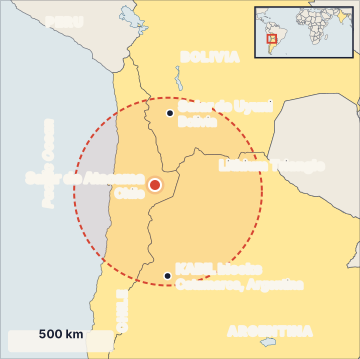
- Brines (salty underground water) in salt flats: found in high, dry areas, especially the "Lithium Triangle" of Chile, Argentina and Bolivia in South America. Chile's Salar de Atacama and Bolivia's Salar de Uyuni are famous examples.
- Hard rock (pegmatite) deposits: lithium is locked in minerals like spodumene. Australia mines most of its lithium this way.
- Clay deposits: lithium-rich clays, being explored in the US and Mexico.
- Seawater and geothermal brines: the oceans hold an estimated 230 billion tonnes of lithium, far more than all land deposits. But it is very thinly spread, at only about 0.17 milligrams per litre.
Who has it and who produces it?
As per the US Geological Survey (February 2026):
- World production (2025, excluding the US): about 290,000 tonnes of lithium, up 31% from 222,000 tonnes in 2024.
- Top producers (2025): Australia (about 92,000 tonnes), China (about 62,000 tonnes), Chile (about 56,000 tonnes), Zimbabwe (about 28,000 tonnes) and Argentina (about 23,000 tonnes).
- World reserves: about 37 million tonnes. Chile has the largest reserves (about 9.2 million tonnes), followed by Australia (about 8.4 million tonnes), China (about 4.6 million tonnes), and Argentina and the US (about 4.4 million tonnes each).
- World resources: about 150 million tonnes, with the largest in Argentina (28 million tonnes) and Bolivia (23 million tonnes).
- China is a large miner but an even bigger player in refining lithium into battery-grade chemicals, which gives it great control over the battery supply chain.
How is lithium extracted?
The method depends on the source:
- Evaporation ponds (for brines): the brine is pumped into huge shallow ponds and left in the sun. Water evaporates over many months, often more than a year, until the lithium is concentrated. It is cheap but slow, and uses a lot of water in very dry regions.
- Hard-rock mining (for spodumene): the rock is mined, crushed, heated to very high temperatures and treated with acid. It is faster but uses a lot of energy and chemicals.
- Direct Lithium Extraction (DLE): a newer group of methods that uses special materials (sorbents, membranes or solvents) to pick lithium directly out of brine, much like a filter, without big evaporation ponds. It is faster and uses less land.
- Solvent extraction: a kind of DLE in which the salty water is mixed with an oily liquid that "grabs" lithium. The two liquids separate like oil and water, and the lithium is then removed from the oily liquid with acid. The BARC method is of this type.
The final products are usually lithium carbonate or lithium hydroxide, which battery makers use to make the cathode (the positive side) of the battery.
Why is seawater so hard?
Seawater has far more magnesium than lithium: the magnesium-to-lithium ratio is more than 6,000 to 1. Magnesium behaves somewhat like lithium chemically, so separating the two is like finding a few grains of sugar mixed into a big bag of salt. Also, since lithium is so dilute, huge volumes of water must be processed, which costs energy and money. That is why no country yet produces lithium from seawater on a commercial scale.
India's position and Indian examples
- Imports: India has no commercial lithium production yet and imports all its lithium and most of its lithium-ion cells.
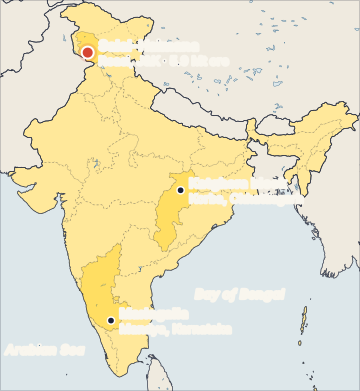
- Jammu and Kashmir: in February 2023, the Geological Survey of India reported 5.9 million tonnes of inferred lithium ore resources (G3 stage) in the Salal-Haimana area of Reasi district. Auctions of this block failed to draw enough bidders in 2023-24, and exploration is continuing.
- Karnataka: the Atomic Minerals Directorate found about 1,600 tonnes of lithium resources at Marlagalla in Mandya district.
- Chhattisgarh: the Katghora lithium and rare earth block in Korba district became India's first lithium block to be auctioned, won by Maiki South Mining in 2024 with a premium of 76.05%.
- Law change: lithium was earlier an "atomic mineral" that only government bodies could mine. The MMDR Amendment Act, 2023 removed it from that list and put it among 24 critical and strategic minerals that the Centre auctions.
- Abroad: in January 2024, KABIL (Khanij Bidesh India Ltd) signed an agreement for exploration of five lithium brine blocks covering about 15,703 hectares in Catamarca province, Argentina.
- Nuclear link: lithium also matters for nuclear science. Lithium compounds are used to control the chemistry of cooling water in some reactors, and lithium is the planned raw material for making tritium, a fuel for future fusion reactors.
Commonly confused concepts
- Reserves vs resources: Resources are all the lithium known or estimated to exist. Reserves are only the part that can be mined profitably with today's technology and prices. The world has about 150 million tonnes of resources but only about 37 million tonnes of reserves.
- G1, G2, G3, G4 stages: under the UN Framework Classification used in India, G4 is the first look (reconnaissance), G3 is prospecting (the "inferred" stage, like the Reasi find), G2 is general exploration and G1 is detailed exploration. A G3 find is still far from a working mine.
- Lithium-ion battery vs lithium metal battery: most rechargeable batteries are lithium-ion (lithium moves as ions). Lithium metal batteries, often single-use (like some coin cells), use pure lithium metal.
- Lithium carbonate vs lithium hydroxide: both are battery chemicals; hydroxide is preferred for high-nickel batteries used in long-range EVs.
- Brine vs seawater: salt-flat brines can hold hundreds of milligrams of lithium per litre, while seawater holds only about 0.17 milligrams, which is why brines are mined and seawater is not, yet.
Issues, criticism and the way forward
- Water and environment: evaporation ponds use large amounts of water in dry areas like Chile's Atacama, affecting farmers and local communities. Hard-rock mining causes land damage and high carbon emissions. Seawater methods must prove they will not harm marine life through chemical discharge.
- Concentrated supply: a few countries mine most lithium and one country dominates refining, so prices and supply can be used as a pressure tool.
- Price swings: the US price of battery-grade lithium carbonate rose to about USD 63,700 per tonne in 2022 and fell to about USD 9,000 in 2025. Such swings make investors careful.
- Slow Indian progress: inferred finds, failed auctions and lack of refining capacity mean India is still years away from its own supply.
- Alternatives: sodium-ion batteries use sodium, which is cheap and plentiful, and can reduce lithium demand for some uses.
- Way forward: experts suggest more exploration, building refining capacity at home, overseas assets through KABIL, battery recycling (urban mining), research into new methods like BARC's seawater process, and partnerships with countries like Australia, Argentina and Chile.
Concepts to Know
- Ion: an atom that has gained or lost a tiny electric charge. In a battery, lithium ions carry charge from one side to the other.
- Brine: water with a very high amount of dissolved salts, found under salt flats or left over from desalination.
- Spodumene: a hard rock mineral that contains lithium; the main lithium ore in Australia.
- Cathode: the positive side of a battery. Lithium compounds are mainly used here.
- Solvent: a liquid that dissolves another substance. In solvent extraction, it is used to pull a chosen metal out of water.
- Inferred resource: an early estimate of how much mineral may exist, based on limited samples. It is the least certain level of estimate.
- Urban mining: recovering metals like lithium from old batteries and electronic waste instead of from the ground.
- Symbol Li; atomic number 3; alkali metal (Group 1); lightest metal; density about 0.534 g/cm³
- Discovered 1817 by Johan August Arfwedson (Sweden), in the mineral petalite
- Lithium-ion battery: first sold by Sony in 1991; Nobel Prize in Chemistry 2019 (Goodenough, Whittingham, Yoshino)
- End uses (USGS 2026): batteries 88%, ceramics and glass 4%, greases 2%
- World production 2025: about 290,000 tonnes (excluding US); top producer Australia (about 92,000 tonnes)
- World reserves: about 37 million tonnes; largest in Chile (about 9.2 million tonnes)
- World resources: about 150 million tonnes; largest in Argentina (28 million tonnes) and Bolivia (23 million tonnes)
- Lithium Triangle: Chile, Argentina, Bolivia
- Seawater: about 230 billion tonnes of lithium at about 0.17 mg per litre; Mg:Li ratio above 6,000
- India: 5.9 million tonnes inferred ore at Salal-Haimana, Reasi (J&K, G3, 2023); 1,600 tonnes at Marlagalla, Mandya (Karnataka); Katghora block (Korba, Chhattisgarh) auctioned in 2024
- Delisted from atomic minerals by the MMDR Amendment Act, 2023
- KABIL: five lithium brine blocks (about 15,703 hectares) in Catamarca, Argentina (agreement of 15 January 2024)
● Tracked since October 20, 2026 · last seen October 20, 2026 · updates as the daily brief publishes