Atomic Energy Commission (AEC) and Department of Atomic Energy (DAE)
The Department of Atomic Energy (DAE) is the Government of India department in charge of everything nuclear in the country: power plants, nuclear research, nuclear fuel, uranium mining and nuclear medicine. The Atomic Energy Commission (AEC) is the top body that makes nuclear policy for the DAE. A simple way to remember it: the AEC is the "brain" that decides the policy, and the DAE is the "body" that carries it out. Both work directly under the Prime Minister.
Why do they exist?
Nuclear energy is not like other kinds of energy. The same science that makes electricity can also make a bomb. Nuclear material is dangerous if it is lost or stolen, and accidents can harm people for many years. So right after Independence, India decided that nuclear matters must be handled by a small, expert, tightly controlled system, close to the top of the government.
Leaders also believed that nuclear power could one day give India energy independence, because India has huge reserves of thorium. The AEC and DAE were set up to plan this long journey.
Where did they come from?
- June 1948: The government created a Department of Scientific Research.
- August 1948: The Atomic Energy Commission was first set up, inside that department. This followed the Atomic Energy Act, 1948, India's first nuclear law. The scientist Homi J. Bhabha was its first chairman.
- 3 August 1954: The Department of Atomic Energy was set up by a Presidential Order, directly under the Prime Minister. All government work on atomic energy moved into it.
- 1 March 1958: By a Government Resolution, the AEC was set up again inside the DAE and given full powers to make policy and handle money for the department. The Prime Minister (Jawaharlal Nehru) placed this resolution before the Lok Sabha on 24 March 1958.
- 1962: The Atomic Energy Act, 1962 replaced the 1948 Act. It kept nuclear power under near-total government control for over 60 years.
- 2025: The SHANTI Act, 2025 replaced the 1962 Act and opened nuclear power generation to licensed private companies, while keeping the most sensitive parts of the fuel cycle with the government.
Who sits on the AEC?
By the 1958 Resolution, the Secretary of the DAE is always the Chairman of the AEC (this is called being chairman "ex officio", meaning by virtue of the post). The other members are appointed for each calendar year on the Chairman's recommendation, with the Prime Minister's approval. The members are a mix of top scientists and very senior officials.
In the reconstitution notified in January 2025, the AEC was chaired by DAE Secretary Ajit Kumar Mohanty. Its ex officio members included the National Security Adviser, the Principal Secretary to the Prime Minister and the Foreign Secretary. Having security and foreign-policy officials on board shows that nuclear policy is about national security and diplomacy, not just electricity.
What does the AEC do?
- It makes the nuclear policy of the government.
- It prepares the DAE's budget and approves big projects.
- It makes sure the policy is carried out.
- It gives final approval for major steps, such as accepting a new site for a nuclear power plant.
What does the DAE look after?
The DAE runs a large family of organisations. According to the DAE, they fall into these groups:
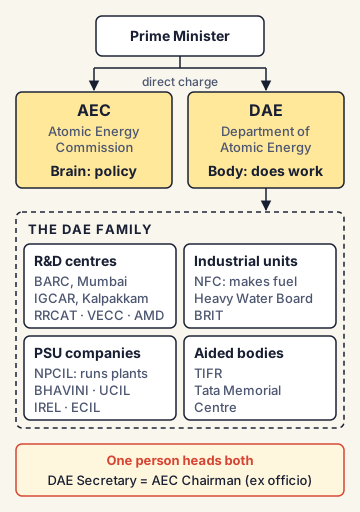
- Research and development centres: Bhabha Atomic Research Centre (BARC, Mumbai, the main nuclear research centre), Indira Gandhi Centre for Atomic Research (IGCAR, Kalpakkam, Tamil Nadu, for fast breeder reactors), Raja Ramanna Centre for Advanced Technology (RRCAT, Indore), Variable Energy Cyclotron Centre (VECC, Kolkata), Atomic Minerals Directorate for Exploration and Research (AMD, Hyderabad, which searches for uranium and thorium) and the Global Centre for Nuclear Energy Partnership (GCNEP, Bahadurgarh, Haryana).
- Industrial organisations: Nuclear Fuel Complex (NFC, Hyderabad, which makes fuel), Heavy Water Board (HWB, Mumbai) and Board of Radiation and Isotope Technology (BRIT, Mumbai).
- Public sector companies: Nuclear Power Corporation of India Ltd (NPCIL, which builds and runs most nuclear plants), Bharatiya Nabhikiya Vidyut Nigam Ltd (BHAVINI, Kalpakkam, for fast breeder reactors), Uranium Corporation of India Ltd (UCIL, Jaduguda, Jharkhand, which mines uranium), IREL (India) Ltd (formerly Indian Rare Earths, which processes beach sand minerals) and Electronics Corporation of India Ltd (ECIL, Hyderabad).
- Aided institutions: Research and medical bodies funded by the DAE, such as the Tata Institute of Fundamental Research (TIFR) and the Tata Memorial Centre (a major cancer hospital).
How does a new nuclear power site get approved?
This is the step-by-step path the news refers to:
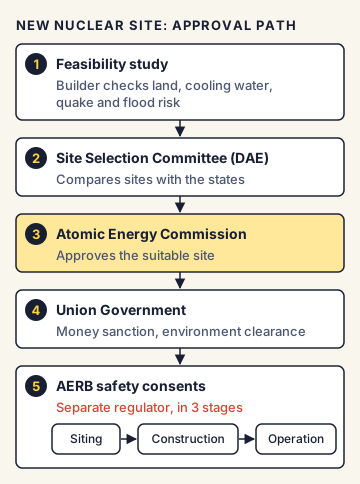
- Feasibility study: The company that wants to build the plant (for example, NPCIL or NTPC) studies possible sites, often with the state government. It checks land, water for cooling, earthquake risk, flood risk, distance from big towns, and roads for heavy equipment.
- Standing Site Selection Committee (DAE): This committee of the DAE checks the report and compares sites. Sites are chosen in consultation with the state governments.
- Atomic Energy Commission: If the committee finds a site technically suitable, the proposal goes to the AEC for approval.
- Government approvals: The project then needs financial approval from the Union Government, and other clearances such as environmental clearance.
- Safety consents from the regulator: The Atomic Energy Regulatory Board (AERB) gives separate permissions in stages: siting, construction, and finally operation.
Safety zones around a plant
The AERB's siting rules mark out zones around every reactor:
- Exclusion zone: a ring of usually about 1.5 km around the reactor where no one may live; the plant operator controls this land.
- Sterilised zone: the ring up to 5 km from the reactor. Only the natural growth of the local population is allowed here; large new settlements are not.
- Emergency planning zone: up to 16 km from the plant. District and state authorities must keep plans ready to protect people here if an accident happens.
India's position and Indian examples
As of December 2025, India's installed nuclear capacity was about 8.8 GW, giving only about 3% of the country's electricity. India now uses its own 700 MW Pressurised Heavy Water Reactor (PHWR) as the standard design. The first 700 MW unit, at Kakrapar in Gujarat (KAPP-3), started commercial operation in 2023. The government has a target of 100 GW by 2047 under the Nuclear Energy Mission, announced in the Union Budget 2025-26. NTPC and NPCIL already have a joint venture, ASHVINI, to build the four-unit Mahi Banswara project in Rajasthan.
Commonly confused concepts
- AEC vs DAE: The AEC is a policy-making commission; the DAE is the government department that carries out the work. The same person heads both.
- DAE vs AERB: The DAE builds and promotes nuclear power. The AERB is the safety watchdog that gives licences and checks safety. The AERB was set up on 15 November 1983 under the Atomic Energy Act, 1962; the SHANTI Act, 2025 gave it statutory status.
- AEC vs IAEA: The AEC is India's own national body. The International Atomic Energy Agency (IAEA), set up in 1957 with headquarters in Vienna, is a global body linked to the UN.
- NPCIL vs BHAVINI vs NTPC: NPCIL runs India's PHWRs and light water reactors; BHAVINI was set up for fast breeder reactors (stage 2 of India's programme); NTPC is a power company under the Ministry of Power that is now entering nuclear power through joint ventures and its own projects.
- BARC vs IGCAR: BARC (Mumbai) is the main multi-purpose nuclear research centre; IGCAR (Kalpakkam) focuses on fast breeder reactor technology.
Issues, criticism and the way forward
- Regulator independence: The AERB checks plants built by DAE companies, while the DAE also promotes nuclear power. Critics say this mixes the roles of "player" and "referee". The SHANTI Act gave the AERB a law of its own, but experts say it also needs its own budget and staff.
- Secrecy and accountability: The DAE's work is partly secret for security reasons. Critics say this leaves less room for public scrutiny of costs and delays.
- Slow growth: India's nuclear capacity has grown slowly for decades because of uranium shortages (before 2008), long construction times and land disputes. Reaching 100 GW by 2047 will need much faster approvals and building.
- Local trust: Projects such as Kudankulam (Tamil Nadu) and Jaitapur (Maharashtra) faced local protests over safety and land. Clear information and fair compensation are seen as key.
- Way forward: Experts suggest faster but strict site and safety approvals, standard reactor designs built in "fleet mode", more private and public investment under the SHANTI Act, and a fully independent, well-staffed regulator.
Concepts to Know
- Feasibility study: A detailed check, before any money is spent on building, of whether a project can work: land, water, cost, safety and approvals.
- Ex officio: Holding one position automatically because you hold another. The DAE Secretary is AEC Chairman ex officio.
- Fuel cycle: All the steps of nuclear fuel: mining uranium, making fuel, using it in a reactor, and then storing or reprocessing the used (spent) fuel.
- Heavy water: Water in which the hydrogen atoms are a heavier form called deuterium. India's PHWRs use it to slow down neutrons so that natural uranium can be used as fuel.
- Statutory body: A body created by a law passed by Parliament, which gives it more legal strength than a body set up by an executive order.
- AEC first set up: August 1948 (first chairman: Homi J. Bhabha); Atomic Energy Act, 1948
- DAE set up: 3 August 1954 by Presidential Order, under the direct charge of the Prime Minister
- AEC reconstituted within the DAE: Government Resolution of 1 March 1958
- DAE Secretary is ex officio Chairman of the AEC; other members appointed each calendar year with the Prime Minister's approval
- Site approval path: feasibility study → DAE's Standing Site Selection Committee → AEC → government sanction → AERB consents (siting, construction, operation)
- AERB safety zones: exclusion zone about 1.5 km; sterilised zone 5 km; emergency planning zone 16 km
- Atomic Energy Act, 1962 replaced by the SHANTI Act, 2025
● Tracked since October 18, 2026 · last seen October 18, 2026 · updates as the daily brief publishes