Law Commission of India
The Law Commission of India is an expert body that studies India's laws and tells the government how to improve them. It suggests which old laws should be removed, which laws should be changed, and which new laws are needed. It only gives advice; the government and Parliament decide whether to follow it. Many states, including Tamil Nadu, have their own State Law Commissions that do the same job for state laws.
Why does it exist?
Laws grow old. A law written in 1880 may use words, punishments and ideas that no longer fit modern India. Ministries are busy running the country day to day, so they rarely have time to study a law deeply. The Law Commission fills this gap. Think of it like a family doctor doing a full health check-up: it looks at the whole body of law, finds the weak spots and writes a prescription. Without it, outdated and confusing laws would pile up, cases would take longer and citizens would suffer.
Where did it come from?
The idea is older than independence.
- The first Law Commission was set up in 1834 under the Charter Act of 1833, with Lord Macaulay as chairman. Its biggest work was the draft of the Indian Penal Code, which was finally passed in 1860.
- Three more commissions followed in British India: in 1853, 1861 (both chaired by Sir John Romilly) and 1879 (chaired by Dr Whitley Stokes). Their work shaped major laws of that era, such as the Indian Contract Act, 1872 and the Indian Evidence Act, 1872.
- After independence, the government set up the first Law Commission of independent India in 1955, with the then Attorney-General M. C. Setalvad as chairman. Its famous 14th Report (1958) was on "Reform of Judicial Administration".
- Since then, a new commission has been formed roughly every three years. The 21st (2015) was chaired by Justice B. S. Chauhan, the 22nd (2020) by Justice Ritu Raj Awasthi, and the 23rd was constituted for 1 September 2024 to 31 August 2027. Retired Supreme Court judge Justice Dinesh Maheshwari became its chairperson in April 2025.
What kind of body is it?
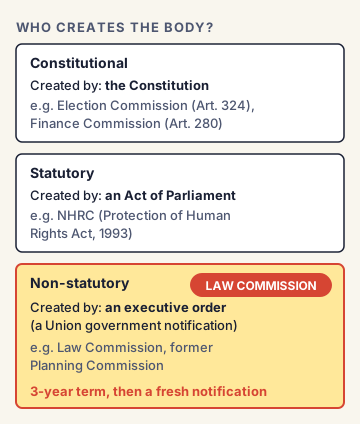
This is the most tested point. The Law Commission is neither constitutional nor statutory. No article of the Constitution and no Act of Parliament creates it. The Union government creates it by an executive order (a government notification), for a fixed term of three years. When the term ends, the commission ends, and the government must notify a fresh one. It works as an advisory body to the Ministry of Law and Justice (Department of Legal Affairs).
Who is in it?
The notification for the 23rd Law Commission provides for:
- A full-time Chairperson (usually a retired Supreme Court judge or High Court Chief Justice)
- Four full-time Members, one of whom is the Member-Secretary
- Two ex officio members (members because of the post they hold): the Secretary, Department of Legal Affairs and the Secretary, Legislative Department
- Not more than five part-time Members
Serving judges of the Supreme Court or High Courts can also be appointed. They then work full time on the commission until they retire from the court or the commission's term ends, whichever comes first.
How does it work?
Work reaches the commission in two ways.
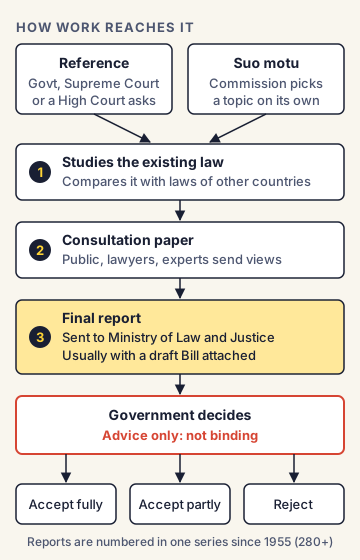
- A reference: the government, the Supreme Court or a High Court asks it to study a specific topic.
- Suo motu: the commission picks a topic on its own (suo motu means "on its own").
It then studies the existing law, compares it with laws in other countries, and often releases a consultation paper asking the public, lawyers and experts for views. Finally it submits a report to the Ministry of Law and Justice, usually with a draft Bill attached. The government may accept it fully, partly or not at all. Reports are numbered in one continuous series across all commissions since 1955, and the list now runs to more than 280 reports.
Important reports to remember
- 14th Report (1958): Reform of Judicial Administration
- 170th Report (1999): Reform of Electoral Laws
- 255th Report (2015): Electoral Reforms
- 262nd Report (2015): The Death Penalty
- 279th Report (2023): Usage of the Law of Sedition. It recommended keeping the sedition law with added safeguards.
- 283rd Report (2023): Age of consent under the POCSO Act. It advised against lowering the age of consent from 18.
- Uniform Civil Code: the 21st Commission released a consultation paper, "Reform of Family Law", on 31 August 2018. It said a uniform civil code was "neither necessary nor desirable at this stage". The 22nd Commission reopened the subject and invited public views in June 2023.
State Law Commissions
States can set up their own law commissions, also by executive order, to review state laws. Tamil Nadu has had a State Law Commission at several points, each for a fixed term. In August 2026 it was reconstituted for three years with former Chief Justice D. Krishnakumar as chairman. Its mandate covers finding gaps in state laws, suggesting amendments and new laws, and examining Union-State and inter-state relations.
Commonly confused concepts
- Law Commission vs Ministry of Law and Justice: the Ministry is a permanent part of the government that drafts and runs laws. The Law Commission is a temporary expert body that only advises.
- Law Commission vs Finance Commission: the Finance Commission is a constitutional body under Article 280, formed every five years to recommend how tax money is shared between the Centre and states. The Law Commission has no constitutional basis and a three-year term.
- Law Commission vs Administrative Reforms Commission (ARC): the ARC (first in 1966, second in 2005) studies how the government machinery works, not the content of laws.
- Non-statutory vs statutory vs constitutional: a constitutional body is created by the Constitution (Election Commission, Article 324). A statutory body is created by an Act (National Human Rights Commission, under the Protection of Human Rights Act, 1993). A non-statutory body is created by a government order (Law Commission, the former Planning Commission).
Issues, criticism and the way forward
- Advice is often ignored: many reports sit unused for years, because the government has no duty to act on them or even to explain why it rejected them.
- Gaps between commissions: since each commission ends after three years, there are often long gaps before the next one is formed or its chairperson is appointed. The 23rd Commission, for example, was notified in September 2024 but got its chairperson only in April 2025.
- Lack of independence: because the government creates it, picks its members and decides its references, critics say it may avoid topics the government does not want studied.
- The way forward: experts and the commission itself have long suggested giving it statutory status (by an Act of Parliament), so that it becomes permanent, has secure funding and enjoys more independence. Others suggest that the government should table an "action taken" note in Parliament on every report.
Concepts to Know
- Executive order: a decision made by the government on its own authority, through a notification or order, without passing a new law. What one executive order creates, another can end.
- Consultation paper: a document that sets out a problem and possible solutions and invites the public to send comments before a final report is written.
- Ex officio: a person who holds a seat because of another post they hold, not because they were separately chosen.
- Reference: a formal request asking the commission to study a particular question.
- Sedition: an offence about speech or acts that try to create hatred or disaffection against the government established by law.
- First Law Commission: 1834, under the Charter Act of 1833, chaired by Lord Macaulay; drafted the Indian Penal Code (enacted 1860)
- Pre-independence commissions: 1834, 1853, 1861, 1879
- First commission of independent India: 1955, chaired by M. C. Setalvad; 14th Report (1958) on Reform of Judicial Administration
- Nature: non-statutory, non-constitutional; created by executive order of the Union government; term of 3 years; advises the Ministry of Law and Justice
- 23rd Law Commission: 1 September 2024 to 31 August 2027; chairperson Justice Dinesh Maheshwari (from April 2025)
- Composition: chairperson, 4 full-time members (including Member-Secretary), 2 ex officio secretaries, up to 5 part-time members
- Notable reports: 170th (1999), 255th (2015) electoral reforms; 262nd (2015) death penalty; 279th (2023) sedition; 283rd (2023) age of consent
- 2018 consultation paper: UCC "neither necessary nor desirable at this stage"
● Tracked since November 09, 2026 · last seen November 09, 2026 · updates as the daily brief publishes