Commissions on Centre-State Relations
Rajamannar, Sarkaria and Punchhi
Updated 12 Nov 2026: Added that Tamil Nadu's Kurian Joseph committee gave its Part I report in February 2026 and was ended in November 2026.
Over the years, several expert bodies have studied how power is shared between the Union (Centre) and the states, and how that sharing could work better. The three most important ones for UPSC are the Rajamannar Committee (set up by Tamil Nadu in 1969), the Sarkaria Commission (set up by the Union government in 1983) and the Punchhi Commission (set up by the Union government in 2007).
Their reports are still the main reference points whenever there is a quarrel over Governors, President's Rule, money or law-making powers.
Why were such commissions needed?
India's Constitution gives the Centre a lot of power. For the first two decades after 1950, one party ruled both at the Centre and in most states, so disagreements were sorted out inside the party. After the 1967 elections, different parties came to power in several states. Clashes increased over the role of Governors, the use of Article 356 (President's Rule) to dismiss state governments, the sharing of money, and the Centre's control over planning.
States wanted a fair and neutral review of the system. A commission is like an outside referee that studies the rules of the game and suggests changes both sides can accept.
Before the big three: the first Administrative Reforms Commission
The first Administrative Reforms Commission (ARC), set up by the Union government in 1966 (first chaired by Morarji Desai and later by K. Hanumanthaiah), had a study team on Centre-State relations. Its report in 1969 recommended setting up an Inter-State Council under Article 263 and appointing experienced, non-partisan persons as Governors.
The Rajamannar Committee (1969-1971)
- Who set it up? The Tamil Nadu government in 1969. It was the first time a state government appointed its own committee to study Centre-State relations.
- Who was in it? Chairman Dr P.V. Rajamannar, former Chief Justice of the Madras High Court, along with Dr A. Lakshmanaswami Mudaliar and P. Chandra Reddy.
- Report: Submitted to the Tamil Nadu government in 1971.
- Main recommendations:
- Set up an Inter-State Council under Article 263 immediately, to consult states on all important matters.
- Make the Finance Commission a permanent body.
- Reduce the Centre's power to give orders to states; it criticised provisions such as Articles 256, 257 and 365 for allowing too much central control.
- Remove or sharply limit Articles 356 and 357, so that state governments could not be easily dismissed.
- Give residuary powers to the states, and move some subjects from the Union and Concurrent Lists to the State List.
- Replace the non-constitutional Planning Commission's control over state plans with a fairer, statutory arrangement.
- What happened next? The Union government did not act on the report. In April 1974, the Tamil Nadu Assembly passed a resolution asking the Centre to accept its recommendations. The report remains a landmark in the demand for state autonomy (more self-rule for states).
The Sarkaria Commission (1983-1988)
- Who set it up? The Union government, by a notification of 9 June 1983, after many states demanded a review. (In the same period, Punjab's Anandpur Sahib Resolution of 1973 and West Bengal's memorandum of 1977 also asked for more state powers.)
- Who was in it? Chairman Justice R.S. Sarkaria, a retired Supreme Court judge, with B. Sivaraman (former Cabinet Secretary) and Dr S.R. Sen (economist) as members.
- Report: Submitted in 1988, with 247 recommendations in 19 chapters. Unlike Rajamannar, it did not suggest big changes in the Constitution. It wanted the existing system to work better, through cooperation.
- Main recommendations:
- Set up a permanent Inter-State Council under Article 263.
- Use Article 356 "very sparingly", only as a last resort, after warning the state and trying all other options.
- Governor: should be an eminent person from outside the state, not too closely tied to local politics, and not an active politician in the recent past. The Chief Minister should be consulted before appointment. The Governor should normally complete the five-year term.
- In a hung Assembly (where no party has a clear majority), the Governor should invite parties in a set order: first a pre-poll alliance, then the single largest party with support, then a post-poll coalition. Majority should be tested on the floor of the House.
- Residuary powers of taxation should stay with Parliament, while other residuary subjects could be placed in the Concurrent List.
- All India Services should be strengthened, not weakened, because they help national unity.
- Zonal Councils should be revived as forums for regional cooperation.
- Result: The Inter-State Council was set up on 28 May 1990 by a Presidential Order. Several other suggestions were followed in practice, and later Supreme Court judgments drew on Sarkaria's views on Article 356 and Governors.
The Punchhi Commission (2007-2010)
- Why a second commission? Much had changed since Sarkaria: coalition governments, economic reforms, the 73rd and 74th Amendments on local bodies, new security threats such as terrorism and Naxalism, and the debate on Governors' roles.
- Who set it up? The Union government on 27 April 2007, chaired by Justice Madan Mohan Punchhi, former Chief Justice of India.
- Report: Submitted on 30 March 2010, in seven volumes, with about 273 recommendations.
- Main recommendations:
- Governor: should be from outside the state and should not have been in active politics for at least two years before appointment. A committee including the Prime Minister, the Union Home Minister, the Lok Sabha Speaker and the state's Chief Minister should help choose the Governor. The Governor should have a fixed tenure, and the "doctrine of pleasure" (the President's power to remove a Governor at any time) should go. The state legislature should be able to move for the Governor's removal through an impeachment-like process.
- Localised emergency: Articles 355 and 356 should be amended so that the Centre can take control of only the troubled district or area, instead of the whole state.
- Central forces: in situations like communal violence, the Centre should be able to send its forces into a state without the state's consent for a short period (it suggested about a week), informing the state afterwards.
- Concurrent List laws: states should be consulted, through the Inter-State Council, before Parliament makes laws on Concurrent subjects.
- Treaties: states should have a bigger say when India signs treaties that affect State List subjects.
- The Inter-State Council should meet regularly and become a strong, active forum.
- Result: The Inter-State Council's Standing Committee discussed the Punchhi recommendations at meetings in 2017 and 2018, but most have not been adopted.
Other bodies worth knowing
The National Commission to Review the Working of the Constitution (NCRWC), chaired by Justice M.N. Venkatachaliah (2000-2002), also made suggestions on Centre-State relations and Article 356. In April 2025, Tamil Nadu set up the Kurian Joseph committee (the High-Level Committee on Union-State Relations), continuing the Rajamannar tradition of a state-appointed review.
- Who was in it? Chairman Justice Kurian Joseph, a retired Supreme Court judge, with K. Ashok Vardhan Shetty and M. Naganathan.
- Report: It gave Part I of its report in February 2026. Among other things, it suggested fixed timelines for Governors to act on state Bills and changes to the GST Council.
- What happened next? In November 2026, Tamil Nadu ended the committee before it finished its work. The state said its work overlapped with the State Law Commission, so its work and records passed to that Commission.
How does the Inter-State Council work?
It is the most important outcome of these commissions, so it helps to know it well.
- Basis: Article 263 lets the President set up a council to look into disputes between states and to discuss subjects of common interest between the Centre and states.
- Members: The Prime Minister (chairman), Chief Ministers of all states, Chief Ministers of Union Territories with legislatures, Administrators of other UTs, and six Union Cabinet ministers named by the Prime Minister.
- Nature: It is a recommendatory body; its advice is not binding. Decisions are by consensus.
- Meetings: The rules say it should meet at least three times a year, but it has met rarely. Its 11th meeting, in July 2016, was the last full meeting.
Commonly confused concepts
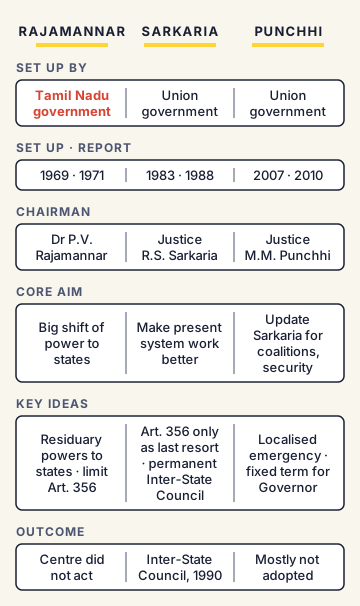
- Rajamannar vs Sarkaria vs Punchhi: Rajamannar (1969, set up by Tamil Nadu, report 1971) wanted major shifts of power to states. Sarkaria (1983, set up by the Centre, report 1988) wanted the existing system to work better through cooperation. Punchhi (2007, set up by the Centre, report 2010) updated Sarkaria for coalition-era and security issues, such as localised emergency.
- Inter-State Council vs Zonal Councils: The Inter-State Council is created under Article 263 of the Constitution. Zonal Councils (five of them) are statutory bodies created by the States Reorganisation Act, 1956, and are chaired by the Union Home Minister. The North Eastern Council was created by a separate Act of 1971.
- Inter-State Council vs NITI Aayog Governing Council: The Inter-State Council is a constitutional forum for Centre-State issues. NITI Aayog (2015) is a non-constitutional policy think tank; its Governing Council of Chief Ministers discusses development policy.
- Statutory vs non-statutory body: A statutory body is created by a law (for example, the National Human Rights Commission). A non-statutory body is created by an executive order of a government (for example, the Kurian Joseph committee or a state law commission set up by order). A non-statutory body can be ended by another order.
- Article 355 vs Article 356: Article 355 puts a duty on the Union to protect states and ensure they are run as per the Constitution. Article 356 gives the power to impose President's Rule when a state's government cannot be carried on as per the Constitution.
Issues, criticism and the way forward
- Reports gather dust: Many recommendations, especially Punchhi's on Governors and Rajamannar's on autonomy, have never been put into effect. Critics say the Centre adopts what suits it and ignores the rest.
- The Governor's role: Disputes over Governors delaying assent to state Bills have reached the Supreme Court several times. In April 2025, in the Tamil Nadu Governor case, the Court set time limits for Governors. In November 2025, a five-judge bench, answering a reference from the President, said courts cannot fix such timelines and that there is no "deemed assent", though Governors must act within a reasonable time and courts can step in, in a limited way, against long and unexplained inaction. This keeps alive the commissions' call for clear rules.
- A weak Inter-State Council: The one body meant for regular Centre-State dialogue rarely meets. Experts suggest fixed meeting dates and a permanent secretariat with real powers.
- Money matters: States complain about a falling share of central taxes in practice because of cesses and surcharges, which are not shared with them, and about conditions on centrally sponsored schemes. The GST Council's voting rules, where the Centre has one-third of the votes and a 75% majority is needed, are also debated.
- Balance of views: Supporters of a strong Centre argue it is needed for national unity, security and a common market. Supporters of state autonomy argue that a diverse country works best when states have enough power and money. Most commissions sought a middle path: cooperative federalism, where both sides work as partners.
- Way forward: Commonly suggested steps include reviving the Inter-State Council, a transparent process for choosing and removing Governors, consulting states on Concurrent List laws, and limiting cesses and surcharges.
Concepts to Know
- Article 356 (President's Rule): A provision that lets the Union take over a state's government if the President is satisfied that it cannot be run as per the Constitution.
- Residuary powers: The power to make laws on subjects not mentioned in any of the three lists. In India, this belongs to Parliament.
- Hung Assembly: A legislature in which no single party or pre-poll alliance has a clear majority.
- Doctrine of pleasure: The rule that some officeholders, such as Governors, hold office only as long as the President wishes, and can be removed without giving reasons.
- Cooperative federalism: An approach in which the Centre and the states work together as partners to solve common problems, rather than competing.
- Cess and surcharge: Extra taxes the Union collects for specific purposes. Unlike most central taxes, they do not have to be shared with the states.
- State autonomy: The idea that states should have more freedom and power to run their own affairs without interference from the Centre.
- First ARC (1966): study team on Centre-State relations; report 1969; recommended an Inter-State Council
- Rajamannar Committee: set up by Tamil Nadu in 1969; chairman Dr P.V. Rajamannar; members A. Lakshmanaswami Mudaliar and P. Chandra Reddy; report 1971; Tamil Nadu Assembly autonomy resolution in April 1974
- Sarkaria Commission: notified 9 June 1983; Justice R.S. Sarkaria with B. Sivaraman and S.R. Sen; report 1988; 247 recommendations
- Inter-State Council: set up 28 May 1990 under Article 263; chaired by the PM; last full meeting (11th) in July 2016
- Punchhi Commission: set up 27 April 2007; Justice M.M. Punchhi; report 30 March 2010 in 7 volumes; localised emergency, fixed tenure for Governors, end to the doctrine of pleasure
- NCRWC: Justice M.N. Venkatachaliah, 2000-2002
- Kurian Joseph committee: set up by Tamil Nadu in April 2025; Part I report February 2026; ended November 2026, its work passed to the State Law Commission
- Zonal Councils: States Reorganisation Act, 1956 (five councils, chaired by the Union Home Minister)
- S.R. Bommai v. Union of India (1994): federalism is part of the basic structure; limits on Article 356
- 12 Nov 2026Added that Tamil Nadu's Kurian Joseph committee gave its Part I report in February 2026 and was ended in November 2026.
● Tracked since November 09, 2026 · last seen November 09, 2026 · updates as the daily brief publishes