Lal Babu Hussein v. Electoral Registration Officer (1995)
Safeguards Against Deleting Voters
Lal Babu Hussein v. Electoral Registration Officer is a 1995 Supreme Court judgment about how a person's name can be removed from a voter list. The court said that once your name is on the roll, an official cannot simply strike it off because of a suspicion. You must be told why you are suspected, shown the material against you, and given a real chance to prove otherwise.
It is the leading case on fair procedure in voter-list deletions, and it is cited in almost every voter-list dispute today.
Why did this case arise?
In the early 1990s, the Election Commission of India (ECI) was worried that foreigners had entered voter lists in some cities. On 9 September 1994, it issued a direction letting Electoral Registration Officers (EROs) identify and delete the names of suspected foreigners. The direction also put the burden of proving citizenship on the person. Some types of documents were not to be accepted as proof.
What happened on the ground?
- In Bombay (now Mumbai), police in 39 police stations sent about 1.67 lakh notices asking people to show a birth certificate, passport, citizenship certificate or extract from the citizenship register.
- In Delhi's Matia Mahal constituency, about 18,000 voters on earlier rolls in some polling stations were cut down to about 300 names in the revised roll. Ration cards and Delhi identity cards were rejected as proof.
- In Motia Khan (Paharganj), poor migrant workers from Uttar Pradesh and Bihar were asked to prove citizenship based on a police report they were never shown.
Many of these people were poor and did not have formal papers. They went to court.
Who decided it?
A three-judge bench of Chief Justice A.M. Ahmadi, Justice N.P. Singh and Justice Sujata V. Manohar decided the case on 6 February 1995. Chief Justice Ahmadi wrote the judgment.
What did the court decide?
The court balanced two ideas. First, only citizens can vote, so checking citizenship is allowed. Second, removing a voter is serious and must be fair.
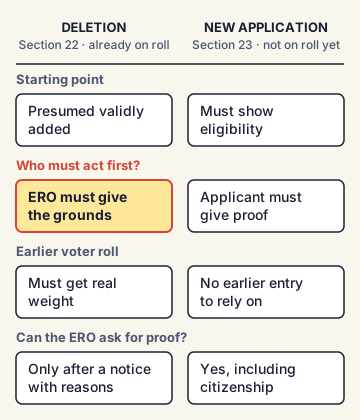
- Only citizens can be voters. Section 16 of the Representation of the People Act, 1950 disqualifies a person who is not a citizen of India. So an ERO may ask a new applicant for proof of citizenship.
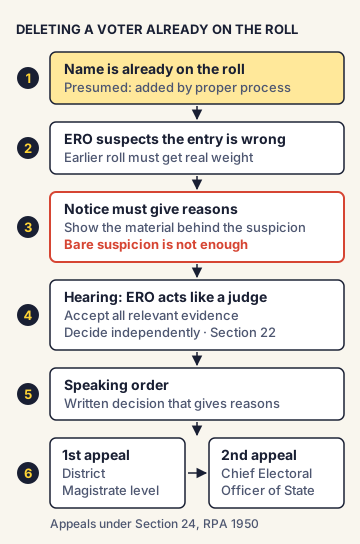
- People already on the roll are in a stronger position. If a name is already on the roll, the ERO must presume that the earlier officials followed the proper process before adding it.
- The earlier roll counts as evidence. If the person was on the immediately preceding roll, the ERO must give that fact real weight, both before sending a notice and while deciding.
- The notice must give reasons. The person must be told the material that created the suspicion. Without this, the hearing is meaningless, because they would not know what to answer.
- It is a quasi-judicial inquiry. This means the ERO acts like a judge, not like a clerk. The ERO must accept all relevant evidence (documents, witnesses, anything useful) and judge its value, not reject whole categories of documents.
- Independent judgment. The ERO must decide on their own assessment, not on outside instructions telling them what result to reach.
- A reasoned order. The ERO must write a "speaking order" (an order that explains its reasons), because the person can appeal.
The court quashed the 1994 direction that barred certain documents. It allowed the ECI to start fresh proceedings, but only with proper notices that disclose the grounds of suspicion.
How does the law protect a voter today?
The judgment works together with the Representation of the People Act, 1950:
- Section 16: a person is disqualified from being registered if they are not a citizen, are declared of unsound mind by a competent court, or are disqualified under election-offence laws.
- Section 19: to be registered, a person must be at least 18 on the qualifying date and "ordinarily resident" in that constituency.
- Section 22: the ERO can correct or delete an entry, but its proviso says no deletion against a person's interest can be made without giving them a reasonable opportunity of being heard.
- Section 23: a person whose name is missing can apply to the ERO to be included.
- Section 24: appeals. A first appeal against the ERO's order goes to the District Magistrate, Additional District Magistrate, Executive Magistrate or District Collector (or an officer of equivalent rank). A second appeal goes to the Chief Electoral Officer of the State.
You can think of it like a school removing a student's name from the register. The school cannot just say "we think you left". It must tell the family why it thinks so, look at the attendance record from last year, listen to them, and write down its decision. The family can then complain to the principal and then to the district education officer.
India's position and examples
The ruling has become central again during the SIR exercises since 2025. In the Bihar SIR, the Supreme Court in August 2025 ordered the ECI to publish the names of about 65 lakh people left out of the draft roll, with the reason for each, and to accept Aadhaar for claims. Petitioners in the West Bengal and Delhi SIR cases have relied on Lal Babu Hussein to argue that notices must state clear reasons and that a long, settled presence on earlier rolls must count in the voter's favour.
The Supreme Court has also held, in its 2026 Bihar SIR ruling, that a roll revision does not let the ECI decide whether a person is an Indian citizen.
Commonly confused concepts
- Lal Babu Hussein (1995) vs Sarbananda Sonowal v. Union of India (2005): Sonowal struck down the Illegal Migrants (Determination by Tribunals) Act, 1983 and upheld Section 9 of the Foreigners Act, 1946, which puts the burden on a person to prove they are not a foreigner in proceedings under that Act. Lal Babu Hussein is about the voter list: before deleting an existing voter, the ERO must disclose grounds and give the earlier roll proper weight.
- Deletion vs non-inclusion: Deleting someone already on the roll (Section 22) needs a hearing and stronger reasons. Refusing a new application (Section 23) is a different decision, where the applicant must show eligibility.
- ERO vs Election Commission: The ERO (usually a government officer in the district) decides individual cases. The ECI sets policy and supervises. Lal Babu Hussein said the ERO must use independent judgment even when following ECI guidance.
- Natural justice vs a full trial: A fair hearing does not always mean a court-style trial. It means notice, disclosure of the material, a chance to answer, and a reasoned decision.
Issues, criticism and the way forward
- Scale vs fairness: When lakhs of notices go out in a short time, it is hard to give each person a meaningful hearing. Critics say mass processes can turn the burden of proof against the voter, which Lal Babu Hussein warned against for people already on the roll.
- Poor and migrant voters: People who move for work, live in rented rooms or lack birth papers are most at risk of being marked "shifted" or "absent".
- Unclear grounds: Petitioners argue categories like "logical discrepancy" are not defined in law, so voters cannot know what they must prove.
- The ECI's position is that a clean roll is essential for free and fair elections, that removing dead, shifted and duplicate entries is a legal duty, and that every flagged person gets notice and a chance to respond, with many already cleared.
- Way forward: Experts suggest clear written rules for each deletion ground, notices in local languages that state the specific reason, accepting a wide range of documents, door-step hearings, publishing deletion lists with reasons, and quick, accessible appeals.
Concepts to Know
- Quasi-judicial: A body or officer that is not a court but must decide like one: hear both sides, look at evidence, and give reasons.
- Speaking order: A written decision that explains the reasons for it, so the affected person and the appeal authority can understand and check it.
- Burden of proof: The duty to prove a fact. Whoever carries it loses if they cannot prove it.
- Ordinarily resident: A person who normally lives at a place. Briefly being away (for example for work or study) does not by itself end ordinary residence.
- Natural justice: Basic rules of fairness: no one should be punished without being heard, and no one should judge their own case.
- Decided: 6 February 1995; bench: CJI A.M. Ahmadi, Justices N.P. Singh and Sujata V. Manohar
- Challenged: ECI direction of 9 September 1994 on deleting suspected foreigners
- About 1.67 lakh notices in 39 Bombay police stations; Matia Mahal (Delhi) about 18,000 voters reduced to about 300
- Held: names already on the roll carry a presumption that due process was followed; presence on the immediately preceding roll must get adequate weight
- Notice must disclose the material behind the suspicion; ERO must accept all relevant evidence and pass a reasoned order
- RPA, 1950: Section 16 (disqualifications), Section 19 (18 years, ordinarily resident), Section 22 (hearing before deletion), Section 23 (inclusion), Section 24 (two-stage appeals: District Magistrate level, then Chief Electoral Officer)
● Tracked since October 28, 2026 · last seen October 28, 2026 · updates as the daily brief publishes