Jagirdari System in Hyderabad State and Its Abolition
A jagir was a grant by a ruler to a person (the jagirdar) of the right to collect land revenue from a set of villages or a tract of land. The jagirdar kept that revenue, usually in return for service to the ruler, such as keeping soldiers. The key point, which courts still repeat today, is this: a jagir gave a share of the land revenue, not ownership of the land itself.
In the princely State of Hyderabad, about 30% of the land was held under jagirs until they were abolished in 1949.
Why did rulers give jagirs?
Old kingdoms did not have a modern salary system or banking. Collecting taxes from far-off villages and sending them to the capital was slow and costly. So a ruler would say to a noble: "Instead of a salary, collect the revenue of these villages yourself, and in return keep soldiers ready for me." Think of it like a company paying a manager by letting him keep the rent from a few of its shops, instead of paying him from the head office.
Where did the system come from?
The idea goes back to the Delhi Sultanate's iqta system, where a soldier or officer was paid from the revenue of a territory. The Mughals made it a regular system. Under Akbar's mansabdari system, every officer (mansabdar) held a rank, and most were paid through a jagir that was expected to yield revenue equal to their salary.
- A Mughal jagir was not hereditary. The emperor could take it back or move it to another region at any time. This stopped nobles from building local power bases.
- The exception was the watan jagir: a hereditary grant to a local chief in his home territory.
- A few officers were paid in cash from the treasury. They were called naqdi mansabdars.
How did it work in Hyderabad State?
The Nizams (the Asaf Jahi dynasty) ruled Hyderabad from 1724 to 1948. They began as the Mughal governors (subedars) of the Deccan and later became independent in practice. Land in Hyderabad State was held in three main ways:
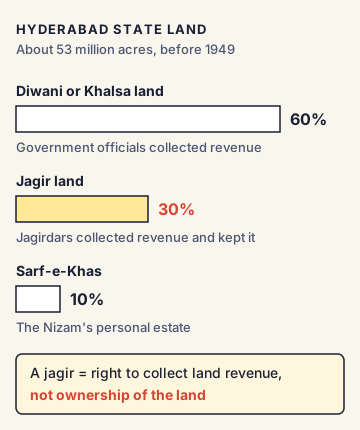
- Diwani or Khalsa land (about 60%): run directly by the government, which collected revenue through its own officials.
- Jagir land (about 30%): revenue collected by jagirdars.
- Sarf-e-Khas (about 10%): the Nizam's own personal estate, whose income went to the ruler and his family.
These shares are of about 53 million acres. Many jagirdars also exercised police and court powers inside their jagirs, so peasants dealt with the jagirdar's agents, not the State.
The Paigahs: the biggest jagir
The Paigah nobles were the most powerful family after the Nizam. The word refers to an estate granted to maintain the ruler's household troops. The family was founded by Abul Fateh Khan, who received the title Shams-ul-Umra ("sun among nobles") from the second Nizam, Nizam Ali Khan. In the late 19th century the estate was divided into three Paigahs: Asman Jahi, Khurshid Jahi and Viqar-ul-Umrai.
The Paigah jagir was the largest in the State. Two Paigah nobles, Asman Jah and Viqar-ul-Umra, served as Prime Ministers of Hyderabad. Towns like Vikarabad and Shamshabad are named after this family.
Why did the system become a problem?
By the 20th century, jagirdars and local landlords (deshmukhs) often charged heavy rents and demanded vetti (forced, unpaid labour) from peasants. Anger against this led to the Telangana armed struggle (1946 to 1951), a peasant uprising against landlords and the Nizam's rule. After independence, India's leaders wanted to remove all "intermediaries" standing between the State and the farmer.
How were jagirs abolished?
Hyderabad joined India after Operation Polo (the police action of September 1948). The State was then run by a Military Governor, Major General J.N. Chaudhuri. The steps were:
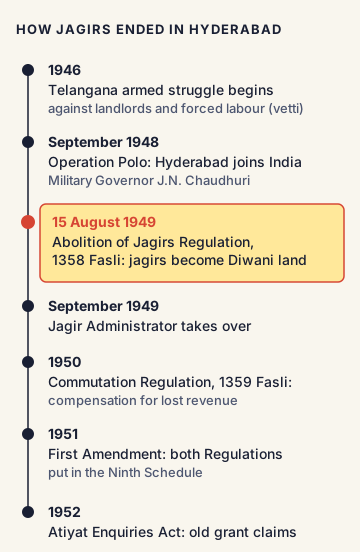
- The Hyderabad (Abolition of Jagirs) Regulation, 1358 Fasli came into force on 15 August 1949. All jagirs were merged into Diwani (government) land, and the jagirdars' rights ended.
- The government took over the administration of jagirs in September 1949, through an officer called the Jagir Administrator.
- The Hyderabad Jagirs (Commutation) Regulation, 1359 Fasli (1950) gave jagirdars commutation: a compensation amount paid in place of the lost revenue.
- The Hyderabad Atiyat Enquiries Act, 1952 set up a process to examine claims about old grants (atiyat) and decide who was entitled to what.
- Both Regulations were placed in the Ninth Schedule of the Constitution by the First Amendment (1951). Laws in this Schedule were shielded from being struck down for violating Fundamental Rights such as the right to property.
The Sarf-e-Khas lands were also merged with government land in 1949. "Fasli" refers to the Fasli calendar, a harvest-based revenue calendar used in Mughal and Deccan administration; 1358 Fasli corresponds roughly to 1948-49.
Why does this still matter today?
Abolition laws decide who owns huge areas of land, especially around fast-growing cities like Hyderabad, where land prices are very high. Many disputes arise because:
- Old record entries (pahanies, khasra registers) were changed later, sometimes through collusion with local revenue officials.
- Heirs of jagirdars or buyers from them claim ownership on the basis of the old grant.
- Courts must check whether any exception applied. For example, the 1949 Regulation let jagirdars keep their "home farms" and personal property, but the person claiming the exception must prove it.
Commonly confused concepts
- Jagirdar vs Zamindar: A jagirdar held a revenue grant from the ruler, often for service, and in the Mughal system it could be withdrawn or transferred. A zamindar (in British India, especially after Lord Cornwallis's Permanent Settlement of 1793 in Bengal) was treated as a hereditary landholder who paid a fixed revenue to the State and collected rent from cultivators.
- Jagir vs Inam: An inam was usually a revenue-free gift of land for religious, charitable or village service purposes (for a temple, a mosque, a village officer). A jagir was linked to service to the ruler, often military.
- Jagir vs Mansab: A mansab was a rank. A jagir was one way of paying the holder of that rank.
- Ryotwari vs Zamindari: Under the ryotwari system (introduced in Madras by Thomas Munro), the State collected revenue directly from the cultivator (ryot), with no middleman.
- Paigah vs Samsthan: Both existed in Hyderabad State. A Paigah was the military-linked estate of the Paigah nobles; samsthans were the territories of older local chiefs who paid tribute to the Nizam.
Issues, criticism and the way forward
- Land records are still messy: Decades after abolition, many records still carry old names. This invites fraud and long court cases. Digitising and cleaning records (as under the Digital India Land Records Modernisation Programme) is the main remedy.
- Long litigation: The Miyapur dispute went from land grabbing cases in 1994 to a High Court judgment in 2003 and a Supreme Court ruling only in 2026. Experts call for faster land tribunals and time limits.
- Use of recovered land: Once the State recovers such land, there is debate over whether to auction it to raise money, or keep it for public uses like housing, parks and institutions.
- Social justice angle: Abolition removed a feudal layer, but in many areas land still remained with the old elite through benami (proxy) holdings and record manipulation, a weakness also seen in other land reforms.
Concepts to Know
- Land revenue: The tax a ruler or government collects on farmland, usually a share of the crop or its value.
- Princely State: A territory in British India ruled by an Indian king who accepted British supremacy. Hyderabad was the largest such State.
- Vesting: When a law says land "vests" in the State, ownership automatically passes to the government from that date.
- Commutation: A one-time compensation paid to a jagirdar in place of the income he lost when his jagir was abolished.
- Revenue records (pahani, khasra): Village registers that note who holds and cultivates each piece of land. They are evidence of possession, but they do not by themselves create ownership.
- Adverse possession: A legal rule under which a person who openly occupies someone else's land for a long time (12 years for private land, 30 years against the government) may claim it. The claimant must prove it strictly.
- Ninth Schedule: A list in the Constitution, created in 1951, of laws protected from challenge for violating Fundamental Rights. Laws added after 24 April 1973 can still be reviewed for violating the basic structure.
- Jagir = right to collect land revenue, not ownership of land
- Mughal jagirs: non-hereditary and transferable; watan jagirs were the hereditary exception
- Asaf Jahi (Nizam) rule in Hyderabad: 1724 to 1948
- Hyderabad State land (about 53 million acres): Diwani/Khalsa about 60%, Jagir about 30%, Sarf-e-Khas about 10%
- Paigah founder: Abul Fateh Khan (title Shams-ul-Umra); three Paigahs: Asman Jahi, Khurshid Jahi, Viqar-ul-Umrai
- Operation Polo: September 1948; Military Governor: Major General J.N. Chaudhuri
- Hyderabad (Abolition of Jagirs) Regulation, 1358 Fasli: in force 15 August 1949
- Hyderabad Jagirs (Commutation) Regulation, 1359 Fasli (1950); Hyderabad Atiyat Enquiries Act, 1952
- Both Regulations placed in the Ninth Schedule by the First Amendment Act, 1951
- Telangana armed struggle: 1946 to 1951
● Tracked since November 07, 2026 · last seen November 07, 2026 · updates as the daily brief publishes