Integration of Princely States into India
When the British left in August 1947, India was not one neat country. About two-fifths of its land was made up of princely states: areas ruled by Indian kings (Maharajas, Nawabs, Nizams) who accepted British supremacy. There were more than 560 of them, from huge Hyderabad to tiny estates of a few villages. The integration of princely states is the story of how almost all of them joined the Indian Union within about two years, mostly peacefully, so that India became one political unit.
What was a princely state?
Under British rule, India had two kinds of territory. British India (the provinces like Bengal, Madras, Bombay) was ruled directly by the British. The princely states had their own rulers, who managed internal matters. But the British Crown controlled their defence and foreign relations. This British supremacy over the rulers was called paramountcy. You can think of it like a big landlord (the Crown) and many tenants (the rulers): the tenants ran their own houses, but the landlord had the final word.
Why was integration a problem in 1947?
The Indian Independence Act, 1947, passed by the British Parliament, said that British paramountcy would lapse on 15 August 1947 (Section 7). This meant the rulers were no longer tied to the Crown. In theory, each ruler could join India, join Pakistan, or try to stay independent. If many had chosen independence, India would have been broken into hundreds of pieces, with "islands" of foreign-controlled land inside it. This was a serious threat to unity, security and economic life (railways, posts and trade crossed these states).
Who did the work?
The Government of India set up a States Department in the summer of 1947 to deal with the rulers.
- Sardar Vallabhbhai Patel headed it as minister. He is often called the "Iron Man of India" for this work.
- V.P. Menon, a senior civil servant, was its Secretary. He drafted the key documents and did much of the negotiating.
- Lord Mountbatten, the last Viceroy, also urged the rulers to join one of the two dominions before 15 August 1947.
How did it work, step by step?
Integration happened in two stages.
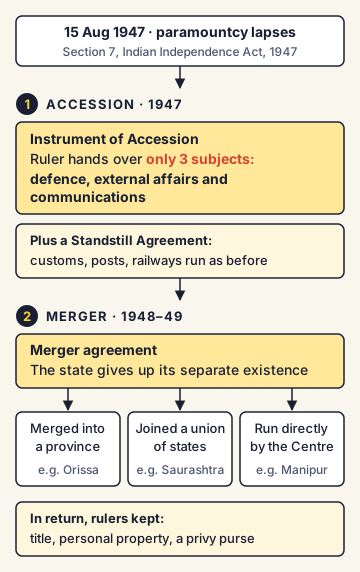
- Accession (joining): Each ruler signed an Instrument of Accession. By this document, the ruler handed over only three subjects to India: defence, external affairs and communications. Everything else stayed with the ruler for the time being. Rulers also signed a Standstill Agreement, which kept old arrangements (like customs, posts and railways) running as before until new ones were made.
- Merger and democratisation (becoming one): In 1948–49, the rulers were persuaded to sign merger agreements. Their states were either merged into neighbouring provinces (for example, Orissa and Chhattisgarh states merged into Orissa and the Central Provinces), or joined together into unions of states (like the Saurashtra union, the Rajasthan union and the Madhya Bharat union), or run directly by the Centre. In return, rulers kept their titles, personal property and a yearly allowance called a privy purse.
By 15 August 1947, almost all states had signed the Instrument of Accession. Three important cases remained.
The three difficult cases
- Junagadh (in present-day Gujarat): The Nawab announced accession to Pakistan in August 1947, though most of his people were Hindu and the state was surrounded by Indian territory. After public protests and the Nawab's flight, India took control. A plebiscite (a public vote on one question) was held on 20 February 1948, and the people voted overwhelmingly to join India.
- Jammu and Kashmir: Maharaja Hari Singh did not join either country at first. In October 1947, armed tribal raiders from Pakistan entered the state. The Maharaja asked India for help and signed the Instrument of Accession on 26 October 1947. Indian troops were flown to Srinagar the next day. This led to the first India-Pakistan war, and India took the issue to the United Nations in January 1948. Part of the state remains under Pakistan's illegal occupation (often called Pakistan-occupied Kashmir).
- Hyderabad: The Nizam, ruler of the largest and richest state, wanted to stay independent. India signed a Standstill Agreement with him in November 1947. But violence by an armed militia called the Razakars grew. In September 1948, India sent in the army in a short action called Operation Polo (officially a "police action"), which began on 13 September. The Nizam's forces surrendered within about four to five days, on 17 September 1948, and Hyderabad joined India.
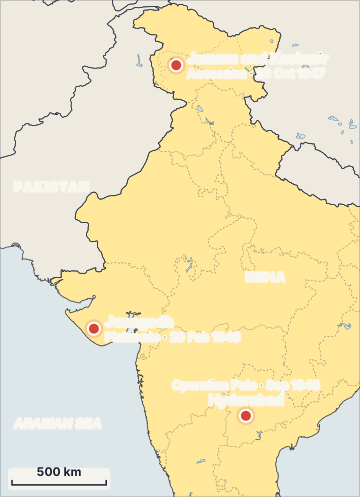
Two other cases are often asked: Manipur signed a merger agreement on 21 September 1949 and became a Centrally administered (Part C) state from 15 October 1949, and Tripura also merged in 1949.
How did the Constitution handle these areas?
When the Constitution came into force on 26 January 1950, it grouped the units into four types:
- Part A states: the former British provinces, run by an elected government and a Governor.
- Part B states: the former princely states or unions of states (like Hyderabad, Mysore, Saurashtra, Travancore-Cochin, Jammu and Kashmir). Each was headed by a Rajpramukh, usually a former ruler, instead of a Governor.
- Part C states: smaller units run by the Centre through a Chief Commissioner (like Delhi, Manipur, Tripura).
- Part D territory: the Andaman and Nicobar Islands.
This four-part system was ended in 1956 by the Seventh Amendment and the States Reorganisation Act, which created the simpler system of states and Union Territories we have today.
What about the French and Portuguese areas?
Integration was not only about princely states. Some coastal areas were still ruled by European powers.
- Pondicherry (French): handed over in practice (de facto) in 1954, legally (de jure) in 1962. The 14th Amendment, 1962 made it a Union Territory.
- Dadra and Nagar Haveli (Portuguese): freed by local people in 1954 and added to India by the 10th Amendment, 1961.
- Goa, Daman and Diu (Portuguese): taken by the Indian armed forces in December 1961 (Operation Vijay) and added by the 12th Amendment, 1962.
What happened to the privy purses?
The privy purses and the rulers' special privileges were promised in Articles 291 and 362 of the Constitution. In 1970, the President issued orders "derecognising" the rulers. In Madhav Rao Scindia v. Union of India (1970), the Supreme Court struck down these orders, because executive orders could not take away rights given by the Constitution.
Parliament then passed the 26th Amendment, 1971. It removed Articles 291 and 362, added Article 363A, ended the recognition of rulers and abolished privy purses. In Raghunathrao Ganpatrao v. Union of India (1993), the Supreme Court upheld this amendment.
India's position and legacy
Integration gave India the territorial unity on which its federal system stands. Patel's role is honoured through Rashtriya Ekta Diwas (National Unity Day) on 31 October, his birth anniversary, and the Statue of Unity in Gujarat. Some regions still carry the memory of how they joined, and this shapes debates today, especially in Jammu and Kashmir and parts of the North-East.
Commonly confused concepts
- Accession vs merger: Accession meant handing over only defence, external affairs and communications. Merger meant the state fully gave up its separate existence and joined a province or union.
- Instrument of Accession vs Standstill Agreement: The first transferred three subjects to India. The second only kept existing practical arrangements running until new ones were made.
- Junagadh vs Hyderabad vs Kashmir: Junagadh joined after a plebiscite (1948). Hyderabad joined after Operation Polo (September 1948). Kashmir joined by the Instrument of Accession signed on 26 October 1947.
- Rajpramukh vs Governor: A Rajpramukh headed a Part B state (usually a former ruler); a Governor heads a state today. The Rajpramukh post ended in 1956.
- Privy purse abolition: done by the 26th Amendment (1971), not the 24th or 42nd.
Issues, criticism and the way forward
- Use of pressure and force: Historians note that many rulers signed under heavy pressure, and Hyderabad and Junagadh needed military or police action. Supporters argue this was necessary to stop India from breaking apart.
- Unresolved legacy in Kashmir: The accession of Jammu and Kashmir led to a war and an international dispute that continues. India's position is that the accession was full, final and legal.
- Questions in the North-East: Some groups in Manipur and elsewhere question whether their mergers had popular consent. This has fed regional movements.
- Broken promises debate: Abolishing privy purses was criticised by some as breaking a solemn constitutional promise. Others saw these payments as out of place in a democratic republic built on equality.
- Way forward: Experts suggest that dealing with regional grievances through dialogue, development and respect for local identity (for example, through Article 371 provisions and the Sixth Schedule) helps complete integration in people's minds, not just on the map.
Concepts to Know
- Paramountcy: The British Crown's supreme power over Indian princely rulers, especially over their defence and foreign affairs.
- Dominion: A self-governing country that still formally kept the British monarch as head. India and Pakistan were dominions from 1947 until they adopted their own constitutions (India became a republic in 1950).
- Plebiscite: A direct vote of all the people of an area on a single question, such as which country to join.
- Privy purse: A fixed yearly payment from the government to a former ruler and his family, given in return for giving up his state.
- De facto and de jure: De facto means "in practice"; de jure means "by law". Pondicherry came under India in practice in 1954, but by law only in 1962.
- Number of princely states at independence: more than 560 (often given as about 562 or 565)
- Lapse of paramountcy: Section 7, Indian Independence Act, 1947, effective 15 August 1947
- States Department: Sardar Patel (minister), V.P. Menon (Secretary)
- Instrument of Accession subjects: defence, external affairs, communications
- Jammu and Kashmir Instrument of Accession: 26 October 1947
- Junagadh plebiscite: 20 February 1948
- Operation Polo (Hyderabad): began 13 September 1948; surrender 17 September 1948
- Manipur merger agreement: 21 September 1949
- 1950 classification: Part A, B (headed by Rajpramukh), C states and Part D territory
- Privy purses abolished: 26th Amendment Act, 1971 (Articles 291 and 362 omitted, Article 363A added); Madhav Rao Scindia case (1970) struck down the earlier presidential orders
- Goa: Operation Vijay, December 1961; 12th Amendment, 1962. Dadra and Nagar Haveli: 10th Amendment, 1961. Pondicherry: 14th Amendment, 1962
- National Unity Day: 31 October (Patel's birth anniversary)
● Tracked since November 01, 2026 · last seen November 07, 2026 · updates as the daily brief publishes