International Renewable Energy Agency (IRENA)
The International Renewable Energy Agency (IRENA) is an intergovernmental organisation that helps countries move to clean energy. It works on all types of renewable energy: solar, wind, hydropower, bioenergy, geothermal and ocean energy. IRENA does not build power plants or give large loans. Its job is to collect data, study costs and pathways, give policy advice and bring countries together. It is headquartered in Masdar City, Abu Dhabi, in the United Arab Emirates (UAE).
Why does IRENA exist?
For decades, the main global energy bodies focused on oil, gas and nuclear power. The International Energy Agency (IEA) was set up in 1974 for oil-importing rich countries, and the International Atomic Energy Agency (IAEA) deals with nuclear energy. There was no global body whose only focus was renewable energy. Countries that wanted to grow solar or wind power had no shared place to get reliable data, compare costs or learn from one another. IRENA was created to fill this gap.
Where did IRENA come from?
The idea was pushed for many years, especially by Germany. IRENA was formally founded at a conference in Bonn, Germany, on 26 January 2009, where 75 countries signed its founding treaty, called the Statute. The Statute entered into force on 8 July 2010, 30 days after the 25th country ratified it (ratify means to formally approve a treaty at home so it becomes binding).
Abu Dhabi was chosen as the interim headquarters in 2009 and later confirmed as the permanent seat. The UAE became the first developing country to host the headquarters of a major international organisation of this kind.
Who runs IRENA?
IRENA has three main bodies:
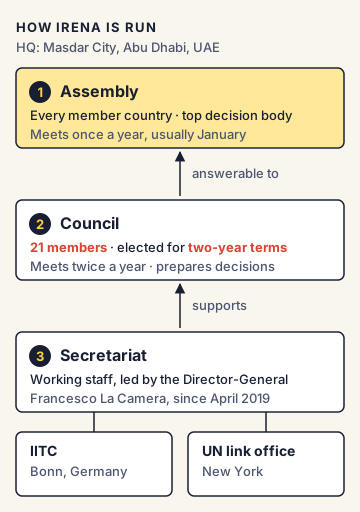
- The Assembly: the highest decision-making body. Every member country has a seat. It meets once a year, usually in January in Abu Dhabi.
- The Council: 21 member countries, elected for two-year terms. It meets twice a year, prepares decisions and is answerable to the Assembly.
- The Secretariat: the working staff, led by the Director-General. Francesco La Camera has been Director-General since 4 April 2019, and was re-elected for a second four-year term.
IRENA also has the IRENA Innovation and Technology Centre (IITC) in Bonn, Germany, and an office in New York that links it with the United Nations.
How big is it?
Membership is open to UN member states and to regional groupings of states, such as the European Union. As of January 2026, IRENA counted 171 members. In January 2026 the United States announced it would withdraw from IRENA. As of that month, IRENA said it had not yet received a formal notice of withdrawal.
What does IRENA actually do?
You can think of IRENA as the world's research centre and meeting place for renewable energy. Its main work includes:
- Data and statistics: it publishes yearly figures on how much renewable power capacity each country has installed (Renewable Capacity Statistics).
- Cost studies: its Renewable Power Generation Costs reports show how cheap solar and wind power have become compared with fossil fuel power.
- Pathways: its World Energy Transitions Outlook sets out a path for the global energy system that is in line with the 1.5°C goal of the Paris Agreement.
- Tracking global goals: it tracks progress on the COP28 promise to triple renewable capacity and double energy efficiency by 2030.
- Advice and projects: it helps member countries plan their energy transition and connects projects with possible investors.
IRENA and the tripling goal
At COP28 in Dubai (2023), countries agreed to work towards tripling global renewable energy capacity by 2030. IRENA works out what this means in numbers. Its tracking report released in September 2026 said:
- The world ended 2025 with about 5.15 TW (terawatts) of installed renewable power capacity.
- The tripling target means about 11.2 TW by 2030.
- A record 693 GW was added in 2025, and about three-quarters of it was solar power.
- About 1.2 TW must be added every year from 2026 to 2030 to reach the target.
India's position and Indian examples
India is a founding member of IRENA. India's ambassador signed the Statute on 17 March 2009, making India the 77th signatory. The Ministry of New and Renewable Energy (MNRE) is India's nodal ministry for IRENA. In January 2022, MNRE and IRENA signed a strategic partnership agreement to support India's energy transition, including green hydrogen and more renewable energy. India is also among the world's largest renewable energy markets, so IRENA's data on solar and wind costs is directly relevant to India's own targets.
Commonly confused concepts
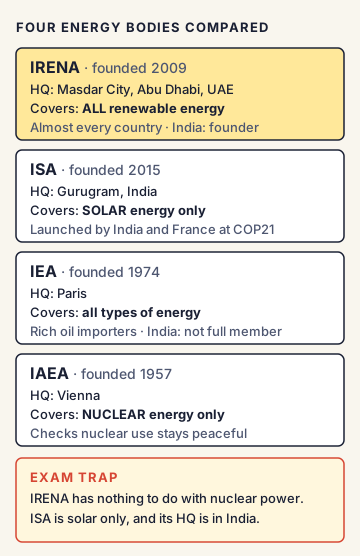
- IRENA vs IEA: IRENA (2009, Abu Dhabi) covers only renewable energy and is open to almost every country. The IEA (1974, Paris) was set up after the 1973 oil crisis, mainly for rich oil-importing countries in the OECD, and covers all types of energy. India is not a full member of the IEA; it is an association country.
- IRENA vs IAEA: The IAEA (1957, Vienna) deals with the peaceful use of nuclear energy and checks that nuclear material is not used for weapons. IRENA has nothing to do with nuclear power.
- IRENA vs International Solar Alliance (ISA): The ISA was launched by India and France at COP21 in Paris in 2015 and is headquartered in Gurugram, India. It focuses only on solar energy, mainly for countries that get a lot of sunshine. IRENA covers all renewables.
Issues, criticism and the way forward
- No power to enforce: IRENA can advise and track, but it cannot make any country meet a target. Goals like tripling renewables depend fully on national action.
- Uneven progress: most new capacity is being added in a few places, especially China. Many developing countries in Africa and elsewhere see little new investment because borrowing money is costly for them.
- Funding and politics: IRENA depends on contributions from members. A major member like the United States announcing withdrawal affects both funding and political weight.
- Way forward: experts point to cheaper finance for developing countries, stronger power grids, energy storage and faster permits as the main steps to turn IRENA's pathways into real projects.
Concepts to Know
- Intergovernmental organisation: a body formed by a treaty between governments, in which countries are the members. The UN, IAEA and IRENA are examples.
- Statute: the founding treaty of an organisation. It sets out the body's aims, members, structure and rules.
- Terawatt (TW) and gigawatt (GW): units of power capacity. 1 TW = 1,000 GW. 1 GW = 1,000 megawatts, roughly the size of one large power plant.
- Installed capacity: the maximum electricity that all power plants of a type can produce at one moment. It is not the same as the electricity actually produced, because solar and wind plants do not run at full power all the time.
- 1.5°C pathway: a plan for how fast the world must cut emissions so that global warming stays close to 1.5°C above pre-industrial (before about 1850) levels.
- Founded: 26 January 2009, Bonn, Germany (75 countries signed the Statute).
- Statute in force: 8 July 2010.
- Headquarters: Masdar City, Abu Dhabi, UAE; IITC in Bonn; office in New York.
- Bodies: Assembly (all members, yearly), Council (21 members, two-year terms), Secretariat (Director-General).
- Director-General: Francesco La Camera (since April 2019).
- Members: 171 (as of January 2026).
- India: founding member, signed on 17 March 2009 as the 77th signatory; nodal ministry MNRE; strategic partnership with IRENA in January 2022.
● Tracked since November 10, 2026 · last seen November 10, 2026 · updates as the daily brief publishes