Integrated Theatre Commands
India's Military Jointness Reform
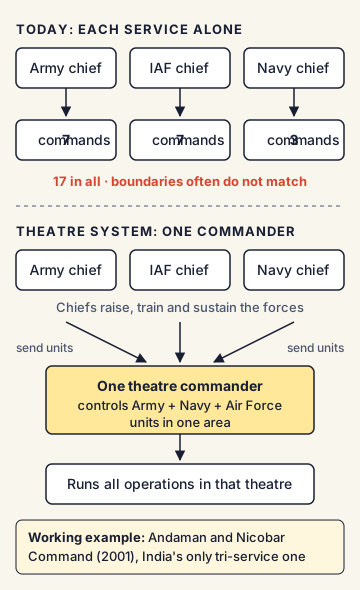
An integrated theatre command puts units of the Army, Navy and Air Force under one commander, who is responsible for all military operations in one geographical area (a "theatre") or for one task. Instead of three separate services each fighting their own part of a war, one commander plans and runs the whole fight with all the tools of all three services. Today, India mostly has single-service commands; a theatre command system would change this.
Why is it needed?
Modern wars are fought on land, sea, air, space and cyberspace at the same time. Picture a cricket team where the bowlers, fielders and wicket-keeper each take orders from different captains. Even good players would make mistakes. In the same way, if the Army, Navy and Air Force plan separately, they may waste resources, duplicate equipment or fail to support each other in time.
A single commander for each theatre can use the right weapon from any service at the right moment. This is called jointness (the three services working as one).
How are India's forces organised today?
India has 17 single-service commands: 7 of the Army, 7 of the Air Force and 3 of the Navy. Each has its own commander, headquarters and boundaries, and these boundaries often do not match. For example, one Army command may face areas looked after by two different Air Force commands. India also has two tri-service commands:
- Andaman and Nicobar Command (ANC), 2001: India's first and only tri-service geographical command, based in Port Blair. It guards the islands and watches the approaches to the Strait of Malacca.
- Strategic Forces Command (SFC), 2003: manages India's nuclear weapons delivery systems. It is a functional command (based on a task, not an area).
Where did the idea come from?
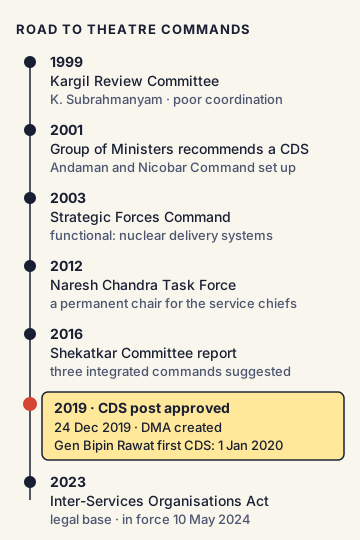
- Kargil Review Committee (1999): After the Kargil War, a committee headed by K. Subrahmanyam studied what went wrong. It submitted its report in January 2000 and pointed to poor coordination.
- Group of Ministers (2001): Building on that report, it recommended a Chief of Defence Staff (CDS). The ANC (2001) and SFC (2003) were set up in this period.
- Naresh Chandra Task Force (2012): recommended a permanent Chairman of the Chiefs of Staff Committee.
- Shekatkar Committee (set up in 2015, report in 2016): headed by Lt Gen D.B. Shekatkar (retd), it suggested three integrated commands: Northern (China), Western (Pakistan) and Southern (maritime).
- CDS created (2019): On 24 December 2019, the Cabinet Committee on Security approved the CDS post. The first CDS, General Bipin Rawat, took charge on 1 January 2020. A new Department of Military Affairs (DMA) was created in the Ministry of Defence, headed by the CDS. One of the CDS's main tasks is to bring jointness and restructure commands, including by setting up theatre commands.
- Inter-Services Organisations (Command, Control and Discipline) Act, 2023: got Presidential assent on 15 August 2023 and came into force on 10 May 2024. Its rules came into effect on 27 May 2025.
What does the 2023 Act do?
Earlier, each service had its own law: the Army Act, 1950, the Navy Act, 1957 and the Air Force Act, 1950. So an Army general heading a joint command could not directly discipline an airman or sailor under him. The 2023 Act gives the Commander-in-Chief or Officer-in-Command of an inter-services organisation full disciplinary and administrative powers over all personnel under them, from any service.
Existing bodies like the ANC, the Defence Space Agency and the National Defence Academy are treated as set up under this Act. It is a legal foundation for future theatre commands.
What is the proposed structure?
As of 2026, reports say the plan has taken shape around three theatre commands:
- Northern Theatre Command: focused on China, to be led by an Army officer
- Western Theatre Command: focused on Pakistan, to be led by an Air Force officer
- Maritime Theatre Command: focused on the Indian Ocean, to be led by a Navy officer
Reports also mention a four-star Vice Chief of Defence Staff. These details are reported plans, not a final government notification [Unverified].
How would it work?
In a theatre system, the service chiefs (Army, Navy, Air Force chiefs) would mainly "raise, train and sustain" their forces: recruit, equip and train them. The theatre commanders would actually use these forces in operations. This is the model used by the United States (since the 1980s) and China (whose People's Liberation Army set up five theatre commands in 2016).
Commonly confused concepts
- CDS vs Chairman, Chiefs of Staff Committee: The CDS is the Permanent Chairman of the Chiefs of Staff Committee. Earlier, the senior-most service chief held this post by rotation, often for a short time. The CDS also heads the Department of Military Affairs and is the principal military adviser to the Defence Minister. The CDS does not command troops in battle.
- Theatre command vs functional command: A theatre command covers an area (for example, the China border). A functional command covers a task across the whole country (for example, nuclear forces under the SFC, or a future air defence or logistics command).
- Joint command vs integrated command: In a joint arrangement, services cooperate but keep their own chains of command. In an integrated theatre, all units in the area answer to one commander.
- Andaman and Nicobar Command vs Strategic Forces Command: The ANC is geographical; the SFC is functional and handles nuclear delivery systems.
Issues, criticism and the way forward
- Air power concerns: The IAF has a limited number of fighter squadrons (29). Some IAF leaders have argued that splitting such a small fleet among many theatres would weaken it, because air power works best when it can be moved quickly wherever needed.
- Differences between services: The services have had different views on the number of theatres, who leads each one, and the role of service chiefs.
- Cost and disruption: New headquarters, communication networks and training will take money and time.
- Lessons from operations: The IAF chief has said that after Operation Sindoor the discussions have moved in a "slightly different direction" because of first-hand experience gained.
- Way forward: Experts suggest common communication networks, joint training and education, a phased roll-out, and clear rules on the roles of service chiefs and theatre commanders.
Concepts to Know
- Jointness: The Army, Navy and Air Force planning, training and fighting together as one team.
- Command: A large military formation, headed by a senior commander, responsible for an area or a task.
- Chiefs of Staff Committee: The forum where the heads of the three services meet to discuss common military issues.
- Department of Military Affairs (DMA): A department in the Ministry of Defence, created in 2019 and headed by the CDS, that deals with the armed forces' joint matters.
- Raise, train and sustain: Recruiting soldiers, training them and keeping them supplied with weapons, spares and equipment.
- 17 single-service commands today: Army 7, Air Force 7, Navy 3
- Andaman and Nicobar Command (2001): first tri-service theatre command; Strategic Forces Command (2003): functional
- Kargil Review Committee (1999, chaired by K. Subrahmanyam); GoM (2001) recommended a CDS; Naresh Chandra Task Force (2012); Shekatkar Committee recommended three integrated commands
- CDS post approved on 24 December 2019; Gen Bipin Rawat first CDS from 1 January 2020; CDS can serve up to age 65
- Inter-Services Organisations (Command, Control and Discipline) Act, 2023: assent 15 August 2023, in force 10 May 2024; rules effective 27 May 2025
- Reported plan: three theatres (Northern for China, Western for Pakistan, Maritime) [Unverified]
● Tracked since March 10, 2026 · last seen October 04, 2026 · updates as the daily brief publishes