Impact of Artificial Intelligence on Employment
Exposure, Complementarity and Substitution
Artificial intelligence (AI) is computer software that can do tasks that once needed human thinking, such as writing, translating, summarising, spotting patterns or answering questions. When AI can do some tasks of a job, economists say that job is "exposed" to AI. Exposure does not automatically mean the job will disappear. AI can either replace the worker (substitution) or help the worker do more and better work (complementarity), and which of these happens decides whether AI is good or bad news for workers.
Why does this debate matter?
Jobs are how most families earn. If a new technology removes jobs faster than new ones appear, incomes fall and inequality rises. If it makes workers more productive, wages can rise and new kinds of work can appear. India has one of the world's youngest and largest workforces, so getting this right matters more for India than for most countries. Governments need to know which workers are at risk so they can plan training, safety nets and education in time.
Where did the idea come from?
Fear of machines taking jobs is old:
- In early 19th-century England, workers called Luddites broke textile machines they believed were taking their work.
- Over the 20th century, tractors cut farm jobs and computers cut many clerical jobs, but new jobs appeared in factories, services and software.
- In 2013, Oxford researchers Carl Benedikt Frey and Michael Osborne studied 702 occupations in the United States. They estimated that about 47% of US employment was at high risk of computerisation. This study started the modern "robots will take our jobs" debate.
- After 2022, generative AI (AI that creates new text, images or code, like chatbots) changed the debate. Earlier machines mostly replaced routine manual work. Generative AI can also do routine thinking work, such as drafting letters or writing basic code, so office jobs are now exposed too.
How do economists measure exposure?
They do not study "jobs" as one block. They break each job into tasks. A bank clerk, for example, counts cash, enters data, talks to customers and checks documents. Then they ask: which of these tasks can AI do today? If many tasks can be done by AI, the job has high exposure. This is called the task-based approach. One well-known measure, by Edward Felten and co-authors, maps what AI can do onto the tasks of each occupation.
Complementarity vs substitution: the key idea
Two jobs can have the same exposure but very different futures:
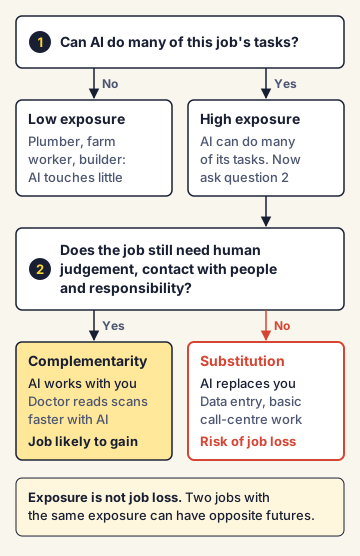
- High exposure, high complementarity: A doctor uses AI to read scans faster. AI does part of the task, but the doctor still makes the final decision, talks to the patient and takes responsibility. The doctor becomes more productive. Such jobs are likely to gain.
- High exposure, low complementarity: A data-entry operator or a basic call-centre worker does tasks that AI can do fully on its own. Such jobs face a real risk of being replaced.
- Low exposure: A plumber, a farm worker or a construction worker does physical work in changing places. AI touches little of it, at least for now.
In 2023, IMF economists (Carlo Pizzinelli and co-authors) built a "complementarity-adjusted" exposure measure. It asks how much a job also depends on human judgement, social contact, physical presence and responsibility. Their study covered India too. They found that once complementarity is counted, the gap in exposure between rich and poor countries becomes smaller.
What do the major global studies say?
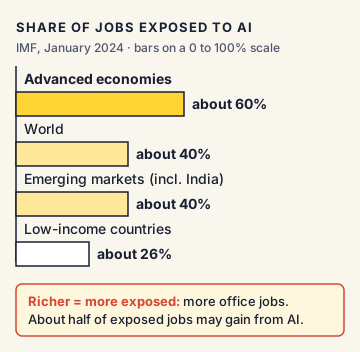
- IMF (January 2024): Almost 40% of global employment is exposed to AI. The share is about 60% in advanced economies, about 40% in emerging markets and about 26% in low-income countries. Roughly half of the exposed jobs may benefit from AI, while the other half may see lower demand for workers and lower wages.
- ILO and Poland's NASK (May 2025): About one in four jobs worldwide (25%) is potentially exposed to generative AI. Only 3.3% of global employment falls in the highest-exposure group. The ILO's main conclusion was that transformation of jobs is more likely than full replacement. Exposure is higher in rich countries (about 34% of jobs) than in low-income countries (about 11%).
- Women are more exposed: In high-income countries, jobs in the highest-exposure group make up about 9.6% of female employment against 3.5% of male employment, because clerical and customer-facing jobs (more often held by women) are highly exposed.
- World Economic Forum, Future of Jobs Report 2025: Employers expect about 170 million new jobs to be created and 92 million to be displaced by 2030, a net gain of about 78 million jobs worldwide.
India's position and Indian examples
India's workforce is very different from that of rich countries:
- A large share of workers are in agriculture, construction and small informal businesses. These are low-exposure jobs, so India's overall exposure is lower than that of the US or Europe.
- But India also has a large IT services, business process outsourcing (BPO) and Global Capability Centre (GCC) sector. Many entry-level tasks there, such as basic coding, testing and customer support, are highly exposed.
- The Economic Survey 2024-25 had a full chapter titled "Labour in the AI Era: Crisis or Catalyst?" It argued that India's large size and relatively low income per person make the challenge bigger. It also said that early hurdles to AI use (reliability, cost, infrastructure gaps) give policymakers a window of time to prepare workers.
- Government responses include the IndiaAI Mission (approved March 2024), whose FutureSkills pillar builds AI talent, and skilling programmes under the Skill India Mission.
Commonly confused concepts
- Exposure vs job loss: Exposure means AI can do some tasks. It does not mean the job will be lost. Exposed jobs may grow if AI complements them.
- Automation vs AI: Automation is any machine doing work humans did, such as a car-assembly robot. AI is a type of automation that does thinking tasks. Old automation hit factory and manual jobs. Generative AI hits office and knowledge jobs.
- Substitution vs complementarity: Substitution means AI does the task instead of the worker. Complementarity means AI does the task with the worker, making the worker more productive.
- Displacement vs net job change: A study may say "92 million jobs displaced" and still find a net gain if more new jobs are created. Always check whether a number is gross or net.
- Generative AI vs Artificial General Intelligence (AGI): Generative AI creates text or images and is available today. AGI is a hypothetical future AI that could do any intellectual task a human can.
Issues, criticism and the way forward
- Uncertain estimates: Exposure studies measure what AI could do, not what firms will do. Adoption depends on cost, laws, trust and infrastructure, so real effects may be smaller or slower. The Economic Survey 2024-25 itself warned that estimates may be higher than what actually happens.
- Missing first rung: If AI does the routine work that freshers used to do, young graduates may find it harder to get their first job and learn on the job.
- Inequality: Gains may go to highly skilled, urban, English-speaking workers and to firms that own AI, while routine workers lose. Women in clerical work may be hit harder.
- Informal workers: Most Indian workers have no unemployment insurance. A job loss can push a family into poverty quickly.
- Way forward suggested by experts and official reports: strong school-level basics (reading, maths), continuous reskilling and upskilling, especially for young and mid-career workers; incentives for firms to use AI that helps workers rather than replaces them; better and more frequent labour data to track changes; and social protection (such as coverage under the Code on Social Security, 2020) for workers who are displaced.
Concepts to Know
- Generative AI: AI that creates new content (text, images, music, code) after learning from huge amounts of data. Chatbots are the best-known example.
- Occupation vs task: An occupation is the job title (say, accountant). Tasks are the separate pieces of work inside it (making entries, checking bills, advising clients).
- Global Capability Centre (GCC): An office set up in India by a foreign company to do its own technology, research or business work, instead of hiring an outside firm.
- Informal sector: Work without a written contract, fixed salary, provident fund or legal job protection, such as street vendors or daily-wage labourers.
- Reskilling and upskilling: Reskilling means learning new skills for a different job. Upskilling means learning advanced skills for the same job.
- White paper: A detailed official or expert document that studies a problem and suggests policy options.
- Frey and Osborne (2013): about 47% of US employment at high risk of computerisation; 702 occupations studied
- IMF Staff Discussion Note (January 2024): about 40% of global jobs exposed; about 60% in advanced economies, 40% in emerging markets, 26% in low-income countries
- IMF Working Paper 23/216 (2023, Pizzinelli et al.): complementarity-adjusted exposure; covered India among other countries
- ILO-NASK index (May 2025): 1 in 4 jobs exposed to generative AI; 3.3% in the highest-exposure group; transformation more likely than replacement
- WEF Future of Jobs Report 2025: 170 million jobs created, 92 million displaced, net +78 million by 2030
- Economic Survey 2024-25, Chapter 13: "Labour in the AI Era: Crisis or Catalyst?"
● Tracked since October 11, 2026 · last seen October 11, 2026 · updates as the daily brief publishes