High Courts in India
Constitution, Composition and Jurisdiction
A High Court is the highest court in a state. It sits above all the district and lower courts of that state, and below only the Supreme Court of India. It hears appeals from lower courts, protects people's Fundamental Rights and other legal rights through writs, and supervises every court and tribunal in its area. India has 25 High Courts, and their powers come mainly from Articles 214 to 231 of the Constitution (Part VI, Chapter V).
Why do states need High Courts?
India is a very large country with crores of court cases. The Supreme Court in Delhi cannot hear every dispute. So the Constitution gives each state its own top court. Think of it like a school system: the district court is the class teacher, the High Court is the principal of one school, and the Supreme Court is the board for the whole country. Most problems get solved at the school level, and only the biggest ones go to the board.
Where did High Courts come from?
High Courts are older than the Constitution. The British Parliament passed the Indian High Courts Act, 1861. Under it, the first High Courts were set up in 1862 at Calcutta, Bombay and Madras, the three "Presidency towns". More High Courts followed over time. When the Constitution came into force in 1950, it kept these courts and gave them a firm constitutional base.
New High Courts have been created as new states were formed. The newest are the Telangana and Andhra Pradesh High Courts, both in 2019, which took the total to 25. The Delhi High Court was set up on 31 October 1966 under the Delhi High Court Act, 1966, with four judges. Before that, the Punjab High Court served Delhi.
What do the main Articles say?
- Article 214: There shall be a High Court for each state.
- Article 231: Parliament can, by law, set up one common High Court for two or more states, or for states and Union Territories. Examples: the Gauhati High Court serves Assam, Nagaland, Mizoram and Arunachal Pradesh; the Bombay High Court serves Maharashtra, Goa, and Dadra and Nagar Haveli and Daman and Diu; the Punjab and Haryana High Court serves Punjab, Haryana and Chandigarh.
- Article 215: Every High Court is a court of record. This means its judgments are kept as permanent records that other courts follow, and it has the power to punish for contempt of itself.
- Article 216: Each High Court has a Chief Justice and other judges. The President decides the number of judges. The Constitution does not fix it.
- Article 217: How judges are appointed, who can become one, how long they serve and how they are removed (explained below).
- Article 222: The President can transfer a judge from one High Court to another, after consulting the CJI.
- Article 223: An acting Chief Justice can be appointed when the post is vacant.
- Article 224: Additional judges (for a temporary rise in work) and acting judges, for up to two years.
- Article 224A: A retired judge can be asked to sit again as a judge (often called an ad hoc judge).
- Article 226: The power to issue writs (explained below).
- Article 227: The power of superintendence over all courts and tribunals in its area.
- Article 230: Parliament can extend a High Court's jurisdiction to a Union Territory, or exclude it.
How is a High Court judge appointed?
Under Article 217, the President appoints High Court judges after consulting the CJI, the Governor of the state and, for judges other than the Chief Justice, the Chief Justice of that High Court. In practice, the choice is driven by the collegium system. This system came from Supreme Court judgments, mainly the Second Judges Case (1993) and the Third Judges Case (1998).
For High Court appointments, the Supreme Court collegium is the CJI and the two senior-most Supreme Court judges. In 2015, the Supreme Court struck down the 99th Constitutional Amendment and the National Judicial Appointments Commission (NJAC), so the collegium system continues.
Who can become a judge, and for how long?
- The person must be a citizen of India, and must have either held a judicial office in India for 10 years or been an advocate of a High Court for 10 years.
- A High Court judge serves until the age of 62. The age was raised from 60 to 62 by the Constitution (Fifteenth Amendment) Act, 1963.
- A judge can resign by writing to the President.
How is a judge removed?
A High Court judge can be removed only in the same way as a Supreme Court judge, under Article 124(4), as Article 217(1)(b) says. The grounds are only "proved misbehaviour or incapacity". Each House of Parliament must pass the motion by a special majority: a majority of the total membership of the House, and two-thirds of the members present and voting.
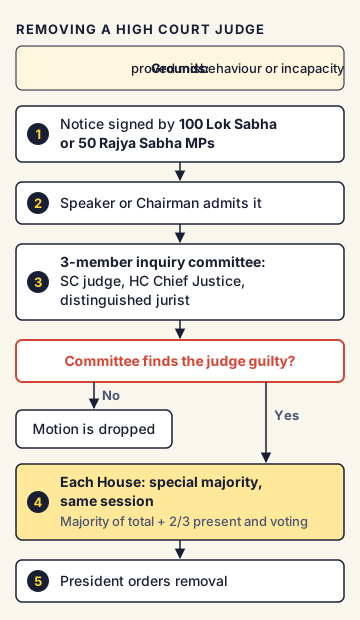
A simple example: in a House of 500 members, if 400 are present, the motion needs at least 267 votes (two-thirds of 400) and also at least 251 votes (more than half of 500). So it needs 267. The detailed procedure, including an inquiry committee of three, is in the Judges (Inquiry) Act, 1968. No High Court judge has been removed this way so far.
What kinds of cases does a High Court hear?
A High Court has several types of powers, called jurisdiction:
- Original jurisdiction: cases that start directly in the High Court. Examples are election petitions for Parliament and state legislature seats, and writ cases. A few High Courts also have ordinary original civil jurisdiction: they can hear large civil suits directly. These five are Delhi, Bombay, Calcutta, Madras and Himachal Pradesh. In Delhi, since 26 October 2015, civil suits worth more than ₹2 crore go straight to the High Court, after the Delhi High Court (Amendment) Act, 2015 raised the limit from ₹20 lakh.
- Appellate jurisdiction: hearing appeals against decisions of district and sessions courts, in both civil and criminal cases. A death sentence given by a sessions court must be confirmed by the High Court before it can be carried out.
- Writ jurisdiction (Article 226): a High Court can issue the five writs: habeas corpus, mandamus, prohibition, certiorari and quo warranto. It can do this for Fundamental Rights and "for any other purpose", meaning other legal rights too. So in this one way, its writ power is wider than the Supreme Court's under Article 32.
- Supervisory jurisdiction (Article 227): it watches over all courts and tribunals in its area (except military tribunals) and can correct them.
- Control over lower courts: Under Articles 233 to 237, the High Court is consulted when district judges are appointed, and it controls postings and promotions in the lower judiciary. Under Article 228, it can take over a case from a lower court if it involves a big question about the meaning of the Constitution.
- Judicial review: it can strike down a central or state law, or a government order, that goes against the Constitution.
The Delhi High Court as an example
The Delhi High Court is special in a few ways. Delhi is a Union Territory, yet it has its own High Court. Because the Union government sits in Delhi, many big cases on government power reach it. It set up the Delhi International Arbitration Centre in 2009, the first arbitration centre attached to a High Court in India.
When the Tribunals Reforms Act, 2021 abolished the Intellectual Property Appellate Board (IPAB), the Delhi High Court created an Intellectual Property Division in July 2021 to hear patent, trademark and copyright cases. Under the Commercial Courts Act, 2015, High Courts with ordinary original civil jurisdiction have a Commercial Division for big business disputes.
Commonly confused concepts
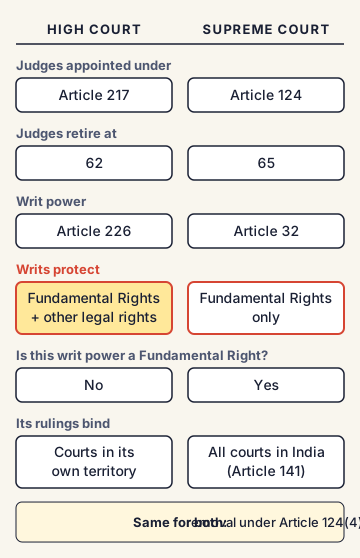
- High Court vs Supreme Court judges: HC judges retire at 62, SC judges at 65. HC judges are appointed under Article 217, SC judges under Article 124. Both are removed by the same process under Article 124(4).
- Article 226 vs Article 32: Article 32 is itself a Fundamental Right and covers only Fundamental Rights. Article 226 is not a Fundamental Right, but it covers Fundamental Rights and other legal rights, so it is wider in scope.
- Article 226 vs Article 227: Article 226 lets the High Court issue writs to any person or authority, including the government. Article 227 is about supervising courts and tribunals below it.
- Additional judge vs acting judge vs ad hoc (retired) judge: an additional judge (Art 224(1)) is added for extra work, for up to two years; an acting judge (Art 224(2)) fills in when a permanent judge is away; a retired judge sits again under Art 224A.
- Supreme Court judgments vs High Court judgments: under Article 141, the law declared by the Supreme Court binds all courts in India. A High Court's ruling binds only the courts within its own territory.
- Principal seat vs bench: the principal seat is the High Court's main location (for example, Chennai for the Madras High Court); a bench is another place where it sits (for example, Madurai).
Issues, criticism and the way forward
- Huge backlog: As of July 2026, about 64.67 lakh cases were pending in High Courts, according to data placed in Parliament. Some cases have been pending for over 30 years.
- Vacancies: High Courts have a sanctioned strength of 1,122 judges, but a large share of posts stay empty at any time. Fewer judges means slower justice.
- Collegium concerns: Critics say the collegium system is not transparent and gives the government little formal role. Supporters say it protects the independence of the judiciary. The Memorandum of Procedure, which sets out the steps for appointments, has long been under discussion between the government and the judiciary.
- Ad hoc judges: In Lok Prahari v. Union of India (2021), the Supreme Court revived the rarely used Article 224A to help clear backlogs, but said ad hoc judges cannot replace regular appointments.
- New technology questions: Issues like AI, data and deepfakes often reach High Courts before Parliament has made clear laws. Courts then have to rely on constitutional values such as Article 14 (equality) and Article 21 (life and personal liberty).
- Way forward: Experts suggest filling vacancies on time, more use of digital courts and e-filing, specialised divisions (like commercial and IP divisions), and better case management to cut delays.
Concepts to Know
- Jurisdiction: The area of power of a court: which cases it can hear and where. A court can hear only the cases that fall within its jurisdiction.
- Writ: A formal written order of a court telling a person or authority to do, or stop doing, something. Habeas corpus (produce a detained person), mandamus (do your public duty), prohibition (a lower court must stop hearing a case beyond its power), certiorari (a higher court cancels a lower court's order) and quo warranto (by what right do you hold this public office?).
- Court of record: A court whose judgments are kept as permanent proof and used as examples (precedents) by other courts. Such a court can also punish people for contempt.
- Contempt of court: Disobeying a court's order, or acting in a way that disrespects the court and harms the justice system.
- Arbitration: A way to settle a dispute outside regular court. Both sides choose a neutral person (the arbitrator), and that person's decision is binding on them. It is usually faster than a court case.
- Collegium: A small group of the senior-most Supreme Court judges, led by the CJI, that recommends names for appointing and transferring judges.
- Pecuniary jurisdiction: The money limit of a court. For example, a court may hear only suits worth more than a certain amount.
- Articles 214–231 (Part VI, Chapter V) deal with High Courts; Article 214: a High Court for each state; Article 231: common High Court for two or more states
- 25 High Courts in India; newest: Telangana and Andhra Pradesh (2019)
- First High Courts: Calcutta, Bombay, Madras (1862), under the Indian High Courts Act, 1861
- Appointment: Article 217, by the President after consulting the CJI, the Governor and the HC Chief Justice
- Qualification: Indian citizen + 10 years judicial office or 10 years as HC advocate
- Retirement age 62; raised from 60 by the 15th Amendment Act, 1963
- Removal: Article 217(1)(b) read with Article 124(4); special majority in both Houses; Judges (Inquiry) Act, 1968
- Article 215: court of record; Article 216: President fixes number of judges; Article 222: transfer; Article 224: additional/acting judges (up to 2 years); Article 224A: retired judges
- Article 226: writs for Fundamental Rights "and for any other purpose"; Article 227: superintendence over courts and tribunals
- Ordinary original civil jurisdiction: Delhi, Bombay, Calcutta, Madras, Himachal Pradesh
- Delhi High Court: set up 31 October 1966 (Delhi High Court Act, 1966) with 4 judges; pecuniary limit ₹2 crore since 26 October 2015
- Delhi International Arbitration Centre: 2009, first High Court-annexed arbitration centre; Delhi HC IP Division: July 2021, after IPAB was abolished (Tribunals Reforms Act, 2021)
- NJAC and the 99th Amendment struck down in 2015; collegium continues
- High Court pendency: about 64.67 lakh cases (July 2026); sanctioned strength 1,122 judges
● Tracked since October 30, 2026 · last seen October 30, 2026 · updates as the daily brief publishes