Copyright Act, 1957
Protecting Creative Work in India
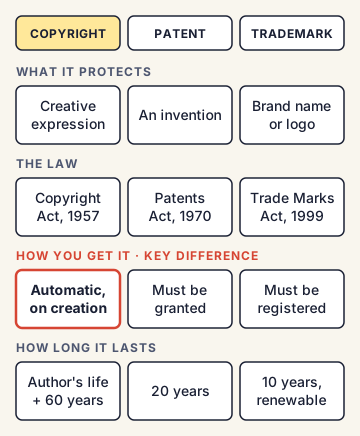
Copyright is a legal right that protects original creative work, such as a book, a song, a painting, a film, a photograph or computer software. It gives the creator the right to decide who can copy, sell, perform or adapt that work, usually for a fixed number of years. In India, copyright is governed by the Copyright Act, 1957. Copyright comes into being automatically the moment an original work is created and fixed in some form; registration is useful as proof but is not compulsory.
Why does copyright exist?
Imagine you spend two years writing a book. The day it is published, anyone can photocopy it and sell it cheaply. You earn nothing, so you stop writing. Copyright stops this. It gives creators a way to earn from their work, which encourages more books, music, films and software. At the same time, copyright does not last forever. After it ends, the work becomes free for everyone, so society also benefits.
Where did India's copyright law come from?
Before independence, India followed the Indian Copyright Act, 1914, which was based on the British Copyright Act of 1911. India joined the Berne Convention, the main international treaty on copyright, in 1928, during British rule. After independence, Parliament passed the Copyright Act, 1957, which came into force on 21 January 1958. It has been amended several times, in 1983, 1984, 1992, 1994, 1999 and 2012.
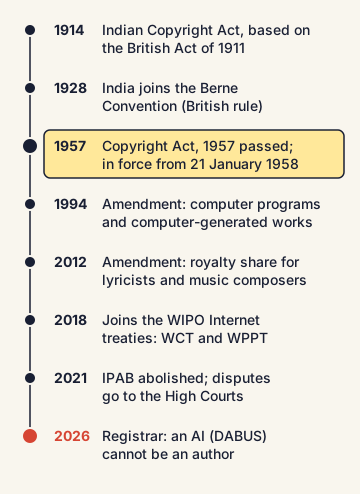
The 1994 amendment added rules on computer programs and computer-generated works. The 2012 amendment gave lyricists and music composers a share in royalties from films, added an exception for persons with disabilities, and brought in rules against breaking digital locks. In 2018, India joined the two WIPO "Internet treaties": the WIPO Copyright Treaty and the WIPO Performances and Phonograms Treaty.
What does copyright protect?
Under Section 13, copyright exists in:
- Original literary works (books, articles, and also computer programs, which the Act treats as literary works)
- Original dramatic works (plays, scripts)
- Original musical works (the music itself)
- Original artistic works (paintings, drawings, sculptures, photographs, architecture)
- Cinematograph films
- Sound recordings
Two basic rules decide what is protected. First, copyright protects the expression of an idea, not the idea itself. The Supreme Court made this clear in R.G. Anand v. Delux Films (1978): two works can share the same theme, but copying the actual way it is expressed is what counts. Second, the work must be original.
In Eastern Book Company v. D.B. Modak (2008), the Supreme Court said that hard work alone ("sweat of the brow") is not enough. The work needs at least a "modicum of creativity", meaning a small amount of creative skill and judgement.
Who is the author, and what rights do they get?
Section 2(d) defines the "author". For a book, it is the writer; for music, the composer; for a photograph, the photographer. For a computer-generated literary, dramatic, musical or artistic work, Section 2(d)(vi) says the author is "the person who causes the work to be created". This clause was added in 1994. The owner gets two kinds of rights:
- Economic rights (Section 14): the right to copy, publish, translate, adapt, perform and communicate the work to the public, and to earn money by licensing these rights.
- Moral rights (Section 57): the right to be named as the author, and to object to changes that harm the author's honour or reputation. These stay with the author even after the economic rights are sold.
How long does copyright last?
For literary, dramatic, musical and artistic works, copyright lasts for the author's lifetime plus 60 years (Section 22). The 60 years count from the start of the calendar year after the author's death. For films and sound recordings, it lasts 60 years from the year of publication. After that, the work enters the public domain, and anyone may use it.
How is copyright enforced?
- Infringement (Section 51): using a copyrighted work without permission in a way only the owner may use it.
- Exceptions (Section 52): some uses are allowed without permission. The best known is fair dealing for private use and research, criticism or review, and reporting current events. There are also exceptions for teaching and for persons with disabilities.
- Civil remedies: the owner can go to court for an injunction (an order to stop), damages and accounts of profits.
- Criminal punishment (Section 63): knowingly infringing copyright can lead to jail of six months to three years and a fine of ₹50,000 to ₹2 lakh. In 2022, the Supreme Court held in Knit Pro International v. State of NCT of Delhi that this offence is cognizable and non-bailable.
- Who decides disputes: the old Copyright Board was merged into the IPAB in 2017. When the IPAB was abolished in 2021, its work went to the High Courts and commercial courts.
- Who runs the system: the Copyright Office, headed by the Registrar of Copyrights. Since 2016, it works under the Department for Promotion of Industry and Internal Trade (DPIIT), Ministry of Commerce and Industry. Earlier it was under the education ministry.
The new challenge: Artificial Intelligence
AI raises two big copyright questions.
- Training (the input side): AI models learn by reading huge amounts of text, images and music, much of it copyrighted. Is that copying allowed? In ANI v. OpenAI, a single judge of the Delhi High Court on 24 July 2026 refused to grant ANI an interim injunction against the use of its news content to train ChatGPT. The judge took a prima facie view (a first look, not a final verdict) that it was fair dealing under Section 52(1)(a). ANI has appealed, and the main case is still pending. Separately, a DPIIT committee released a working paper on 8 December 2025 proposing a hybrid model: a mandatory blanket licence that lets AI developers train on lawfully accessed works, with a legal right for creators to be paid royalties once the AI is used commercially. It proposed a central collecting body for these royalties. This is a proposal, not law.
- Authorship (the output side): Can an AI be the "author" of what it makes? In an order dated 31 August 2026, the Registrar of Copyrights refused to record the AI system DABUS as the author of an artwork. The Office accepted that the work was original, but held that DABUS is neither a natural person nor a legal person, so it cannot be an author under Section 2(d)(vi). It said giving AI legal personhood is a matter for Parliament.
Commonly confused concepts
- Copyright vs Patent vs Trademark: copyright protects creative expression (automatic, life + 60 years); a patent protects an invention (must be granted under the Patents Act, 1970, usually for 20 years); a trademark protects a brand name or logo (Trade Marks Act, 1999, 10 years, renewable again and again).
- Copyright vs Geographical Indication (GI): a GI (like Darjeeling Tea) protects a product's link to a place, under the GI Act, 1999. It belongs to a community of producers, not one creator.
- Fair dealing (India) vs fair use (USA): India's fair dealing allows only uses listed in Section 52. The US "fair use" is an open test that judges apply case by case, so it is more flexible.
- Idea vs expression: the plot idea of "two lovers from enemy families" is free for all; the exact script of a film on it is protected.
- Registration vs protection: registration under the Act is optional proof of ownership; protection exists even without it.
Issues, criticism and the way forward
- AI training and fair pay: Creators and news publishers say AI firms use their work without paying. AI developers say strict rules would slow innovation. The DPIIT hybrid model is one attempt to balance both, but it is still under discussion.
- AI authorship gap: Section 2(d)(vi) was written in 1994 for computer-aided work, when humans clearly directed the machine. It is unclear who "causes" a work when an AI produces it from a short prompt. Courts and the Copyright Office have so far insisted on a human author.
- Access to knowledge: In the Delhi University photocopy case (Rameshwari Photocopy, 2016), the Delhi High Court favoured students' access to course packs. This showed the tension between copyright and education in a developing country.
- Piracy: Online piracy of films, music and books causes large losses. Courts now often issue "dynamic injunctions" that block mirror websites.
- Way forward: Experts suggest clearer law on AI training and outputs, faster dispute resolution in specialised IP divisions, and stronger copyright societies so that creators actually receive royalties.
Concepts to Know
- Public domain: Works that are no longer protected by copyright (or never were). Anyone can use them freely, for example the original works of Kalidasa.
- Royalty: A payment made to the owner for each use or sale of their work, like a small fee a radio station pays each time it plays a song.
- Licence: Permission given by the copyright owner to someone else to use the work, usually in return for money.
- Injunction: A court order telling a person to stop doing something, for example to stop selling pirated copies.
- Prima facie: "At first look". A prima facie view is a court's early opinion before a full trial, not its final decision.
- Cognizable and non-bailable offence: Cognizable means the police can register a case and arrest without a court warrant. Non-bailable means bail is not a right; the court decides whether to give it.
- WIPO: The World Intellectual Property Organization, a UN agency based in Geneva that manages international treaties on copyright, patents and trademarks.
- Copyright Act, 1957; in force from 21 January 1958; replaced the Indian Copyright Act, 1914
- Amendments: 1983, 1984, 1992, 1994, 1999, 2012
- Section 13: works protected (literary, dramatic, musical, artistic, films, sound recordings); computer programs = literary works
- Section 2(d)(vi): author of a computer-generated work = "the person who causes the work to be created" (added 1994)
- Section 14: economic rights; Section 57: moral rights
- Section 22: term = author's life + 60 years; films and sound recordings: 60 years from publication
- Section 51: infringement; Section 52: fair dealing and other exceptions
- Section 63: 6 months to 3 years jail, ₹50,000 to ₹2 lakh fine; cognizable and non-bailable (Knit Pro, 2022)
- Copyright Board merged into IPAB (2017); IPAB abolished by Tribunals Reforms Act, 2021
- Copyright Office under DPIIT since 2016
- India joined Berne Convention in 1928; joined WIPO Copyright Treaty and WPPT in 2018
- R.G. Anand v. Delux Films (1978): idea vs expression; Eastern Book Co. v. D.B. Modak (2008): "modicum of creativity"
- DPIIT working paper (8 December 2025): hybrid model, mandatory blanket licence with statutory royalties for AI training
- ANI v. OpenAI: Delhi HC denied interim injunction on 24 July 2026 (prima facie fair dealing); appeal pending
- DABUS order of the Registrar of Copyrights: 31 August 2026, AI cannot be an author
● Tracked since October 30, 2026 · last seen October 30, 2026 · updates as the daily brief publishes