Graphics Processing Unit (GPU)
The Engine of AI Computing
A Graphics Processing Unit, or GPU, is a computer chip that can do thousands of small calculations at the same time. It was first built to draw images and video games on a screen quickly. Today it is the main chip used to build and run artificial intelligence (AI) systems like chatbots. Whoever has more GPUs can build bigger and better AI, so GPUs have become a matter of national strategy, not just technology.
Why does AI need GPUs?
Every computer has a CPU (Central Processing Unit), its general "brain". A CPU has a small number of very powerful cores (workers) that do tasks one after another, very fast. A GPU has thousands of smaller, simpler cores that all work at once. This is called parallel processing.
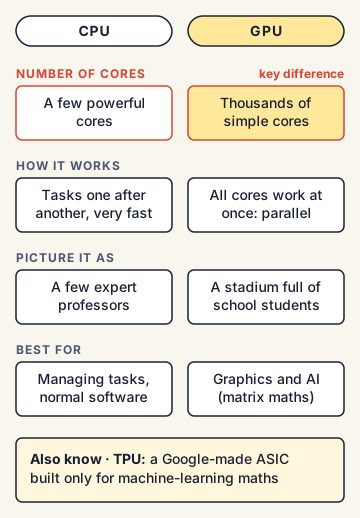
You can picture it like this. A CPU is like a few expert professors solving hard problems one by one. A GPU is like a stadium full of school students, each solving one easy sum at the same time. Training an AI model means doing billions of simple multiplications on large tables of numbers (called matrices). The "stadium of students" finishes this kind of work far faster than a few professors.
Where did GPUs come from?
- In the 1990s, video games needed to draw millions of tiny dots (pixels) on screen many times a second. Special graphics chips were made to handle this.
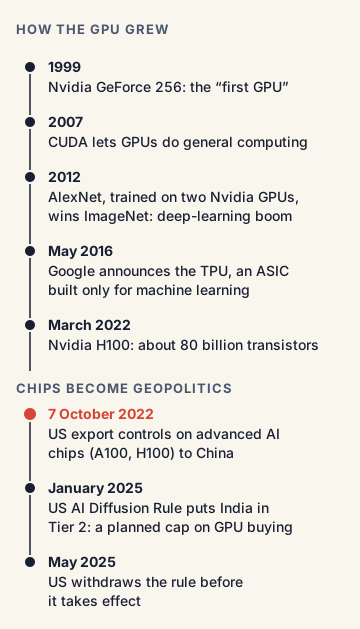
- In October 1999, the US company Nvidia launched the GeForce 256 and called it the world's "first GPU". It took over 3D graphics work that the CPU used to do.
- In 2007, Nvidia released CUDA, a software platform that let programmers use GPUs for general calculations, not just graphics. Scientists started using GPUs for weather models, physics and medicine.
- In 2012, an AI model called AlexNet won a famous image-recognition contest (ImageNet). It was trained on just two Nvidia gaming GPUs (GTX 580). This showed the world that GPUs could make AI "deep learning" practical, and the modern AI boom began.
- Since then, GPUs have been redesigned mainly for AI. Nvidia's H100 chip, revealed in March 2022, has about 80 billion transistors (tiny electronic switches) and 80 GB of very fast memory.
How is AI built on GPUs, step by step?
- Training: The AI model reads huge amounts of text, images or audio. Thousands of GPUs, linked together in a data centre, adjust billions of internal numbers (called parameters) until the model gets good at its task. This can take weeks and uses enormous electricity.
- Inference: Once trained, the model is used to answer questions or produce content. Each answer also needs GPU work, but much less than training.
- Measuring the work: Computing work is counted in FLOPs (floating-point operations, basically single calculations with decimal numbers). Big AI models need trillions of trillions of FLOPs to train.
Other AI chips you should know
- TPU (Tensor Processing Unit): A chip designed by Google only for machine learning. Google announced it in May 2016 (it had been using it inside its data centres since 2015) and opened it to cloud customers in 2018. A TPU is an ASIC (Application-Specific Integrated Circuit), a chip built for one kind of job.
- NPU (Neural Processing Unit): A small AI chip inside phones and laptops that runs AI features on the device itself.
- CPU: Still needed in every system, to manage tasks and run normal software.
Why GPUs have become geopolitical
- Most advanced AI chips are designed by a few US companies, Nvidia being the most dominant. Most are manufactured by TSMC in Taiwan.
- On 7 October 2022, the United States put export controls on advanced AI chips (like the A100 and H100) going to China. These rules were tightened again in 2023.
- In January 2025, the US issued an "AI Diffusion Rule" that sorted countries into three tiers for buying AI chips. India was placed in Tier 2, which would have capped how many advanced GPUs it could buy. The US withdrew this rule in May 2025, before it took effect.
- This history shows why countries talk of "compute sovereignty": the ability to get enough computing power without depending on one foreign supplier's permission.
India's position
India has many AI researchers but, until recently, very little shared computing power. India's approach has three parts:
- Rent, not own (short term): Under the IndiaAI Mission, private cloud companies buy GPUs and rent them to Indian users at a government-subsidised rate. More than 38,000 GPUs had been empanelled by late 2025, at an average of about ₹65 per GPU-hour.
- Build chips at home (long term): The government has said India aims to design its own GPU within a few years. C-DAC (Centre for Development of Advanced Computing) has said it plans to deploy indigenous GPUs in cloud servers and supercomputers by 2030. The India Semiconductor Mission supports chip manufacturing and packaging plants.
- Public supercomputers: India also has government-owned machines. AIRAWAT, an AI supercomputer at C-DAC Pune funded by MeitY, was ranked 75th in the world's Top500 supercomputer list in May 2023. Separately, the National Supercomputing Mission (2015) has built the PARAM series of supercomputers.
Commonly confused concepts
- GPU vs CPU: A CPU has a few powerful cores for varied, step-by-step work. A GPU has thousands of simple cores for doing the same simple task on lots of data at once.
- GPU vs TPU: A GPU is a general parallel chip used for graphics, science and AI. A TPU is a Google-made ASIC built only for machine-learning maths.
- Training vs inference: Training builds the model (very costly, done once or rarely). Inference uses the trained model (cheaper per use, but happens millions of times a day).
- Compute capacity vs data centre capacity: Data centre capacity is usually measured in megawatts (MW) of power. Compute capacity is measured in number of GPUs or in FLOPs.
Issues, criticism and the way forward
- Dependence on imports: India buys almost all its advanced AI chips from abroad. Any change in US export policy could hit India's AI plans.
- High cost and energy use: A single top-end AI GPU can draw several hundred watts, and AI data centres need huge amounts of electricity and water for cooling. This links AI policy to energy and climate policy.
- Who gets access: Public compute funds must balance big national model projects against wide access for universities, students and small start-ups. Critics say small users face slow approvals and paperwork. The government's view is that large national models need concentrated support to compete globally.
- Underused capacity: Empanelled GPUs are useful only if they are actually rented and used. Experts stress tracking real utilisation, not just the number of GPUs announced.
- Way forward: Experts suggest faster and simpler approvals for academia, transparent public dashboards on allocation and use, a mix of rented and government-owned capacity, investment in chip design talent, and energy-efficient data centres powered by clean energy.
Concepts to Know
- Artificial Intelligence (AI): Computer systems that can do tasks that normally need human intelligence, like understanding language, recognising images or making decisions.
- Foundation model: A very large AI model trained on huge, general data, which can later be adapted for many different tasks. Large language models (LLMs) like chatbots are one type.
- Parameter: One of the billions of adjustable numbers inside an AI model. During training these numbers are tuned so the model gives better answers.
- Core: One working unit inside a chip that can carry out instructions. More cores means more work can be done at the same time.
- Transistor: A tiny electronic switch. A modern chip has billions of them; more transistors usually means a more powerful chip.
- Export control: A government rule that stops or limits the sale of certain goods (like advanced chips) to other countries, usually for security reasons.
- Cloud computing: Renting computing power over the internet from a company's data centre, instead of buying your own machines.
- GPU = Graphics Processing Unit; works by parallel processing (thousands of cores at once)
- Nvidia GeForce 256 (October 1999): marketed as the first GPU
- CUDA (2007): made GPUs usable for general computing
- AlexNet (2012): trained on two Nvidia GTX 580 GPUs; started the deep-learning boom
- Google TPU: announced May 2016; an ASIC for machine learning; cloud access from 2018
- Nvidia H100 (revealed March 2022): about 80 billion transistors, 80 GB HBM3 memory
- US export controls on advanced AI chips to China: 7 October 2022
- US AI Diffusion Rule: issued January 2025 (India in Tier 2); rescinded May 2025
- IndiaAI Mission: 38,000+ GPUs empanelled (late 2025); average subsidised rate about ₹65 per GPU-hour
- C-DAC target: indigenous GPUs in Indian cloud servers and supercomputers by 2030
● Tracked since October 20, 2026 · last seen October 20, 2026 · updates as the daily brief publishes