Global Fund to Fight AIDS, Tuberculosis and Malaria
The Global Fund to Fight AIDS, Tuberculosis and Malaria (usually called just "the Global Fund") is an international organisation that collects money from rich countries, companies and charities and gives it to poorer countries to fight three diseases: HIV/AIDS, tuberculosis (TB) and malaria. It does not run hospitals or programmes itself. It is like a big common pot: donors put money in, and countries apply to take money out for their own plans. It is the world's largest international source of money for TB programmes.
Why does it exist?
Around the year 2000, AIDS, TB and malaria were killing millions of people every year, mostly in poor countries. These countries did not have enough money for medicines, tests or bed nets. Help from rich countries came in small, scattered pieces from many different donors. Leaders felt the world needed one large, well-run fund, so that money could be pooled and spent where it would save the most lives.
Where did it come from?
- In April 2001, at a summit of African leaders in Abuja (Nigeria), the then UN Secretary-General Kofi Annan called for a global "war chest" to fight these diseases.
- The G8 group of rich countries backed the idea in 2001.
- The Global Fund was set up in January 2002. It is a partnership of governments, civil society, the private sector and people affected by the diseases.
- It is based in Geneva, Switzerland, and was set up as a private foundation under Swiss law. It is not a UN agency, though it works closely with UN bodies like WHO and UNAIDS.
How does it raise money?
The Global Fund raises money in three-year rounds called replenishments (to replenish means to fill up again). Donors make promises, called pledges, at a big conference.
- Seventh Replenishment (New York, September 2022): total commitments of about US$ 15.67 billion for 2023-2025, against a target of at least US$ 18 billion.
- Eighth Replenishment (Johannesburg, South Africa, 21 November 2025): about US$ 11.34 billion pledged at the summit for 2026-2028, well below its target. More pledges came in later.
- The United States has long been the largest donor. Private foundations, such as the Bill & Melinda Gates Foundation, also give large sums.
How does the money reach a country?
The system has a few key players. Think of it like a school scholarship that a committee applies for, a trusted person receives, and an auditor checks.
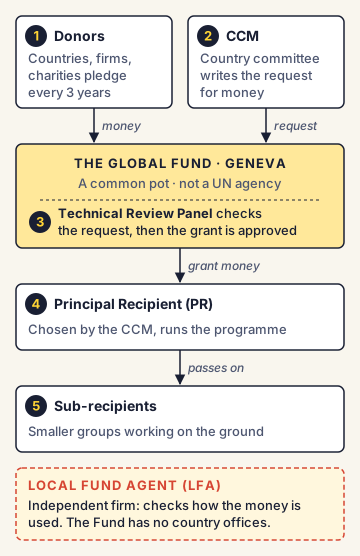
- Country Coordinating Mechanism (CCM): A committee in each country made up of government, civil society groups, people living with the diseases, private companies and partner agencies. It writes the country's request for money and watches over the grants.
- Principal Recipient (PR): The organisation the CCM chooses to receive the money and run the programme. It is often a health ministry, but can also be a civil society group or a UN agency. It can pass money on to smaller groups, called sub-recipients.
- Local Fund Agent (LFA): An independent firm hired by the Global Fund in each country to check how the money is used. The Global Fund has no country offices, so the LFA acts as its eyes on the ground.
- Technical Review Panel: A group of independent experts who check whether a country's request is sound before money is approved.
The key idea is country ownership: each country designs its own plan, and the Global Fund pays for it and checks results.
What has it achieved?
According to the Global Fund's 2025 Results Report:
- Programmes it supports have saved about 70 million lives by the end of 2024.
- It gives about 73% of all international money for TB programmes.
- It is also a major funder of malaria programmes (bed nets, medicines) and HIV programmes (testing, treatment).
India's position
India has a special double role.
- Recipient: Since 2002, the Global Fund has supported India's fight against HIV/AIDS, TB and malaria with grants.
- Donor: India has also been giving money to the Global Fund since 2006. For the Eighth Replenishment, India pledged US$ 30 million in November 2025, about 20% more than its previous pledge.
- Over the years, India has paid for a much larger share of its TB programme itself, so foreign money is now a small part of its TB budget.
Commonly confused concepts
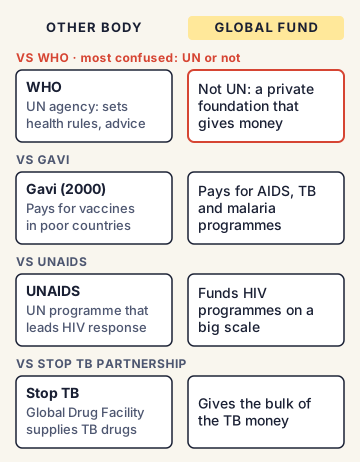
- Global Fund vs WHO: WHO is a UN agency that sets health rules, gives technical advice and publishes reports like the Global TB Report. The Global Fund is a financing body that gives money; it is not part of the UN.
- Global Fund vs Gavi: Gavi, the Vaccine Alliance (2000, Geneva) pays for vaccines in poor countries. The Global Fund pays for programmes against AIDS, TB and malaria.
- Global Fund vs UNAIDS: UNAIDS is a UN programme that leads and coordinates the world's response to HIV/AIDS. It does not fund programmes on the scale of the Global Fund.
- Global Fund vs Stop TB Partnership: The Stop TB Partnership (hosted by UNOPS, Geneva) brings together groups working on TB and runs the Global Drug Facility to supply TB medicines. The Global Fund gives the bulk of the money.
- Pledge vs contribution: A pledge is a promise to give money. A contribution is money actually paid.
Issues, criticism and the way forward
- Falling donor money: The Eighth Replenishment raised much less than its target, and international TB funding fell in 2025. Fewer funds can mean fewer tests and treatments in poor countries.
- Dependence on a few donors: A large share of the money comes from a few rich countries. If one of them cuts its aid, programmes in many countries suffer.
- Transition risk: As countries become richer, the Global Fund slowly reduces its support. If a country's own budget does not fill the gap, services can break down.
- Misuse of funds: In the past, its Office of the Inspector General found misuse of money in some grants, which led to stronger checks.
- Way forward: Experts suggest that countries raise their own health spending (domestic resource mobilisation), that new donors such as emerging economies give more, and that the Fund focuses on the countries and groups with the greatest need.
Concepts to Know
- Replenishment: A three-year fundraising round in which donors promise money to the Global Fund.
- Grant: Money given for a purpose that does not have to be paid back.
- Civil society: Groups of citizens outside the government, such as NGOs, community groups and patient groups.
- Domestic resource mobilisation: A country raising more money from its own taxes and budget, instead of depending on foreign aid.
- G8: An earlier name of the group of major rich countries (now the G7, after Russia was suspended in 2014).
- Set up: January 2002; headquarters: Geneva, Switzerland; a private foundation, not a UN agency
- Idea pushed by Kofi Annan at the Abuja summit, April 2001
- Funds three diseases: HIV/AIDS, TB and malaria
- Gives about 73% of all international financing for TB (2025 Results Report)
- About 70 million lives saved by end-2024 (2025 Results Report)
- Seventh Replenishment (2022, New York): about US$ 15.67 billion for 2023-2025
- Eighth Replenishment (21 November 2025, Johannesburg): about US$ 11.34 billion pledged for 2026-2028
- India: recipient since 2002, donor since 2006; pledged US$ 30 million for the Eighth Replenishment
- Country-level structure: Country Coordinating Mechanism, Principal Recipient, Local Fund Agent
● Tracked since November 13, 2026 · last seen November 13, 2026 · updates as the daily brief publishes