Ganges River Dolphin
The Ganges river dolphin is a freshwater dolphin that lives in the Ganga and Brahmaputra river systems of India, Bangladesh and Nepal. It is almost blind and "sees" by using sound. It is India's National Aquatic Animal. Because it can only live in clean, deep, flowing rivers, its health tells us how healthy our rivers are. Its scientific name is Platanista gangetica, and in many parts of India people call it "susu" or "soons".
Why does it matter so much?
The dolphin sits at the top of the river food chain. It eats fish, prawns and other small river animals. If dolphins are doing well, it means the river has enough water, enough fish and not too much pollution. Scientists call such an animal an indicator species: like a health report for the whole river. Losing it would be a warning sign that the river itself is dying.
What does it look like, and how does it live?
It is very different from the sea dolphins people see on TV:
- It has a long, thin beak full of sharp teeth, and a small hump instead of a tall fin on its back.
- Females are bigger than males. Females can grow up to about 2.7 metres; males reach about 2.1 metres.
- Its eyes have no lens, so it cannot form images. It can only sense light and its direction. That is why it is called functionally blind.
- To find its way and catch food, it uses echolocation. It sends out high-pitched clicks and listens to the echoes that bounce back from fish and objects, like a ship's sonar.
- It is a mammal, so it must come up to breathe. During the national survey, dolphins stayed on the surface for only about 1.26 seconds and then dived for around 107 seconds on average, which makes them very hard to count.
- A female usually gives birth to one calf every two to three years. Slow breeding means the population recovers slowly after losses.
- It prefers deep pools and places where two rivers meet (confluences), where the water swirls and fish gather.
Where is it found?
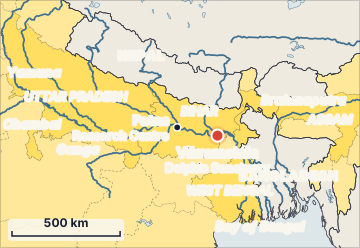
Its range covers the Ganga-Brahmaputra-Meghna and Karnaphuli-Sangu river systems, from the Himalayan foothills down to where the tides reach, in India, Nepal and Bangladesh. In India, it lives in the Ganga and its tributaries (such as the Yamuna, Ghaghara, Gandak, Kosi, Son and Chambal) and in the Brahmaputra and its tributaries in Assam.
Where did its protection come from?
India has steadily raised its protection over the years:
- 1991: Vikramshila Gangetic Dolphin Sanctuary was set up in Bihar. It covers about 60 km of the Ganga from Sultanganj to Kahalgaon in Bhagalpur district. It is India's only sanctuary created specially for this dolphin.
- 2008: Assam declared the dolphin (locally called "xihu") its State Aquatic Animal.
- 5 October 2009: It was declared India's National Aquatic Animal at the first meeting of the National Ganga River Basin Authority. Since then, 5 October is marked as National Dolphin Day.
- 15 August 2020: The government announced Project Dolphin, a 10-year programme for both river and sea dolphins, with the environment ministry as the nodal ministry and the Wildlife Institute of India (WII) as a key partner.
- March 2024: India's first National Dolphin Research Centre was inaugurated on the Patna University campus, near the Ganga in Bihar.
The first national count
Under Project Dolphin, the Wildlife Institute of India carried out the first-ever range-wide estimate of river dolphins between 2021 and 2023. It covered about 8,507 km of 28 rivers in eight states. The team used boats with two sets of observers and underwater microphones (hydrophones) that pick up dolphin clicks, so the same dolphin was not counted twice. The report was released on 3 March 2025 at the meeting of the National Board for Wildlife held at Gir, Gujarat.
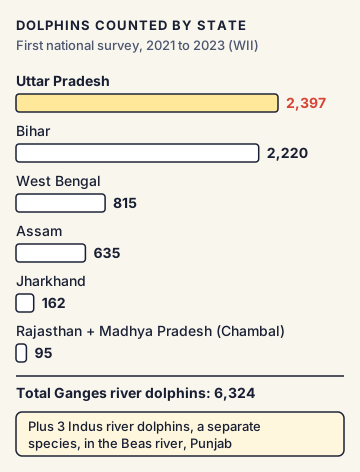
- Ganges river dolphins: 6,324 (range about 5,977 to 6,688)
- Uttar Pradesh: 2,397 (highest), Bihar: 2,220, West Bengal: 815, Assam: 635, Jharkhand: 162, Rajasthan and Madhya Pradesh: 95 (together, for the Chambal)
- Indus river dolphins: 3, all in the Beas river in Punjab (taking the total of river dolphins to 6,327)
Its legal and global status
- IUCN Red List: Endangered
- Wildlife (Protection) Act, 1972: Schedule I (the highest level of protection; hunting it is a serious crime)
- CITES: Appendix I (international trade in it is banned)
Commonly confused concepts
- Ganges river dolphin vs Indus river dolphin: Both were once treated as two sub-types of one species. A 2021 study of skulls and genes showed they are separate species: Platanista gangetica (Ganga-Brahmaputra) and Platanista minor (Indus system, mainly in Pakistan; a tiny group survives in India's Beas river). The Indus river dolphin is Punjab's state aquatic animal.
- Ganges river dolphin vs Irrawaddy dolphin: The Irrawaddy dolphin (Orcaella brevirostris) has a round head with no long beak and lives in coastal lagoons and estuaries. In India, Chilika Lake in Odisha is its best-known home. It is also listed as Endangered on the IUCN Red List.
- National Aquatic Animal vs National Heritage Animal: The Ganges river dolphin is the National Aquatic Animal (2009). The elephant was declared the National Heritage Animal (2010). The tiger is the National Animal.
- Vikramshila (dolphin sanctuary) vs Vikramshila (ancient university): Both are in Bhagalpur district, Bihar, which often confuses students.
Issues, criticism and the way forward
- Fishing nets: Many dolphins die by getting tangled in fishing nets, especially fine nylon gill nets. This accidental catch is called bycatch.
- Dolphin oil: In some areas, dolphins have been killed for their oil, which is used as bait to catch fish.
- Dams and barrages: Structures like barrages cut the river into pieces, split dolphin groups and reduce the water flow they need, especially in the dry season.
- Sand mining and dredging: These destroy the deep pools where dolphins live and feed.
- Pollution and noise: Sewage, industrial waste and pesticides poison the river. Noise from ships on inland waterways interferes with the clicks dolphins use to find food.
- Local losses: The survey found no dolphins in the Barak river and falling numbers in some rivers like the Subansiri.
- Way forward: Experts suggest dolphin-safe fishing gear and support for fishers, enough water flow downstream of dams, strict control of sand mining near dolphin pools, quieter vessels on waterways, regular surveys about every four years, and using the dolphin as the measure of success of river clean-up programmes like Namami Gange.
Concepts to Know
- Echolocation: Finding objects by sending out sound and listening for the echo. Bats and dolphins both use it.
- Indicator species: An animal or plant whose health shows the health of its whole habitat.
- Bycatch: Animals that get caught by mistake in nets meant for other fish.
- Hydrophone: A microphone that works under water and records sounds such as dolphin clicks.
- Brackish water: Water that is saltier than river water but less salty than sea water, found where rivers meet the sea.
- CITES: The Convention on International Trade in Endangered Species of Wild Fauna and Flora, an international agreement that controls trade in wild animals and plants. Appendix I species cannot be traded commercially.
- Scientific name: Platanista gangetica; IUCN Endangered; WPA 1972 Schedule I; CITES Appendix I
- National Aquatic Animal: declared 5 October 2009; National Dolphin Day: 5 October
- Assam State Aquatic Animal: 2008
- Vikramshila Gangetic Dolphin Sanctuary, Bhagalpur, Bihar: 1991, about 60 km (Sultanganj to Kahalgaon)
- Project Dolphin announced 15 August 2020 (10-year programme)
- First estimate (2021 to 2023, WII): 6,324 Ganges river dolphins; 8,507 km of 28 rivers; released 3 March 2025
- Top states: Uttar Pradesh 2,397; Bihar 2,220; West Bengal 815; Assam 635
- Indus river dolphin (Platanista minor): 3 in the Beas, Punjab; separate species since a 2021 study
- National Dolphin Research Centre, Patna: inaugurated March 2024
● Tracked since October 08, 2026 · last seen October 08, 2026 · updates as the daily brief publishes