Gandhara School of Art
Where the Buddha First Took Human Form
The Gandhara School of Art is a style of sculpture, mostly of the Buddha, that grew in the Gandhara region in the north-west of the Indian subcontinent (today's north-west Pakistan and east Afghanistan). It mixed Indian Buddhist themes with Greek and Roman ways of carving. It flourished from about the 1st century BCE to the 5th century CE, and reached its peak under the Kushana kings. Along with the Mathura school, it was among the first to show the Buddha as a human figure.
Why does it matter?
In the earliest Buddhist art, the Buddha was never shown as a person. Artists at Bharhut (2nd century BCE) and Sanchi used symbols instead: a footprint, an empty throne, the Bodhi tree, a wheel or a stupa. This is called aniconic art (art without an image of the person). Gandhara and Mathura changed this by making the Buddha a human figure that people could see and pray before. This change matched the rise of Mahayana Buddhism, which encouraged worship of the Buddha and Bodhisattvas.
Where did it come from?
Gandhara sat on busy trade and invasion routes between India, Central Asia, Persia and the Mediterranean world. After Alexander's campaign (327 to 325 BCE), Greek rulers called the Indo-Greeks (from Bactria) ruled parts of the region. Later came the Shakas, Parthians and then the Kushanas. Greek and Roman artistic ideas came into the region through these rulers and through trade with the Roman world.
Local artists used these ideas to show Buddhist stories. The school declined after the Huna (White Hun) invasions in the 5th century CE, which damaged many monasteries.
The Kushana connection
The Kushanas ruled a large empire from Central Asia to the Gangetic plains. Their most famous king, Kanishka (around the 2nd century CE), was a great patron of Buddhism. The Fourth Buddhist Council was held in Kashmir in his time. The Kushanas supported both the Gandhara and Mathura schools. Gandhara and Mathura were two key centres of their empire.
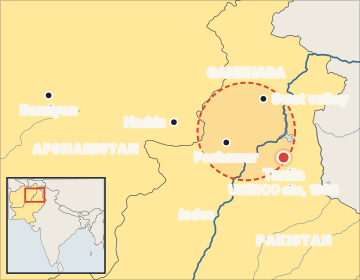
Main sites of Gandhara art
- Taxila (near Islamabad, Pakistan): a famous ancient city and centre of learning. It became a UNESCO World Heritage Site in 1980. Excavations here, led by John Marshall, also found fine gold jewellery.
- Peshawar valley and Swat valley (Pakistan).
- Hadda and Bamiyan (Afghanistan). The giant Buddha statues of Bamiyan were destroyed by the Taliban in 2001.
Features of a Gandhara Buddha (learn these for Prelims)
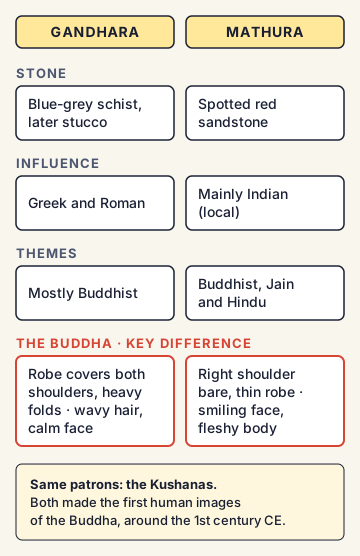
- Material: mainly blue-grey schist (a layered stone). Later works used stucco (lime plaster) and terracotta.
- Face: calm and spiritual, with eyes half-closed, often looking like the Greek god Apollo.
- Hair: wavy or curly hair, tied in a bun on top of the head (the ushnisha). Sometimes a moustache.
- Robe: a thick robe covering both shoulders, with deep, heavy folds, like a Roman toga.
- Body: realistic, with careful attention to muscles and anatomy.
- Halo: usually plain, with little decoration.
- Subject: almost entirely Buddhist: the Buddha, Bodhisattvas, and scenes from the Buddha's life and the Jataka tales (stories of the Buddha's past lives).
Commonly confused concepts: Gandhara vs Mathura vs Amaravati
| Gandhara | Mathura | Amaravati | |
|---|---|---|---|
| Region | North-west (Pakistan, Afghanistan) | Mathura, Uttar Pradesh | Krishna river valley, Andhra Pradesh |
| Main patrons | Kushanas (earlier Indo-Greeks, Shakas) | Kushanas | Satavahanas, later Ikshvakus |
| Material | Blue-grey schist, stucco | Spotted red sandstone | White marble (limestone) |
| Influence | Greek and Roman | Mainly Indian (local) | Mainly Indian (local) |
| Themes | Mostly Buddhist | Buddhist, Jain and Hindu | Mostly Buddhist, narrative scenes |
| Buddha's look | Spiritual, wavy hair, both shoulders covered | Smiling, fleshy, right shoulder bare, thin robe | Shown in lively story panels |
Who made the first Buddha image?
Scholars have argued about this for over a century. The French scholar Alfred Foucher said Gandhara came first, under Greek influence. Ananda Coomaraswamy argued that Mathura developed the Buddha image on its own, from Indian roots. Most scholars today say both schools made Buddha images independently, around the 1st century CE.
Gandhara art is not "Greek art"
This is a common mistake. The ideas, stories and religion are fully Indian and Buddhist. Only the carving style and some techniques were borrowed. This is why it is often called Greco-Buddhist or Indo-Greek art.
India's position and Indian examples
Most Gandhara sites are now in Pakistan and Afghanistan. But India holds important Gandhara collections, mainly at the National Museum, New Delhi and the Indian Museum, Kolkata. Under the Antiquities and Art Treasures Act, 1972, any object that is at least 100 years old counts as an "antiquity" and cannot be exported from India except by the government or an authorised agency.
Issues, criticism and the way forward
- Looting and smuggling: Gandhara pieces are in high demand in the global art market. Many were dug illegally and smuggled, especially during conflict in Afghanistan and north-west Pakistan.
- Destruction in conflict: The loss of the Bamiyan Buddhas in 2001 showed how fragile this heritage is.
- Colonial-era bias: Early European scholars praised Gandhara mainly for its "Greek" look. Later scholars criticised this as undervaluing Indian creativity.
- Way forward: International cooperation under the 1970 UNESCO Convention (against illegal trade in cultural property), better records of museum collections, and digital catalogues can help protect and return these objects.
Concepts to Know
- Bodhisattva: In Buddhism, a being who is on the path to becoming a Buddha and who helps others to reach liberation.
- Mahayana Buddhism: A major branch of Buddhism that worships the Buddha and Bodhisattvas through images. It grew strong in the Kushana period.
- Schist: A layered, grey rock that can be carved in fine detail.
- Stucco: A plaster made of lime and sand, shaped while wet.
- Patron: A ruler or rich person who pays for and supports artists.
- Region: Gandhara (Peshawar valley, Swat, Taxila in Pakistan; Hadda, Bamiyan in Afghanistan)
- Period: about 1st century BCE to 5th century CE; peak under the Kushanas (Kanishka, around the 2nd century CE)
- Material: blue-grey schist, later stucco; Greco-Roman style; Buddhist themes
- Mathura: red sandstone, local style, Buddhist + Jain + Hindu; Amaravati: white marble, Satavahanas
- Taxila: UNESCO World Heritage Site, 1980
- Antiquities and Art Treasures Act, 1972: antiquity = at least 100 years old
● Tracked since November 16, 2026 · last seen November 16, 2026 · updates as the daily brief publishes