Yuge Yugeen Bharat Museum
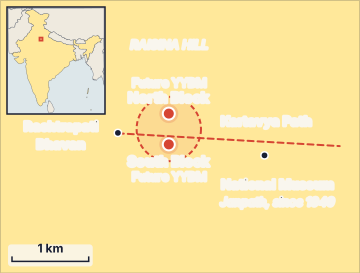
The Yuge Yugeen Bharat Museum is a planned national museum in New Delhi that will tell the story of Indian civilisation across about 5,000 years. "Yuge Yugeen" roughly means "through the ages", showing the idea of a culture that has continued from age to age. It is being created inside the North Block and South Block, the two grand colonial-era secretariat buildings on Raisina Hill that housed key ministries for over 90 years. When complete, it is expected to be the museum with the largest display area in the world.
Why is it being built?
There are three main reasons.
- Space for India's collections: India has a vast number of artefacts, but existing museums can display only a small part. The National Museum, for example, holds around 2 lakh objects but shows only a fraction.
- One national story: The aim is to show India's history, science, art and living traditions as one connected story, from ancient times to the present.
- New use for heritage buildings: As ministries move into new offices under the Central Vista Redevelopment Project, the old North and South Blocks would have fallen empty. Turning them into a museum protects them and opens them to the public for the first time.
Where did it come from?
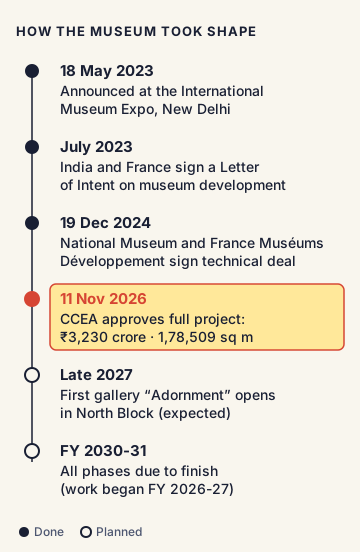
- The museum was announced on 18 May 2023 (International Museum Day) at the International Museum Expo in New Delhi, where a virtual walkthrough was shown.
- During the Prime Minister's visit to France in July 2023, India and France agreed in a Letter of Intent to cooperate on museum development.
- On 19 December 2024, India's National Museum and France Muséums Développement (the French agency that helped create the Louvre Abu Dhabi) signed an agreement for technical help: feasibility studies, interpretation planning and building design.
- Early plans spoke of about 1.17 lakh square metres, around 950 rooms over a basement and three floors, and eight themed sections.
- On 11 November 2026, the CCEA approved the full project at ₹3,230 crore, with a built-up area of about 1,78,509 square metres.
How will it be developed?
- Implementing ministry: Ministry of Culture.
- Method: adaptive reuse. The outer look and heritage features of the buildings stay. The insides are carefully adapted into galleries, storage and visitor spaces.
- Phased work: FY 2026-27 to FY 2030-31.
- First gallery: "Adornment" (jewellery and ornament traditions), in North Block, expected in late 2027.
- Contents: Galleries on India's knowledge systems, art, crafts, religions, science and technology, and intangible traditions, using immersive digital displays alongside real objects.
- Back-end facilities: Collection storage, conservation laboratories and research spaces.
What is adaptive reuse?
Adaptive reuse means giving an old building a new purpose while keeping its historic character. Instead of demolishing a heritage building or leaving it empty, you adapt it. For example, an old mill can become a shopping centre, or an old palace a hotel. Famous museum examples include the Louvre in Paris (once a royal palace) and the Tate Modern in London (once a power station).
In India, many forts and palaces have become museums or heritage hotels. It saves the building, its history and the energy needed to build something new.
Tangible and intangible heritage: what the museum will show
- Tangible heritage is physical: sculptures, coins, paintings, manuscripts, textiles, buildings. It is protected internationally under the UNESCO World Heritage Convention, 1972.
- Intangible heritage is living: music, dance, festivals, crafts skills, oral stories, rituals and knowledge. It is protected under the UNESCO Convention for the Safeguarding of the Intangible Cultural Heritage, 2003, which India ratified in 2005.
- The YYBM aims to show both, so that an object (say, a temple bell) is displayed along with the living practice around it.
How are museums governed in India?
The Constitution splits responsibility for museums and monuments:
- Union List, Entry 62: institutions such as the National Library, the Indian Museum and the Victoria Memorial, and any similar institution financed by the Centre and declared by Parliament to be of national importance.
- Union List, Entry 67: ancient and historical monuments and archaeological sites declared by Parliament to be of national importance.
- State List, Entry 12: libraries, museums and similar institutions controlled or financed by the State, and monuments not declared to be of national importance.
- Concurrent List, Entry 40: archaeological sites and remains other than those declared of national importance.
- Article 49 (a Directive Principle) asks the State to protect monuments and objects of national importance.
- Article 51A(f) (a Fundamental Duty) asks every citizen to value and preserve India's rich heritage of composite culture.
- The Antiquities and Art Treasures Act, 1972 treats an object as an "antiquity" if it is at least 100 years old, and controls its sale and export.
India's major museums (for context)
- Indian Museum, Kolkata (1814): India's oldest museum.
- National Museum, New Delhi (opened 15 August 1949): first displayed in Rashtrapati Bhavan; later moved to its Janpath building; works under the Ministry of Culture; holds about 2 lakh objects covering over 5,000 years.
- Pradhanmantri Sangrahalaya (2022), New Delhi: on all Prime Ministers of India, at Teen Murti.
Commonly confused concepts
- Yuge Yugeen Bharat Museum vs National Museum: The National Museum (1949) is an existing museum on Janpath. The YYBM is a new, much larger museum in North and South Block. The National Museum is the Indian partner in the agreement with France.
- North Block and South Block vs Rashtrapati Bhavan: The two Blocks are the secretariat buildings on either side of Raisina Hill. Rashtrapati Bhavan, the President's house, sits between and behind them at the top of the hill.
- Adaptive reuse vs restoration vs reconstruction: Restoration brings a building back to an earlier state. Reconstruction rebuilds something lost. Adaptive reuse keeps the building but gives it a new use.
- Tangible vs intangible heritage: Objects and places vs living practices and knowledge (see above).
Issues, criticism and the way forward
- Heritage risk: Experts warn that adapting century-old buildings for heavy visitor numbers, climate control and new technology must be done carefully, or original features could be damaged.
- Curation and history: A museum telling a "national story" must be balanced and evidence-based. Historians stress the need for scholarly curation and peer review of how periods and communities are shown.
- Cost and priorities: Some question large spending on one flagship museum when many state and district museums are under-staffed and poorly maintained.
- Collections: Moving and conserving lakhs of fragile objects needs trained conservators, which India has in short supply.
- Way forward: Suggestions include open, expert-led curation, strong conservation standards, training of museum professionals, digitisation of collections, and linking the new museum with smaller museums across India through loans and travelling exhibitions.
Concepts to Know
- Civilisational legacy: Everything a civilisation has built and passed down over time: ideas, art, science, beliefs, buildings and ways of life.
- Curation: Choosing, arranging and explaining objects in a museum so that they tell a clear story.
- Conservation (of artefacts): Scientific care of objects to stop damage from light, moisture, insects and age.
- Immersive technology: Digital displays like 3D projections, virtual reality and interactive screens that make visitors feel they are inside a scene.
- Public Investment Board (PIB): A body under the Department of Expenditure, Ministry of Finance, that examines large government projects before they are approved.
- CCEA (Cabinet Committee on Economic Affairs): A committee of the Union Cabinet, chaired by the Prime Minister, that approves major economic decisions and large projects.
- Location: North Block and South Block, Raisina Hill, New Delhi
- Announced: 18 May 2023, International Museum Expo, New Delhi (International Museum Day)
- India-France agreement: 19 December 2024, National Museum and France Muséums Développement
- Approved by CCEA on 11 November 2026; cost ₹3,230 crore; appraised by the Public Investment Board
- Built-up area: about 1,78,509 sq m; billed as the world's largest museum by display area
- Phases: FY 2026-27 to FY 2030-31; first gallery "Adornment" in North Block, late 2027
- Ministry: Ministry of Culture; method: adaptive reuse
- Constitution: Union List Entries 62, 67; State List Entry 12; Concurrent List Entry 40; Article 49; Article 51A(f)
- Antiquities and Art Treasures Act, 1972: antiquity = at least 100 years old
● Tracked since November 11, 2026 · last seen November 11, 2026 · updates as the daily brief publishes