Dancing Girl of Mohenjo-daro
The Harappan Bronze Masterpiece
The Dancing Girl is a small bronze statue of a young woman, found at Mohenjo-daro, one of the greatest cities of the Indus Valley (Harappan) Civilisation. It is only about 10.5 cm tall, roughly the length of your palm. It is about 4,500 years old (usually dated to around 2500 BCE). It is one of the oldest known metal statues in the world made by the lost-wax method, and today it is kept in the National Museum, New Delhi.
Why is it so important?
Most things we know about the Harappans come from bricks, pots, seals and beads. The Dancing Girl shows something more: that these people could make fine art in metal. It proves that the Harappans knew how to make bronze (a mix of copper and tin) and how to cast it into a detailed human shape. It also gives us a rare look at how people of that time may have dressed their hair and worn jewellery.
Where did it come from?
The Indus Valley Civilisation grew along the Indus river and its neighbours, in today's Pakistan and north-west India. Its "mature" or city phase is usually dated to about 2600 to 1900 BCE. Harappa was the first city to be dug, by Daya Ram Sahni in 1921. Mohenjo-daro (in Sindh, Pakistan) was dug from 1922 by R.D. Banerji.
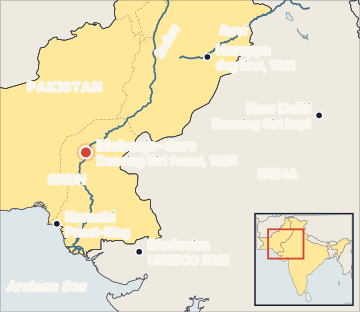
The Dancing Girl was found in 1926 by the archaeologist Ernest Mackay, in an area of Mohenjo-daro called the "HR area". Mohenjo-daro became a UNESCO World Heritage Site in 1980.
What does the statue look like?
- She stands naked, in a relaxed and confident pose, with her right hand on her hip.
- Her left arm is covered with about 24 to 25 bangles. Her right arm has 4 bangles.
- Her left hand rests near her thigh and seems to hold a small object.
- She wears a necklace and her hair is tied in a loose bun.
- Her head is slightly tilted, and her legs are slightly bent, which gives a feeling of movement.
Nobody really knows if she was a dancer. The name "Dancing Girl" was given by the early excavators because of her pose. The British archaeologist Mortimer Wheeler called her his favourite statue and admired her self-confident look.
How was it made? The lost-wax method
The Dancing Girl is a solid bronze made by lost-wax casting (also called cire perdue, French for "lost wax"). It works like this:
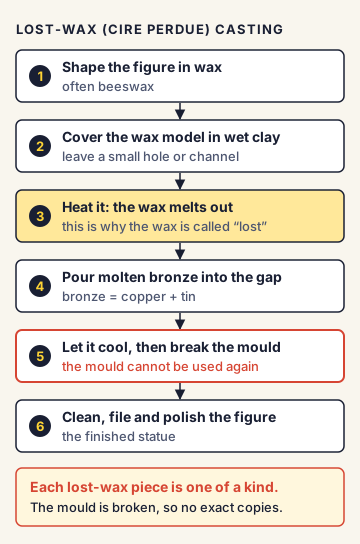
- The artist shapes a model of the figure in wax (often beeswax).
- The wax model is covered with layers of wet clay, leaving a small hole or channel.
- The clay is dried and then heated. The wax melts and flows out through the hole. This is why it is called "lost" wax.
- Now there is an empty space inside the clay, in the exact shape of the figure. Molten (liquid) metal is poured into it.
- Once the metal cools and becomes hard, the clay mould is broken.
- The figure is cleaned, filed and polished.
Because the mould is broken every time, each lost-wax piece is one of a kind. You cannot make an exact copy from the same mould. Think of it like a sand-castle mould that you must break to take out the castle.
A living tradition in India
The same basic method is still used in India today.
- Dhokra (Dokra): tribal metal craft of Chhattisgarh (Bastar), Odisha, West Bengal, Jharkhand and Telangana (Adilabad). Bastar Dhokra and Adilabad Dokra have GI tags (Geographical Indication tags, a legal label that only products from that place may use).
- Chola bronzes of Tamil Nadu (for example the Nataraja figures, about 9th to 13th century CE).
- Swamimalai bronze icons of Tamil Nadu, which have a GI tag.
Other famous Harappan art objects
- "Priest-King": a bearded male figure in steatite (soapstone), wearing a robe with a trefoil (three-leaf) pattern, from Mohenjo-daro.
- Pashupati seal: a seal showing a seated figure surrounded by animals, from Mohenjo-daro.
- Daimabad bronzes (Maharashtra): a chariot pulled by oxen, an elephant, a rhinoceros and a buffalo, found in 1974, now in the National Museum.
- Terracotta (baked clay) figures, including the so-called "mother goddess" figurines.
Why is it in India and not in Pakistan?
In 1947, many Harappan objects were in Delhi for an exhibition. After Partition, the objects from Mohenjo-daro were divided between India and Pakistan by agreement. The Dancing Girl stayed in India, while the Priest-King went to Pakistan (it is in the National Museum of Pakistan, Karachi). Some people in Pakistan have demanded the Dancing Girl back. In 2016 a petition was filed in the Lahore High Court for its return.
Commonly confused concepts
- Dancing Girl vs Priest-King: The Dancing Girl is bronze and is in New Delhi. The Priest-King is steatite (stone) and is in Karachi. Both are from Mohenjo-daro.
- Bronze vs terracotta vs steatite: Bronze is a metal alloy (copper + tin). Terracotta is baked clay. Steatite is a soft stone (soapstone), used for most Harappan seals.
- Lost-wax (Harappan) vs Chola bronzes: Same technique, but separated by over 3,000 years. The Chola bronzes are much later (medieval South India).
- Harappa vs Mohenjo-daro: Harappa (Punjab, Pakistan, on the Ravi) was dug first, in 1921. Mohenjo-daro (Sindh, Pakistan, on the Indus) was dug from 1922. The Dancing Girl is from Mohenjo-daro.
- Mohenjo-daro vs Dholavira (UNESCO): Mohenjo-daro was listed by UNESCO in 1980 (Pakistan). Dholavira in Gujarat was listed in 2021, as the first Harappan city in India on the list.
Issues, criticism and the way forward
- Fragile objects and travel: Moving ancient metal objects carries a risk of damage. Experts stress careful packing, climate control and handling when objects are shifted between museums.
- Ownership claims: Pakistan's demands show how Partition left questions over shared heritage. India's position is that the division of objects was settled by agreement after 1947.
- Interpretation: We do not know who she was or what she held. Calling her a "dancing girl" may be a modern guess. Many scholars say museums should present such labels with care.
- Way forward: Better display with clear labels, digital 3D copies for study, and more public access can help more people see and understand Harappan art.
Concepts to Know
- Indus Valley (Harappan) Civilisation: A Bronze Age civilisation of planned cities with brick houses, drains and granaries, in today's Pakistan and north-west India. It is named "Harappan" after Harappa, the first city found.
- Bronze: A metal made by mixing copper with tin. It is harder than pure copper.
- Excavation: Carefully digging a site to find and study old objects and buildings.
- Alloy: A metal made by mixing two or more metals.
- Geographical Indication (GI) tag: A legal label for a product that comes from a specific place and has qualities linked to that place, like Darjeeling tea.
- Height about 10.5 cm; bronze; made by lost-wax (cire perdue) casting
- Found in 1926 by Ernest Mackay at Mohenjo-daro (Sindh, Pakistan); dated around 2500 BCE
- About 24 to 25 bangles on the left arm, 4 on the right arm; right hand on hip
- Kept at the National Museum, New Delhi; Priest-King (steatite) is in Karachi
- Harappa dug in 1921 (Daya Ram Sahni); Mohenjo-daro from 1922 (R.D. Banerji)
- Mohenjo-daro UNESCO site: 1980; Dholavira (Gujarat) UNESCO site: 2021
- Lost-wax tradition continues in Dhokra, Chola bronzes and Swamimalai icons
● Tracked since June 15, 2026 · last seen November 16, 2026 · updates as the daily brief publishes