Freedom of Peaceful Assembly
Article 19(1)(b)
Article 19(1)(b) of the Constitution gives every citizen of India the right "to assemble peaceably and without arms". In simple words, citizens can come together in a group, hold a meeting, march in a procession or sit in a demonstration to share their views, as long as they are peaceful and carry no weapons. This is the legal root of the right to protest in India.
Like other freedoms in Article 19, it is not absolute: the State can put reasonable restrictions on it under Article 19(3).
Why does it exist?
In a democracy, voting once every five years is not the only way people speak. Between elections, people need a way to tell the government "we disagree" or "please listen to us". Coming together in public is one of the oldest and strongest ways to do this. India's own freedom struggle was built on peaceful mass gatherings: the Salt March (1930), the Quit India movement (1942) and countless public meetings.
The makers of the Constitution knew that a government which can ban every meeting can silence the people. So they made peaceful assembly a Fundamental Right.
Where did it come from?
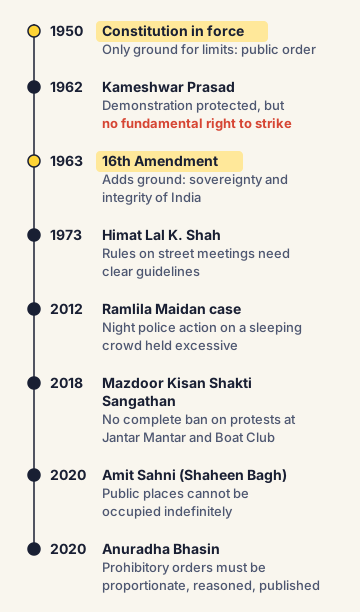
- 1950: Article 19(1)(b) came into force with the Constitution. Article 19(3) allowed restrictions only in the interest of public order.
- 1963: The 16th Constitutional Amendment Act added "the sovereignty and integrity of India" as a second ground for restriction in Article 19(3). It followed a recommendation of the Committee on National Integration and Regionalism, at a time of concern over separatist demands.
- Since then, the Supreme Court has shaped the right through a series of cases (see below).
What does the right include, and what does it not?
- Included: public meetings, processions, rallies, sit-ins, candle marches, dharnas and demonstrations, as long as they are peaceful and unarmed.
- Not included: violent gatherings, gatherings with weapons, and gatherings that turn into rioting. The Constitution itself says "peaceably and without arms".
- Not an absolute right to any place: The right does not mean you can protest anywhere and for any length of time. The State can choose places, times and routes, as long as its rules are reasonable.
- Only citizens: Like all Article 19 freedoms, this right belongs only to citizens, not to foreigners.
What are the limits under Article 19(3)?
The State can make laws putting reasonable restrictions on peaceful assembly only on two grounds:
- Public order: to keep peace and safety in the community, for example to prevent a clash or a stampede.
- Sovereignty and integrity of India: to stop gatherings that aim to break up the country.
Compare this with freedom of speech under Article 19(2), which has eight grounds. The assembly right can be limited on fewer grounds. Laws that regulate gatherings in India include Section 163 of the BNSS (prohibitory orders, which earlier was Section 144 of the CrPC), police laws such as the Delhi Police Act, 1978, which let the police regulate processions and meetings, and provisions on unlawful assembly in the Bharatiya Nyaya Sanhita (BNS), 2023.
How do courts decide if a restriction is "reasonable"?
Courts ask simple questions:
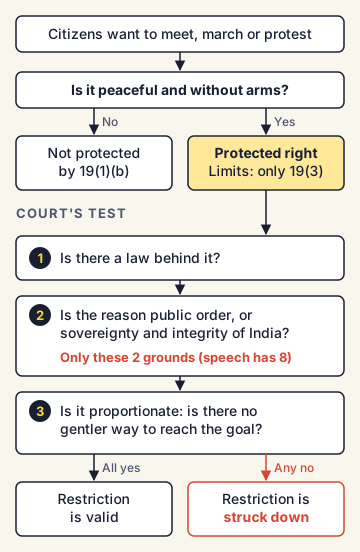
- Is there a law behind the restriction?
- Is the reason really public order or sovereignty, or is it just to stop criticism?
- Is the restriction proportionate? That means: does it go only as far as needed, and is there no gentler way to reach the same goal? A total ban when a time limit would do is usually disproportionate.
The key cases to know
- Kameshwar Prasad v. State of Bihar (1962): The Court struck down a service rule that banned all demonstrations by government employees. It said a demonstration is a form of expression protected by Article 19. But it also said there is no fundamental right to strike.
- Himat Lal K. Shah v. Commissioner of Police, Ahmedabad (1973): The Court said the State can regulate meetings on public streets, but cannot give officials unlimited power to refuse permission. Rules must have clear guidelines.
- Ramlila Maidan Incident, In re (2012): A late-night police action had cleared a sleeping crowd at Ramlila Maidan, Delhi, in June 2011. The Court said the right to assemble peacefully is a basic feature of democracy, and that the police action was excessive. It also held that the State must have strong reasons, not a mere fear, before stopping a gathering.
- Mazdoor Kisan Shakti Sangathan v. Union of India (2018): The Court said a complete ban on protests at Jantar Mantar and the Boat Club area in Delhi was not acceptable. It asked the police to frame guidelines so that protests are allowed there with reasonable conditions.
- Amit Sahni v. Commissioner of Police (2020), the Shaheen Bagh case: The Court said the right to protest is protected, but public ways and public places cannot be occupied indefinitely. Protests should take place in designated areas, and the right of others to move freely must also be respected.
- Anuradha Bhasin v. Union of India (2020): About internet shutdowns and prohibitory orders in Jammu and Kashmir, the Court said such orders must be proportionate, must give reasons, must be published and can be challenged in court.
Freedom of assembly and freedom of movement
Protests often clash with another right: Article 19(1)(d), the right of every citizen to move freely throughout India. Article 19(5) allows reasonable restrictions on this freedom in the interest of the general public or to protect Scheduled Tribes. When the State closes roads, stations or the Metro to control a protest, it limits the movement of everyone, including people who have nothing to do with the protest.
Courts therefore try to balance three things: the protesters' right to assemble, other citizens' right to move and work, and the State's duty to keep public order.
India's position and examples
In Delhi, Jantar Mantar and Ramlila Maidan are the usual places where permission is given for protests. Police usually ask organisers for an application, give a limited time and area, and may refuse permission with written reasons. India is also a party to the International Covenant on Civil and Political Rights (ICCPR), whose Article 21 recognises the right of peaceful assembly.
Commonly confused concepts
- Article 19(1)(b) vs Article 19(1)(c): 19(1)(b) is the freedom to assemble (come together physically). 19(1)(c) is the freedom to form associations or unions (and, since the 97th Amendment, 2011, cooperative societies).
- Article 19(3) vs Article 19(2): 19(3) has only two grounds for restricting assembly (public order; sovereignty and integrity). 19(2) has eight grounds for restricting speech.
- Peaceful assembly vs unlawful assembly: An unlawful assembly, under criminal law, is a group of five or more persons with a common unlawful aim, such as using force or committing a crime. A peaceful protest is not unlawful just because the government dislikes it.
- Right to protest vs right to strike: Protest is protected under Article 19. The Supreme Court has said there is no fundamental right to strike (as in Kameshwar Prasad, and later T.K. Rangarajan v. Government of Tamil Nadu, 2003, about government employees).
- Prohibitory order vs curfew: A Section 163 order usually bars gatherings or certain acts in an area. A curfew is a stronger order that tells people to stay indoors during set hours.
Issues, criticism and the way forward
- Blanket bans: Critics argue that wide prohibitory orders across whole cities, issued again and again, empty the right of meaning. Courts have warned against this.
- Designated spaces: Keeping protests only in fixed sites can make them invisible to the people they are aimed at. Others argue fixed sites protect the rights of commuters and residents.
- Collateral restrictions: Shutting the Metro, trains or internet to stop a protest affects lakhs of people who are not protesting. The proportionality test asks for the least harmful option.
- Police accountability: Mass detentions and use of force against peaceful protesters raise concerns. Clear standard operating procedures and independent review are suggested.
- Way forward: Clear, published rules for permission, quick decisions with reasons, protest sites that are visible but safe, a "least restrictive means" approach to crowd control, and training police in negotiated crowd management.
Concepts to Know
- Fundamental Rights: Basic rights in Part III of the Constitution (Articles 12 to 35) that the State cannot take away. A citizen can go directly to the Supreme Court (Article 32) or a High Court (Article 226) if they are violated.
- Reasonable restriction: A limit on a fundamental right that is made by law, has a valid purpose listed in the Constitution, and is not more than needed.
- Public order: Peace and safety of the community as a whole, more serious than just "law and order" in a small area. A street quarrel is a law-and-order problem; a riot that affects a whole locality is a public-order problem.
- Proportionality: A test courts use to check if a restriction is fair. The State must use the least harmful means that can achieve its goal.
- Designated protest site: A place, such as Jantar Mantar in Delhi, where authorities allow protests under set conditions.
- Article 19(1)(b): right to "assemble peaceably and without arms" (citizens only)
- Article 19(3): reasonable restrictions on two grounds: public order; sovereignty and integrity of India (added by the 16th Amendment, 1963)
- Article 19(1)(d): freedom of movement throughout India; restrictions under Article 19(5)
- Kameshwar Prasad (1962): demonstration protected; no fundamental right to strike
- Himat Lal K. Shah (1973): regulation of meetings on public streets must have guidelines
- Ramlila Maidan (2012): police action on a sleeping crowd held excessive
- Mazdoor Kisan Shakti Sangathan (2018): no complete ban on protests at Jantar Mantar and Boat Club
- Amit Sahni (Shaheen Bagh, 2020): public places cannot be occupied indefinitely
- ICCPR Article 21: international recognition of peaceful assembly
● Tracked since October 11, 2026 · last seen October 11, 2026 · updates as the daily brief publishes