Free, Prior and Informed Consent (FPIC)
Free, Prior and Informed Consent, or FPIC, is the idea that indigenous and tribal communities have the right to say "yes" or "no" to a project that affects their land, forests, water or way of life. The consent must be free (given without pressure), prior (given before the project starts), and informed (given after the people fully understand what the project will do). It is now a key principle in international law on indigenous peoples and in many Indian laws on tribal land and forests.
What does each word mean?
- Free: No force, threats, bribes or tricks. People must not be scared into agreeing, for example by police deployment or by threats to stop government benefits.
- Prior: Consent must be sought before any decision is final, and with enough time for the community to discuss it in its own way. Asking after the bulldozers arrive is not "prior".
- Informed: The community must get full, honest information in a language it understands: how much land will go, who will be displaced, the environmental risks, the compensation and the benefits.
- Consent: The community can agree, agree with conditions, or refuse. If the answer can only be "yes", it is not real consent. This is the most debated part, as explained below.
Why does it exist?
For a long time, big dams, mines and roads were built on tribal land without asking the people who lived there. Millions were displaced, often with little compensation, and many lost their culture along with their land. Tribal communities usually depend directly on forests, rivers and common land for food and income, so losing land hurts them far more than it hurts an urban landowner.
They also often hold land by custom, without papers, so normal land laws do not protect them well. FPIC was developed to correct this power imbalance by giving the community a real voice before the damage is done.
Where did it come from?
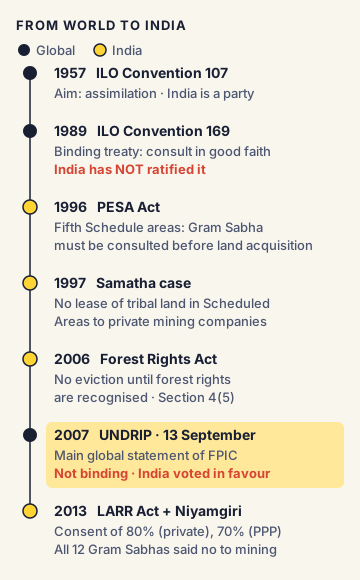
- ILO Convention 107 (1957): An early international treaty on "indigenous and tribal populations". It aimed mainly at bringing tribal people into the "mainstream", an approach later criticised as assimilation. India is a party to this convention.
- ILO Convention 169 (1989): It replaced the idea of assimilation with respect for tribal peoples' own institutions and asked governments to consult them in good faith. Its Article 16 says relocation should take place only with their free and informed consent, with limited exceptions. India has not ratified Convention 169.
- UN Declaration on the Rights of Indigenous Peoples (UNDRIP), 2007: Adopted by the UN General Assembly on 13 September 2007, with 144 votes in favour, 4 against (Australia, Canada, New Zealand and the United States, all of which later changed their position) and 11 abstentions. India voted in favour. UNDRIP is a declaration, so it is not legally binding, but it is the main global statement of FPIC.
- Convention on Biological Diversity (1992) and the Nagoya Protocol (2010): These use a related idea, prior informed consent (PIC), for using the traditional knowledge and biological resources of local communities.
What does UNDRIP say about FPIC?
The key articles are:
- Article 10: Indigenous peoples shall not be forcibly removed from their lands, and no relocation shall take place without their FPIC and agreement on fair compensation.
- Article 19: States must consult indigenous peoples through their own representative institutions to obtain FPIC before adopting laws or policies that affect them.
- Article 32(2): States must consult in good faith to obtain FPIC before approving any project affecting their lands or resources, especially for minerals, water or other resources.
How does India apply this idea?
India does not use the term "FPIC" in its laws. India's official position at the UN is that its entire population at independence and their descendants are indigenous, so it does not treat any one group as "indigenous peoples" in the UN sense. Instead, Indian law protects Scheduled Tribes and forest dwellers through several consent and consultation rules:
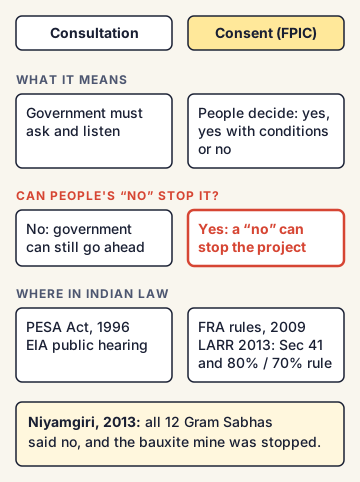
- PESA Act, 1996 (Panchayats (Extension to the Scheduled Areas) Act): In Fifth Schedule areas, the Gram Sabha (the assembly of all adult voters of a village) or panchayat must be consulted before land is acquired for development projects and before resettling affected people. Note: this is "consultation", not "consent".
- Forest Rights Act (FRA), 2006: It recognises individual and community rights of forest dwellers over forest land. It gives the Gram Sabha the authority to protect community forests. Under Section 4(5), no forest dweller can be evicted until the process of recognising rights is complete. In 2009, the Union Environment Ministry made the Gram Sabha's consent and the completion of rights recognition a condition before forest land is diverted for projects.
- Land Acquisition Act, 2013 (Right to Fair Compensation and Transparency in Land Acquisition, Rehabilitation and Resettlement Act, 2013): Under Section 2(2), land for private projects needs the consent of at least 80% of affected families, and public-private partnership (PPP) projects need 70%. Under Section 41, land in Scheduled Areas should be acquired only as a last resort and with the prior consent of the Gram Sabha or panchayat. Projects by the government itself do not need the 70% or 80% consent.
Landmark case: Niyamgiri (2013)
In Orissa Mining Corporation v. Ministry of Environment and Forest, decided on 18 April 2013, the Supreme Court said that the Gram Sabhas around the Niyamgiri hills in Odisha must decide whether bauxite mining would harm the religious, cultural and community rights of the Dongria Kondh and other forest dwellers. In July and August 2013, all 12 selected Gram Sabhas voted against the mining project, and it did not go ahead.
This is often called India's first "environmental referendum" and is the clearest Indian example of FPIC in action. Earlier, in Samatha v. State of Andhra Pradesh (1997), the Supreme Court had held that tribal land in Scheduled Areas cannot be leased to private companies for mining.
Commonly confused concepts
- Consultation vs consent: Consultation means the government must ask and listen, but it can go ahead even if people disagree. Consent means the people's "no" can stop the project. PESA mostly requires consultation; FRA rules and LARR Section 41 move closer to consent.
- FPIC vs public hearing: A public hearing under the EIA (Environmental Impact Assessment) Notification, 2006 records people's views on environmental effects, but it is not a vote and cannot veto a project. FPIC is a collective decision by the community.
- FPIC vs Social Impact Assessment (SIA): An SIA under the 2013 land law studies how a project will affect families and livelihoods. It informs the decision, while consent is the decision itself.
- UNDRIP vs ILO 169: UNDRIP is a non-binding declaration that India supported. ILO 169 is a binding treaty that India has not ratified.
- Fifth Schedule vs Sixth Schedule: The Fifth Schedule covers Scheduled Areas in most tribal states (where PESA applies). The Sixth Schedule creates Autonomous District Councils in parts of Assam, Meghalaya, Tripura and Mizoram. Arunachal Pradesh is under neither; it has special provisions under Article 371H.
Issues, criticism and the way forward
- Is it a veto? Many experts and tribal groups argue that consent must include the right to say no, or it is meaningless. Governments argue that a full veto by a small group could block projects of national importance, such as power, defence or water security.
- Watering down: Critics, including the National Commission for Scheduled Tribes, argued that the Forest (Conservation) Rules, 2022 weakened consent by allowing forest diversion approvals before forest rights are settled. The Environment Ministry's position was that the rules do not dilute the Forest Rights Act and that other laws still apply.
- "Manufactured" consent: Gram Sabha meetings are sometimes held in a hurry, with heavy security or without proper information, which defeats the "free" and "informed" parts.
- Customary land: In states like Arunachal Pradesh, most land is owned by clans and villages by custom. So the question of who speaks for the community (the Gram Sabha, the traditional village council, or the clan) is complex.
- Way forward suggested by experts: Hold consent processes through the community's own institutions; share full project documents in local languages; allow independent observers; give enough time; and treat benefit-sharing (jobs, a share of revenue, free power) as part of the deal, not a favour.
Concepts to Know
- Indigenous peoples: Communities who lived in a region before others arrived or before modern states were formed, and who keep their own distinct culture, language and institutions.
- Gram Sabha: The assembly of all adults registered as voters in a village. It is the base of village self-government.
- Scheduled Tribes: Tribal communities listed by the President under Article 342 of the Constitution, who get special protections and reservations.
- Displacement: When people are forced to leave their homes and land, for example because a dam reservoir will flood them.
- Diversion of forest land: Using forest land for a non-forest purpose such as a dam, mine or road, which needs Central approval.
- Ratify: When a country formally agrees to be legally bound by an international treaty.
- FPIC = Free (no pressure), Prior (before the decision), Informed (full information), Consent (can agree or refuse)
- UNDRIP adopted 13 September 2007: 144 for, 4 against, 11 abstentions; India voted in favour; not legally binding
- UNDRIP Articles 10 (no relocation without FPIC), 19 (laws and policies) and 32(2) (projects on land and resources)
- ILO Convention 169 (1989): India has not ratified it
- PESA Act, 1996: Gram Sabha to be consulted before land acquisition in Fifth Schedule areas
- FRA, 2006: Section 4(5) bars eviction until rights recognition is complete
- LARR Act, 2013: Section 2(2) consent of 80% (private) and 70% (PPP); Section 41 Gram Sabha consent in Scheduled Areas
- Niyamgiri case (18 April 2013): all 12 Gram Sabhas rejected bauxite mining
- Samatha v. State of Andhra Pradesh (1997): no lease of tribal land in Scheduled Areas to private mining companies
- Arunachal Pradesh: under neither the Fifth nor the Sixth Schedule; special provision in Article 371H
● Tracked since November 02, 2026 · last seen November 07, 2026 · updates as the daily brief publishes