Adi Tribe of Arunachal Pradesh
The Adi are one of the largest tribal communities of Arunachal Pradesh. They live mainly in the valleys of the Siang river and its tributaries, in districts such as East Siang, Upper Siang, Siang, West Siang and Lower Dibang Valley. They speak languages of the Tani group, part of the larger Tibeto-Burman family. They are famous for their democratic village councils called Kebang and for their nature-based faith, Donyi-Polo (worship of the Sun and the Moon).
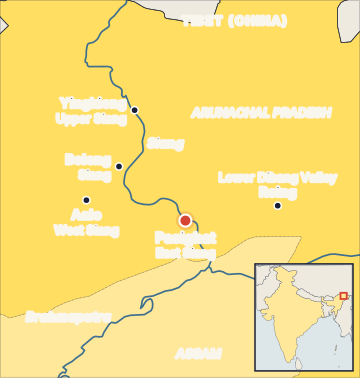
Who are the Adi, and what does the name mean?
In older British records, the Adi were called "Abor". This word came from Assamese and was seen as an insulting outsider's label, so the community adopted the name "Adi", which literally means "hill" or "mountain top". The Adi are not one single group. They are a family of related sub-groups, including the Padam, Minyong, Pasi, Pangi, Shimong, Bori, Bokar, Karko, Milang and Komkar, each with its own dialect and area. Their close cousins in the Assam plains are the Mishing (also called Miri), who also speak a Tani language.
Why does this community matter for the dam debate?
The Siang valley is not just land to the Adi. Their villages, fields, forests, burial grounds and sacred places sit along the river. Most land in their areas is held under customary ownership: it belongs to the clan or the village community, by tradition, rather than through government land records. When a project needs to survey or acquire such land, the community expects to be consulted through its own traditional bodies. This is why opposition to large dams in the Siang valley is closely tied to Adi identity.
How does the Kebang system work?
Each Adi village has a headman, traditionally called the Gam (also known as the Gaon Burah, a term from Assamese). The village council, the Kebang, is made up of village elders and respected men. It works as a local government and a traditional court at the same time:
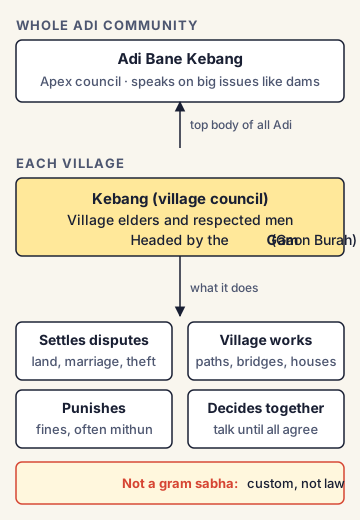
- It settles disputes over land, marriage, theft and quarrels.
- It decides on village works such as building paths, bridges and community houses.
- It punishes offenders, often with fines in the form of animals like mithun (a semi-wild bovine valued in the region).
- Decisions are reached through open discussion until there is general agreement.
At the top of this structure today is the Adi Bane Kebang, the apex traditional council of the Adi community. It speaks for the Adi on big issues, including the dam. In the recent violence its office in Pasighat was vandalised.
Faith and festivals
- Donyi-Polo: "Donyi" means the Sun and "Polo" means the Moon. The faith treats them as symbols of truth and the guiding light of the universe. The Donyi-Polo movement, which organised these beliefs into an institutional faith, was led by Talom Rukbo. Some Adi also follow Christianity or Buddhism.
- Solung: The main Adi festival, an agricultural festival held in early September after sowing, with prayers to the crop goddess Kine Nane for a good harvest.
- Ponung: A traditional dance performed during Solung. Girls and women dance in a circle around a single male singer, called the Miri, whose folk song is the only music for the dance.
- Aran (Unying Aran): A major festival celebrated around 7 March, linked to hunting and the new year.
How do the Adi live?
Most Adi are farmers. They practise jhum (shifting cultivation, where a forest patch is cleared, farmed for a few years and then left to regrow) and also settled wet-rice farming in the valleys. They are known for skilled cane and bamboo craft and for building long bridges of cane and bamboo across fast rivers. Villages are often built on hill slopes with houses raised on stilts.
History
The Adi hills lay beyond direct British rule for a long time. The British controlled entry to these hills through the Inner Line, created by the Bengal Eastern Frontier Regulation, 1873. Relations were often tense, and the British sent several military expeditions into the Adi hills. The most famous is the Abor Expedition of 1911–12 (October 1911 to April 1912).
It followed the killing of British officer Noel Williamson, the Assistant Political Officer at Sadiya, and his party in 1911. Local tradition places the killing at Komsing village on the Siang, and remembers Matmur Jamoh as the leader of the Adi fighters. The battle of Kekar Monying (December 1911) is remembered locally as a symbol of Adi resistance.
India's position and protections today
- The Adi are a recognised Scheduled Tribe in Arunachal Pradesh. Scheduled Tribes make up about 68.8% of Arunachal's population (Census 2011: 9,51,821 out of 13,83,727).
- Arunachal still uses the Inner Line Permit (ILP) under the 1873 Regulation. Indian citizens from outside the state need a permit to enter, which protects tribal land and culture.
- Arunachal is not under the Fifth or Sixth Schedule, and Article 371H (unlike Article 371A for Nagaland) does not give constitutional protection to customary land. Land protection comes mainly from state laws, the ILP and custom.
- Large projects in the area must follow the EIA Notification, 2006 (including a public hearing) and forest clearance rules, which give the community formal chances to raise objections.
Commonly confused concepts
- Adi vs Galo: The Galo (once called Gallong) of West Siang and nearby areas are a related Tani tribe. Older records sometimes grouped them with the Adi, but they are recognised and identify as a separate community, with their own festival, Mopin.
- Adi vs Mishing: Both speak Tani languages and share roots. The Adi live in the hills of Arunachal; the Mishing mainly live in the plains of Assam along the Brahmaputra.
- Kebang vs Gram Sabha: The Kebang is a traditional, custom-based council. A gram sabha is a body created by law (under the 73rd Amendment and related laws) made up of all adult voters of a village.
- Inner Line Permit vs Sixth Schedule: The ILP controls entry of outsiders. The Sixth Schedule creates autonomous district councils with law-making powers, and it applies only to tribal areas of Assam, Meghalaya, Tripura and Mizoram.
Issues, criticism and the way forward
- Development vs displacement: The state and Centre see big dams as a source of clean power, income and strategic security. Many Adi see the loss of land, forests and sacred places as a threat to their very identity.
- Consent and trust: Communities ask for genuine consultation before surveys begin. Officials argue that a pre-feasibility survey only studies the site and does not mean the dam is approved. Deep mistrust between the two sides has fed the violence.
- Use of strict laws: Arrests under preventive and special security laws are criticised by activists as harsh. The government says such steps are needed to stop arson and attacks on public property.
- Ecological risk: The Siang flows through a seismically active, landslide-prone zone with rich biodiversity. Experts stress careful cumulative impact studies of all dams in the basin.
- Way forward suggested by experts: transparent sharing of project data, consultation through traditional bodies like the Kebang, fair compensation and resettlement, protection of cultural sites, and peaceful dialogue, while also addressing India's genuine concerns about China's upstream dam.
Concepts to Know
- Scheduled Tribe (ST): A community listed as a tribe under Article 342 of the Constitution by a presidential order. STs get special protections such as reservation in jobs, education and legislatures.
- Customary land ownership: Land owned by a clan or community by long tradition, not by individual title deeds recorded with the government.
- Tani languages: A group of related languages spoken by tribes of central Arunachal Pradesh (such as the Adi, Galo, Nyishi, Apatani and Tagin) and by the Mishing of Assam.
- Inner Line: A boundary drawn by the British in 1873 beyond which outsiders could not go without a pass. It continues today as the Inner Line Permit.
- Jhum cultivation: Shifting cultivation, common in the North-East, where land is farmed for a few years and then left fallow to recover.
- Bandh: A general shutdown called as a protest, during which shops, offices and traffic stop.
- Adi: major Tani-speaking tribe of the Siang valley; formerly called "Abor" in British records
- Districts: East Siang, Upper Siang, Siang, West Siang, Lower Dibang Valley
- Village council: Kebang, headed by the Gam; apex body: Adi Bane Kebang
- Faith: Donyi-Polo (Sun and Moon)
- Festivals: Solung (September, agricultural), Aran (around 7 March); dance: Ponung
- Abor Expedition: October 1911 to April 1912, after the killing of Noel Williamson (1911)
- Arunachal ST share: about 68.8% (Census 2011)
- Inner Line Permit: Bengal Eastern Frontier Regulation, 1873
- Arunachal is outside the Fifth and Sixth Schedules; Article 371H gives the Governor special responsibility for law and order
● Tracked since October 27, 2026 · last seen October 27, 2026 · updates as the daily brief publishes