Forfeiture of Publications
Section 98 BNSS (formerly Section 95 CrPC)
Forfeiture of a publication means the government officially declares that every copy of a particular book, newspaper issue or document now belongs to the government. The police can then seize those copies wherever they find them. In India, this power belongs to the state government and comes from Section 98 of the Bharatiya Nagarik Suraksha Sanhita (BNSS), 2023. Before 1 July 2024, the same power was in Section 95 of the Code of Criminal Procedure (CrPC), 1973.
Why does this power exist?
Sometimes a book or pamphlet may be written to stir up hatred between communities, insult a religion on purpose, or attack the unity of the country. If such material spreads, it can lead to riots before any court case is finished. A criminal trial punishes the writer after the harm is done, but it does not stop copies from spreading today.
Forfeiture is meant to be a preventive step: like a fire officer removing a can of petrol from a crowded room before anything catches fire.
Where did it come from?
- The power is old. It began in British India, when the colonial government used it to seize nationalist and "seditious" writings.
- In the old CrPC of 1898, it was Section 99A. The 1973 CrPC kept it as Section 95.
- The BNSS, 2023, which came into force on 1 July 2024, kept it as Section 98, with the offence list updated to the new Bharatiya Nyaya Sanhita (BNS), 2023.
When can a state government use it?
Under Section 98(1), the state government can act when any newspaper, book or document, wherever printed, appears to it to contain matter whose publication is punishable under these BNS sections:
- Section 152: acts endangering the sovereignty, unity and integrity of India (this took the place of the old sedition offence, Section 124A of the Indian Penal Code).
- Section 196: promoting enmity between groups on grounds of religion, race, place of birth, language and so on (old IPC Section 153A).
- Section 197: imputations and assertions prejudicial to national integration (old IPC Section 153B).
- Section 294: sale and circulation of obscene books and material (old IPC Section 292).
- Section 295: sale of obscene objects to a child (old IPC Section 293).
- Section 299: deliberate and malicious acts meant to outrage the religious feelings of any class (old IPC Section 295A).
The words "wherever printed" matter: a state can forfeit a book even if it was printed in another state or abroad.
How does it work, step by step?
- The state government forms an opinion that the publication contains such matter.
- It issues a notification, published in the Official Gazette, that states the grounds of its opinion and declares every copy forfeited.
- Any police officer can then seize the copies anywhere in India.
- A magistrate can issue a search warrant to enter and search a place where copies may be kept.
- Under Section 98, no court can question the order except in the way laid down in Section 99.
How can the order be challenged?
Under Section 99 BNSS (old Section 96 CrPC), any person with an interest in the publication, such as the author, publisher or a bookseller, can apply to the High Court to set aside the declaration. Key rules:
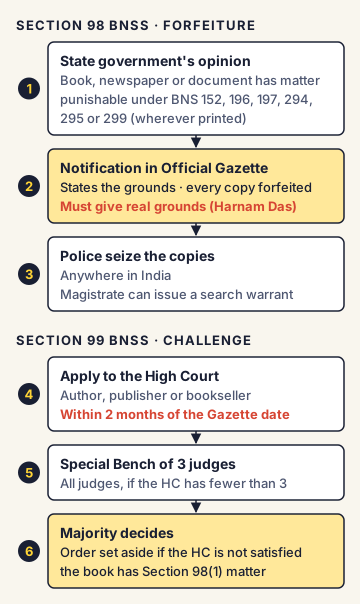
- The application must be made within two months from the date the declaration is published in the Official Gazette.
- Where the High Court has three or more judges, the case is heard by a Special Bench of three judges. Where it has fewer than three judges, the bench is all the judges. The majority view decides.
- The High Court sets aside the declaration if it is not satisfied that the publication contained the kind of matter listed in Section 98(1).
What have the courts said? (Landmark cases)
- Harnam Das v. State of Uttar Pradesh (1961): A five-judge bench of the Supreme Court struck down the forfeiture of two books under the old Section 99A. It held that stating the grounds is mandatory, and merely repeating the words of the section is not enough.
- Baragur Ramachandrappa v. State of Karnataka (2007): The Supreme Court upheld Karnataka's 1997 forfeiture of the Kannada novel Dharmakaarana. It said the power is preventive and that the government may forfeit a publication that endangers public order, even if this restricts free expression.
- State of Maharashtra v. Sangharaj Damodar Rupawate (2010): The Supreme Court upheld the Bombay High Court's decision to quash Maharashtra's forfeiture of James W. Laine's book Shivaji: Hindu King in Islamic India. It held that the notification must give real reasons, and that a mere citation of the law is not enough.
India's experience and recent examples
- On 5 August 2025, the Jammu and Kashmir government declared 25 books forfeited under Section 98 BNSS, saying they promoted secessionism and endangered the sovereignty and integrity of India. The Supreme Court refused to hear a challenge directly and sent the petitioners to the High Court, where a special bench of three judges took up the case.
- In Karnataka, books such as Dharmakaarana have been forfeited in the past.
- A different route is an import ban under the Customs Act. The Satanic Verses was barred from import in 1988. In November 2024, the Delhi High Court closed a challenge after the government could not produce the 1988 notification, and the court presumed it did not exist.
Commonly confused concepts
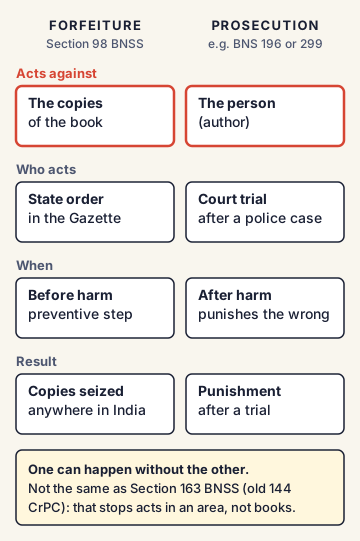
- Forfeiture (Section 98 BNSS) vs prosecution of the author: forfeiture acts against the copies of the book. Prosecution under BNS sections such as 196 or 299 acts against the person and can lead to punishment after a trial. One can happen without the other.
- Forfeiture vs a prohibitory order (Section 163 BNSS): Section 163 (old Section 144 CrPC) lets a magistrate pass urgent orders to stop gatherings or acts in an area. It is about actions and places, not about declaring a book forfeited.
- State government vs Centre: the Section 98 power belongs to the state government. The Centre's tools are different, for example import bans under the Customs Act. Do not read "state government" as "states only": Jammu and Kashmir is a Union Territory, and its 2025 order came from the Home Department of the J&K government.
- "Three grounds" vs eight grounds: news reports often speak of national security, public order and morality. But Article 19(2) actually lists eight grounds: sovereignty and integrity of India, security of the State, friendly relations with foreign States, public order, decency or morality, contempt of court, defamation, and incitement to an offence. Any restriction must fit one of them and be reasonable.
- Removing a book from libraries vs forfeiture: a government may remove a book from public libraries under its own control. That is not a forfeiture under Section 98, which makes every copy liable to seizure everywhere.
Issues, criticism and the way forward
- Free speech concerns: critics argue that the power is too wide and is sometimes used to please angry groups. This can create a "heckler's veto", where whoever protests loudest decides what others may read.
- Weak reasons in orders: many forfeiture orders simply repeat the words of the law, which the Supreme Court said is not enough in Harnam Das and Rupawate.
- The "spark in a powder keg" test: in S. Rangarajan v. P. Jagjivan Ram (1989), the Supreme Court said speech can be restricted for public order only when the link between the speech and the danger is close and direct, like a spark in a powder keg, not remote or far-fetched.
- The government's view: the State has a duty to keep public order and protect communal harmony. In a diverse country, one provocative text can spark violence, so a quick preventive tool is needed.
- Way forward suggested by experts: use forfeiture only as a last resort; give specific passages and reasons in every order; decide challenges quickly; and prefer less drastic steps, such as prosecution in a specific case or counter-speech, where possible.
Concepts to Know
- Forfeit: To lose something to the government by law. Here, the copies of a book legally become government property and can be seized.
- Notification / Official Gazette: A notification is a formal government order. The Official Gazette is the government's official publication where such orders are printed so they take legal effect.
- Preventive measure: A step taken to stop harm before it happens, rather than punishing someone after it happens.
- Bharatiya Nagarik Suraksha Sanhita (BNSS), 2023: The new law on criminal procedure (how police and courts handle crimes) that replaced the CrPC from 1 July 2024.
- Bharatiya Nyaya Sanhita (BNS), 2023: The new law that lists crimes and punishments, which replaced the Indian Penal Code (IPC) from 1 July 2024.
- Special Bench: A bench of judges set up for a particular type of case. For forfeiture challenges, it is three judges of the High Court. If the High Court has fewer than three judges, it is all of them.
- Heckler's veto: When a protesting group's anger, rather than the law, ends up deciding whether something can be said or published.
- Forfeiture power: Section 98 BNSS, 2023 (formerly Section 95 CrPC, 1973; Section 99A of the 1898 CrPC)
- Power belongs to the state government; acts on any newspaper, book or document "wherever printed"
- Covers matter punishable under BNS Sections 152, 196, 197, 294, 295 and 299
- Notification must state the grounds of the government's opinion
- Challenge: Section 99 BNSS, to the High Court within two months from the date of publication in the Official Gazette; heard by a Special Bench of three judges (all the judges, if the High Court has fewer than three)
- Harnam Das (1961): grounds are mandatory; Baragur Ramachandrappa (2007): forfeiture of Dharmakaarana upheld; Rupawate (2010): forfeiture of James Laine's book on Shivaji quashed
- J&K forfeited 25 books under Section 98 BNSS on 5 August 2025
● Tracked since November 21, 2026 · last seen November 21, 2026 · updates as the daily brief publishes