Fee Regulation in Private Unaided Professional Colleges
From TMA Pai to Modern Dental
Private unaided professional colleges are colleges for courses like engineering, medicine, dentistry and management that are run by private trusts or societies and get no regular money from the government. They pay their costs mostly from student fees, so they are also called "self-financing" colleges. In India, these colleges can set their own fees, but the state can check those fees through a committee so that colleges do not cheat students or make huge profits.
This balance between the college's freedom and the student's protection was built up over about 25 years by a series of Supreme Court judgments.
Why is regulation needed?
A seat in a good professional college is in very high demand, and supply is limited. When demand is far higher than supply, a college can charge almost anything. In the 1980s and 1990s, many colleges took large secret payments, called capitation fees, for admission. This meant a seat went to the family with money, not to the student with merit.
On the other hand, if the government fixes fees too low, colleges cannot pay good teachers or build labs, and quality falls. So the law tries to do two things at once: let colleges recover their real costs, and stop them from turning education into a money-making business.
Where did it come from? The court cases in order
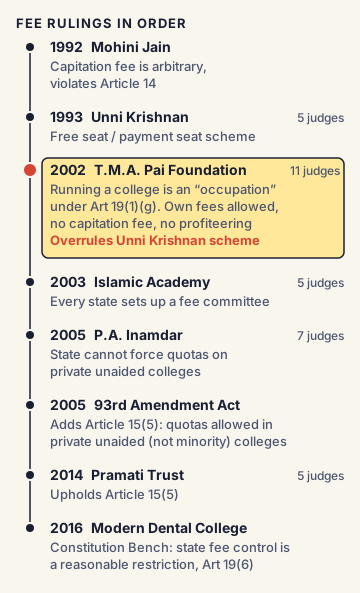
- Mohini Jain v. State of Karnataka (1992): The Supreme Court said charging capitation fees was arbitrary and violated Article 14 (right to equality), because it gave admission based on money rather than merit. The court also linked a right to education with Article 21 (right to life).
- Unni Krishnan v. State of Andhra Pradesh (1993): A five-judge bench said the right to education flows from Article 21, but the right to free education is limited to children up to 14 years. Beyond that, it depends on the state's economic capacity. The court also created a "free seat / payment seat" scheme for private professional colleges, under which some seats were filled on merit at low fees and the rest at higher fees.
- T.M.A. Pai Foundation v. State of Karnataka (2002): An 11-judge bench, with the majority opinion written by Chief Justice B.N. Kirpal, overruled the Unni Krishnan scheme. It said that setting up and running an educational institution is an "occupation" protected by Article 19(1)(g). Unaided institutions can set their own fee structure, but they cannot charge capitation fees or indulge in profiteering. They may keep a reasonable surplus to grow and improve the institution.
- Islamic Academy of Education v. State of Karnataka (2003): A five-judge bench explained what T.M.A. Pai meant. It said there can be no rigid fee fixed by the government, but it directed every state to set up a committee to regulate the fee structure in unaided minority and non-minority institutions. States usually set up two committees, one for admissions and one for fees, each headed by a retired High Court judge.
- P.A. Inamdar v. State of Maharashtra (2005): A seven-judge bench, with Chief Justice R.C. Lahoti on it, said every institution is free to design its own fee structure, but this can be regulated to prevent profiteering. It said that the state cannot force reservation (quota) seats on private unaided colleges. It treated the Islamic Academy committees as a temporary arrangement until states made proper laws.
- Modern Dental College and Research Centre v. State of Madhya Pradesh (2016): A Constitution Bench upheld a Madhya Pradesh law of 2007 that let a state committee fix fees for private medical and dental colleges. The court said such fee control is a reasonable restriction under Article 19(6) because it stops commercialisation of education. The committee's job is to check that fees match real costs and do not amount to profiteering.
What is the constitutional basis?
Three parts of the Constitution meet here:
- Article 19(1)(g): gives every citizen the right to practise any profession or carry on any occupation, trade or business. Running a college falls under "occupation".
- Article 19(6): allows the state to put "reasonable restrictions" on that right in the interest of the general public. Fee regulation is justified under this clause.
- Entry 25, List III (Concurrent List): education, including technical and medical education, is a subject on which both Parliament and state legislatures can make laws. This is why states can pass fee regulation laws.
How does fee fixing work in practice?
A college sends its accounts and expenses to the state fee committee. The committee checks the audited costs: teachers' salaries, buildings, equipment, maintenance, and a reasonable amount for future growth. It then sets a fee or a fee ceiling for a fixed period. Regulations usually allow a revision only once in about three years, based on audited spending and future needs.
Think of it like an electricity regulator setting a tariff: the company gets its costs plus a fair margin, but cannot charge whatever it likes just because people need power.
Minority institutions are also covered
Minority institutions have a special right under Article 30(1) to set up and run educational institutions of their choice. But courts have held that this right does not give complete immunity from fee checks. In Icon Education Society v. State of Madhya Pradesh (2023), the Supreme Court held that a minority institution cannot claim full exemption from a fee regulatory committee's review.
Reservation in private colleges
After P.A. Inamdar said the state could not force quotas on unaided colleges, Parliament passed the 93rd Constitutional Amendment Act, 2005. It added Article 15(5), which allows the state to make special provisions (such as reservation) for socially and educationally backward classes, SCs and STs in admissions to educational institutions, including private unaided ones, but not minority institutions. In Pramati Educational and Cultural Trust v. Union of India (2014), a five-judge bench upheld Article 15(5).
India's position and examples
Most states have their own fee regulation laws and committees. Examples include the Madhya Pradesh Niji Vyavsayik Shikshan Sanstha (Pravesh Ka Viniyaman Avam Shulk Ka Nirdharan) Adhiniyam, 2007, and Gujarat's 2008 law for professional colleges. For technical colleges, the All India Council for Technical Education (AICTE) also has norms on fees, such as the AICTE (Norms and Guidelines for Fees and Guidelines for Admission in Professional Colleges) Regulations, 1994. For medical colleges, the National Medical Commission (NMC) issues fee guidelines for 50% of seats in private colleges.
Commonly confused concepts
- Capitation fee vs tuition fee: A tuition fee is the openly declared charge for teaching. A capitation fee is an extra, usually hidden, payment for getting a seat. Capitation fees are banned; regulated tuition fees are allowed.
- Reasonable surplus vs profiteering: A reasonable surplus is a small extra amount kept for growth and improvement. Profiteering is making large profits that are taken out of education. The first is allowed, the second is not.
- Aided vs unaided institutions: Aided institutions get regular government grants, so the government has more control over them. Unaided institutions get no such grants, so they have more freedom, but still within limits.
- Article 19(1)(g) vs Article 30(1): Article 19(1)(g) is a right of every citizen to run any occupation, including a college. Article 30(1) is a special right only for religious and linguistic minorities to set up and run their own educational institutions.
- Article 15(4) vs Article 15(5): Article 15(4) (added in 1951) allows special provisions for backward classes in general. Article 15(5) (added in 2005) specifically covers admissions to educational institutions, including private unaided ones.
Issues, criticism and the way forward
- Late fee decisions: Fee committees often take years to revise fees. Colleges then try to recover the gap from students already admitted, which causes disputes like the one in this case.
- Lack of transparency: Students rarely see how a committee arrived at a fee. Colleges sometimes hide real costs or show inflated ones.
- Hidden charges: Even with fee caps, some colleges add "development fees", hostel charges or other items to increase the total cost.
- Quality vs affordability: Critics of strict fee control say low fees push colleges to cut corners on faculty and labs. Supporters say without control, professional education would be only for the rich.
- Way forward: Experts suggest fixing the fee for the full course before admission, revising fees on a fixed timetable, publishing committee reasoning online, and offering scholarships and education loans so that merit, not money, decides admission. The National Education Policy (NEP) 2020 also calls for transparent, fair fee setting and checks on commercialisation of education.
Concepts to Know
- Self-financing college: A private college that pays for itself mainly from student fees, without regular government grants.
- Overruled: When a larger bench of the Supreme Court says an earlier judgment was wrong, that earlier judgment stops being the law.
- Bench: The group of judges who hear a case. A bigger bench (for example 11 judges) can overrule a smaller one (for example 5 judges).
- Constitution Bench: A bench of at least five Supreme Court judges that decides important questions about the meaning of the Constitution (Article 145(3)).
- Reasonable restriction: A limit on a fundamental right that the Constitution allows, as long as it is fair, needed and not excessive.
- Commercialisation of education: Running education mainly as a business to make profits, instead of as a service.
- Mohini Jain (1992): capitation fee held arbitrary, violative of Article 14
- Unni Krishnan (1993): 5 judges; free education right up to age 14; free seat / payment seat scheme
- T.M.A. Pai Foundation (2002): 11 judges; running an institution is an "occupation" under Article 19(1)(g); no capitation fee, no profiteering, reasonable surplus allowed; Unni Krishnan scheme overruled
- Islamic Academy (2003): 5 judges; state-level committees to regulate fees
- P.A. Inamdar (2005): 7 judges; no state quotas in private unaided colleges; fee can be regulated to prevent profiteering
- 93rd Amendment Act, 2005 added Article 15(5); upheld in Pramati Educational and Cultural Trust (2014)
- Modern Dental College (2016): Constitution Bench; state fee regulation upheld as a reasonable restriction under Article 19(6)
- Education is in Entry 25 of List III (Concurrent List)
● Tracked since October 18, 2026 · last seen October 18, 2026 · updates as the daily brief publishes