Doctrine of Promissory Estoppel
When the Government Must Keep Its Word
Promissory estoppel is a legal rule that stops a person or the government from going back on a clear promise when someone else has trusted that promise and acted on it. "Estoppel" simply means "being stopped". If the government promises you something, and you change your position because of that promise (for example, you invest money), the court can stop the government from breaking its word. In India, this rule is used mostly against the government, to make it act fairly.
Why does it exist?
Imagine the government announces that new factories in a backward district will pay no sales tax for three years. A businessman believes this, takes a large bank loan and builds a factory. Then, a year later, the government suddenly withdraws the tax holiday. The businessman would face heavy losses only because he trusted the government. Promissory estoppel exists to prevent this kind of unfairness. It protects trust in public promises, which is needed for people and businesses to plan and invest.
Where did it come from?
The rule grew in English law. The best-known English case is Central London Property Trust v. High Trees House (1947), decided by Justice Denning. A landlord had promised during World War II to accept half the rent on a block of flats. The court said the landlord could not later claim the full rent for the war period, because the tenant had relied on that promise.
In England, the rule is mostly a defence: it can be used "as a shield, not a sword", meaning you can use it to defend yourself but usually cannot sue on it alone.
How did India adopt it?
Indian courts went further than England.
- Union of India v. Indo-Afghan Agencies (1968): The Supreme Court held the government bound by an export promotion scheme it had announced, because exporters had acted on it.
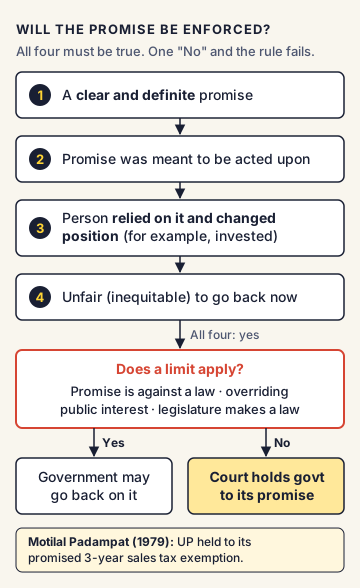
- Motilal Padampat Sugar Mills v. State of Uttar Pradesh (1979): This is the landmark case. Justice P.N. Bhagwati wrote the judgment. The Uttar Pradesh government had assured new industries a three-year sales tax exemption. The company set up a vanaspati (cooking fat) plant by borrowing money on this assurance. The court held the state bound by its promise and restored the exemption. It also said that in India, promissory estoppel can be used to start a case (as a cause of action), not only as a defence.
How does it work? The conditions
Courts usually check these points:
- There was a clear and definite promise (not a vague statement).
- The promise was meant to be acted upon.
- The other person actually relied on it and changed their position, for example by investing money or giving up something.
- It would be unfair (inequitable) to let the promise-maker go back on it now.
When does it NOT apply? The limits
- No estoppel against law: The government cannot be forced to keep a promise that is against a law or that it had no legal power to make.
- Public interest: If there is a strong, overriding public interest, the government may change its stand. The court must be satisfied that such public interest really exists. In Shrijee Sales Corporation v. Union of India (1996), the Supreme Court said the government can withdraw a promise when a greater public interest (a "supervening public equity") demands it.
- Sovereign and legislative functions: The rule cannot stop the legislature from making a law. A promise cannot block Parliament or a state legislature from changing the law.
- No reliance, no estoppel: If the person did not actually change their position because of the promise, the rule does not apply.
What is the legal basis?
Ordinary estoppel is written in the law of evidence. It was in Section 115 of the Indian Evidence Act, 1872, and is now in Section 121 of the Bharatiya Sakshya Adhiniyam, 2023, which replaced the old Act. Promissory estoppel, however, is mainly a rule of equity (fairness) developed by judges. Against the government, it is closely linked to Article 14, because the courts see breaking a promise without good reason as arbitrary and unfair state action.
Commonly confused concepts
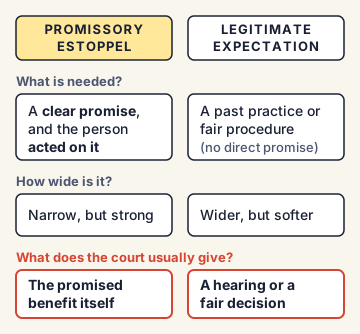
- Promissory estoppel vs legitimate expectation: Promissory estoppel needs a clear promise and that the person acted on it. Legitimate expectation is wider and softer: a person may reasonably expect the government to follow a past practice or a fair procedure, even without a direct promise. Usually legitimate expectation gives a right to be heard or to a fair decision, not a right to the exact benefit.
- Promissory estoppel vs estoppel by representation (Section 121, BSA): Estoppel by representation is about a statement of an existing fact ("this land is mine"). Promissory estoppel is about a promise for the future ("you will pay no tax for three years").
- Promissory estoppel vs a contract: A contract needs an offer, acceptance and "consideration" (something given in return). Promissory estoppel can apply even when there is no formal contract and no consideration, as long as the person relied on the promise.
- Equity vs law: "Law" means written rules in Acts and the Constitution. "Equity" means rules of fairness that judges use when strict law would give an unjust result.
Issues, criticism and the way forward
- Policy flexibility vs certainty: Governments argue they must be able to change tax and industrial policies when the economy changes. Investors argue that sudden changes destroy trust and discourage investment. Courts try to balance the two through the public interest exception.
- Uncertain outcomes: Because the public interest exception is broad, results differ from case to case. This makes it hard for people to know in advance whether a promise will be enforced.
- Use against private parties: The rule is applied with more care in private matters, such as an advertisement or a brochure, because a brochure is often not a clear, binding promise. Courts look at its exact words and whether the person truly relied on it.
- Way forward: Experts suggest that governments announce policy changes with notice periods and protect people who have already acted under the old policy (often called "grandfathering"). This keeps both flexibility and trust.
Concepts to Know
- Equity: Fairness. Courts use equitable rules when applying the strict law would give a clearly unjust result.
- Cause of action: The set of facts that gives a person the right to file a case in court.
- Grandfathering: Letting people who already acted under an old rule continue under that old rule, even after a new rule comes in.
- Arbitrary: A decision taken without good reason, by whim. Under Article 14, arbitrary state action is unconstitutional.
- Representation: In law, any statement, promise or assurance that one person gives to another.
- Origin in English law: Central London Property Trust v. High Trees House (1947), Justice Denning
- Union of India v. Indo-Afghan Agencies (1968): government bound by its export scheme
- Motilal Padampat Sugar Mills v. State of UP (1979): landmark; three-year sales tax exemption promise enforced; Justice P.N. Bhagwati
- In India it can be a cause of action, not only a defence
- Exceptions: no estoppel against a statute, against legislative power, or where overriding public interest exists (Shrijee Sales Corporation, 1996)
- Ordinary estoppel: Section 115, Indian Evidence Act, 1872, now Section 121, Bharatiya Sakshya Adhiniyam, 2023
● Tracked since October 18, 2026 · last seen October 18, 2026 · updates as the daily brief publishes