External Benchmark Lending Rate (EBLR)
How a Repo Rate Change Reaches Your Loan
The External Benchmark Lending Rate, or EBLR, is a way of setting the interest rate on a bank loan by linking it to a rate that the bank does not control, such as the RBI's repo rate. Your loan rate equals that outside "benchmark" plus a fixed extra amount called the spread. So when the RBI changes the repo rate, your loan rate changes too, within about three months.
Since October 1, 2019, all new floating-rate retail loans and loans to micro and small businesses given by banks must use such an external benchmark.
Why does it exist?
When the RBI cuts or raises the repo rate, it wants the change to reach ordinary borrowers. This passing-on is called monetary policy transmission. For many years, banks set loan rates using their own internal formulas. These formulas were slow and hard to check. When the RBI cut rates, banks often took months to cut loan rates, and sometimes did not cut them at all.
A borrower had no easy way to know if the bank was being fair. The EBLR fixed this by tying the loan rate to a public number that the bank cannot change.
Where did it come from? (A short history of loan benchmarks)
India tried several systems before the EBLR:
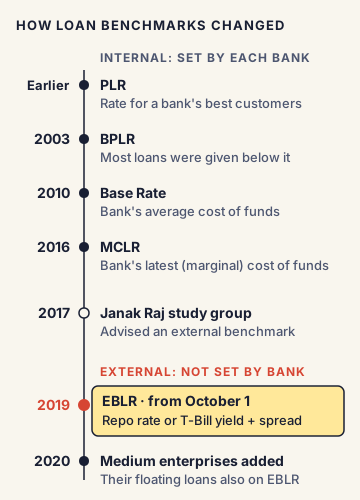
- Prime Lending Rate (PLR): Banks announced the rate they charged their best customers. Other loans were priced above it.
- Benchmark Prime Lending Rate (BPLR), April 2003: Meant to be more transparent, but banks lent a large share of loans below the BPLR, so it stopped being a real benchmark.
- Base Rate, July 2010: The minimum rate below which banks could not lend. It was based on the bank's average cost of funds, which changes slowly.
- Marginal Cost of Funds based Lending Rate (MCLR), April 1, 2016: Based on the bank's latest (marginal) cost of borrowing money. Faster than the Base Rate, but still an internal number calculated by each bank.
- External Benchmark Lending Rate (EBLR), October 1, 2019: The loan rate is linked to an outside benchmark.
The push for the EBLR came from an RBI Internal Study Group chaired by Dr. Janak Raj. Its report, released on October 4, 2017, found that internal benchmarks like the Base Rate and MCLR had not passed on policy changes well. It recommended a move to an external benchmark. The RBI then issued its circular on September 4, 2019.
How does it work, step by step?
- Each bank chooses one external benchmark for each type of loan (for example, all its home loans).
- The loan rate = benchmark + spread.
- The bank must reset the loan rate at least once every three months, so the benchmark change shows up quickly.
- The spread has two parts: the credit risk premium (extra charge based on how risky the borrower is) and other components (the bank's costs and margin).
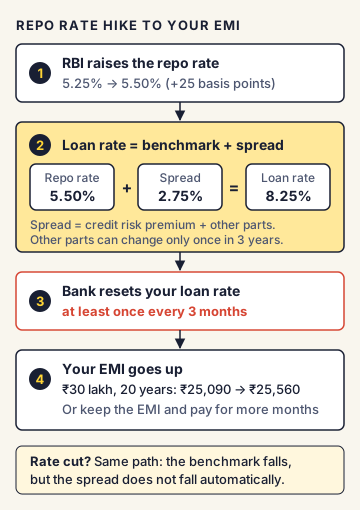
A simple example: Suppose your home loan is linked to the repo rate with a spread of 2.75%. If the repo rate is 5.25%, your rate is 8.00%. If the RBI raises the repo rate to 5.50%, your rate becomes 8.25% at the next reset. On a ₹30 lakh loan for 20 years, the EMI rises from about ₹25,090 to about ₹25,560, roughly ₹470 a month more. Or, if you keep the same EMI, the loan runs for more months.
The key rules
- Which loans? All new floating-rate personal or retail loans (home, car, education and similar) and floating-rate loans to micro and small enterprises from October 1, 2019. Loans to medium enterprises were added from April 1, 2020.
- Allowed benchmarks: The RBI repo rate; the government's 3-month Treasury Bill yield or 6-month Treasury Bill yield published by Financial Benchmarks India Pvt. Ltd. (FBIL); or any other market rate published by FBIL. Most banks chose the repo rate.
- One benchmark per loan category: A bank cannot use different benchmarks for loans of the same type.
- Reset: At least once in three months.
- Spread rules: The credit risk premium can change only if the borrower's credit assessment changes substantially. The other components can be changed only once in three years. From October 1, 2025, banks may reduce these other components earlier than three years if it benefits the borrower.
- Old loans: Existing borrowers on MCLR or Base Rate can switch to the EBLR, usually by paying a fee and agreeing to new terms.
India's position and examples
The EBLR has slowly taken over. As of end-September 2025, 64.8% of all outstanding floating-rate rupee loans of scheduled commercial banks were linked to an external benchmark. About 32.2% were still on MCLR, and the rest on older systems. In 2023 the RBI also added a borrower-protection rule. From its August 18, 2023 circular (to be applied by December 31, 2023), when the floating rate is reset, lenders must tell borrowers clearly and offer them choices: a higher EMI, a longer loan period, a mix of both, a switch to a fixed rate, or prepayment.
Commonly confused concepts
- EBLR vs MCLR: MCLR is an internal benchmark worked out by each bank from its own cost of funds. EBLR is linked to an external number such as the repo rate, which the bank does not control. EBLR reacts faster and is easier for borrowers to check.
- Repo-Linked Lending Rate (RLLR) vs EBLR: RLLR is simply an EBLR where the chosen benchmark is the repo rate. Most banks call their EBLR an RLLR.
- Floating rate vs fixed rate loan: A floating rate changes when the benchmark changes. A fixed rate stays the same for an agreed period. The EBLR rule applies only to floating-rate loans.
- Benchmark vs spread: The benchmark is the outside rate that moves with RBI policy. The spread is the bank's extra charge on top. A rate cut lowers the benchmark, but the bank's spread does not automatically fall.
Issues, criticism and the way forward
- Faster both ways: Fast transmission is good news when rates fall. But it also means borrowers feel rate hikes within three months. Households with large home loans face sudden EMI or tenure increases.
- Deposit side mismatch: Banks' loan rates now move quickly with the repo rate, but most of their deposits are fixed for a period. When rates fall, loan income falls fast while deposit costs fall slowly, squeezing bank profits. This is one reason banks are cautious.
- Old loans left behind: Many older borrowers are still on MCLR or Base Rate and do not get the full benefit of rate cuts unless they switch.
- Spread changes: Borrowers have complained that banks raised spreads quietly. The RBI's rules on when spreads can change, and its 2023 transparency rules, aim to address this.
- Way forward: Better borrower awareness, easier switching of old loans, and wider use of external benchmarks for other loan types (such as larger corporate loans) are often suggested.
Concepts to Know
- Repo rate: The interest rate at which the RBI lends short-term money to banks against government bonds. It is the RBI's main policy rate.
- Basis point: One-hundredth of a percentage point. 25 basis points = 0.25%.
- Monetary policy transmission: How a change in the RBI's policy rate spreads to the interest rates that ordinary people and businesses pay and earn.
- Treasury Bill (T-Bill): A short-term loan taken by the central government from the market, repaid within one year (for example in 91 days, about 3 months, or 182 days, about 6 months). Its yield is the interest it effectively pays.
- Financial Benchmarks India Pvt. Ltd. (FBIL): An independent company that calculates and publishes key Indian market interest rates used as benchmarks.
- EMI (Equated Monthly Instalment): The fixed amount you pay every month to repay a loan.
- Credit risk premium: Extra interest a bank charges because a borrower might not repay. A borrower with a better repayment record pays a smaller premium.
- EBLR mandatory for new floating-rate retail and MSE loans from October 1, 2019 (RBI circular of September 4, 2019); medium enterprises from April 1, 2020
- Benchmarks allowed: RBI repo rate, FBIL 3-month T-Bill yield, FBIL 6-month T-Bill yield, or any other FBIL market benchmark
- Reset at least once every 3 months; other spread components can change once in 3 years (may be reduced earlier from October 1, 2025)
- History: PLR → BPLR (April 2003) → Base Rate (July 2010) → MCLR (April 1, 2016) → EBLR (October 1, 2019)
- Janak Raj Internal Study Group report: October 4, 2017, recommended an external benchmark
- Share of EBLR-linked loans in outstanding floating-rate loans: 64.8% at end-September 2025 (MCLR: 32.2%)
- RBI circular of August 18, 2023: borrowers to be offered EMI/tenure choices and a switch to fixed rate at reset
● Tracked since October 07, 2026 · last seen October 07, 2026 · updates as the daily brief publishes