Export Control Regimes
Wassenaar Arrangement, MTCR, NSG and Australia Group
An export control is a rule by which a country stops or limits the sale of certain goods, software or know-how to other countries. Usually it applies to things that could help build weapons or that give a country an important strategic edge. Export control regimes are informal groups of countries that agree on common lists of such items and coordinate their rules.
There are four main global regimes: the Nuclear Suppliers Group (NSG), the Missile Technology Control Regime (MTCR), the Australia Group and the Wassenaar Arrangement.
Why do export controls exist?
Some products can be used for both peaceful and military purposes. A chemical used to make fertiliser can also be used to make a poison gas. A powerful computer chip can run a hospital system or a missile guidance system. These are called dual-use items. Countries want trade to continue, but they do not want these items to reach terrorists, rogue groups or countries building weapons of mass destruction (WMDs: nuclear, chemical and biological weapons).
Export controls are the filter. In recent years, countries also use them to protect a technology lead, as the news on solar shows.
Where did they come from?
During the Cold War, the US and its allies set up COCOM (Coordinating Committee for Multilateral Export Controls) in 1949 to stop Western technology from reaching the Soviet bloc. COCOM was closed on 31 March 1994, after the Cold War ended. Over time, more specialised groups were formed after specific shocks:
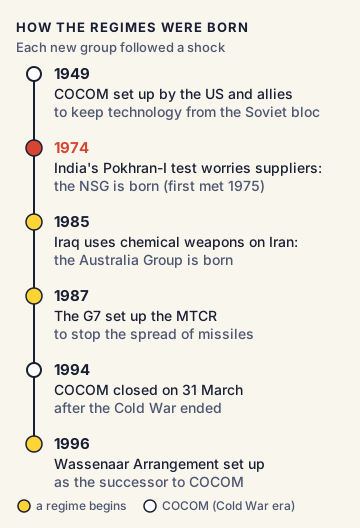
- 1974: India's first nuclear test (Pokhran-I, "Smiling Buddha") worried nuclear suppliers. Seven of them began meeting in London (first meeting 1975). This became the NSG.
- 1985: Iraq used chemical weapons in the Iran-Iraq war, partly using chemicals bought legally from abroad. This led to the Australia Group, which first met in Brussels in June 1985.
- 1987: The G7 countries (Canada, France, Germany, Italy, Japan, the UK and the US) set up the MTCR on 16 April 1987 to stop the spread of missiles.
- 1996: The Wassenaar Arrangement was set up as the successor to COCOM, to cover conventional arms and dual-use goods. It is named after Wassenaar, a town near The Hague in the Netherlands, where it was agreed.
How do they work?
None of these regimes is a treaty. They are voluntary, informal agreements, so they are not legally binding under international law. Each one works roughly like this:
- Members agree, by consensus (everyone must agree), on a control list of sensitive items.
- Each member makes these lists part of its own national law.
- A company that wants to export a listed item must get a licence from its government.
- Members share information about licences they have denied, so a buyer refused by one country cannot simply buy from another.
The four regimes at a glance
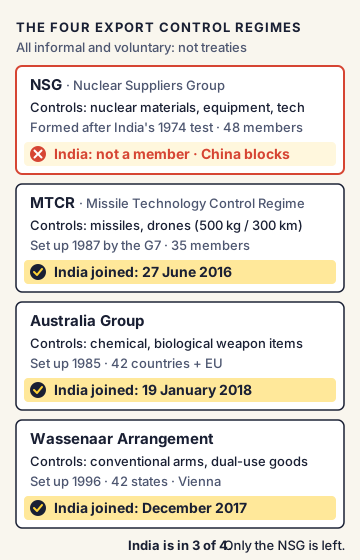
- Nuclear Suppliers Group (NSG): controls nuclear materials, equipment and technology. 48 participating governments. India is not a member. India received a special waiver from the NSG in September 2008, which allowed nuclear trade with India. Its membership bid has been blocked mainly by China, which argues that members should have signed the NPT (Nuclear Non-Proliferation Treaty).
- Missile Technology Control Regime (MTCR): controls missiles, drones and related technology. Its key test (Category I) is systems that can carry a 500 kg payload to 300 km or more. 35 members. India joined on 27 June 2016 as the 35th member. This was India's first entry into any of these regimes. China is not a member.
- Australia Group: controls chemicals and biological agents (and equipment) that could be used for chemical and biological weapons. 42 countries plus the European Union. India joined on 19 January 2018.
- Wassenaar Arrangement: controls conventional weapons and dual-use goods and technologies (such as advanced electronics, computers, sensors, lasers). 42 participating states; secretariat in Vienna, Austria. India joined in December 2017 as the 42nd member. China is not a member.
National export control systems
The regimes only work through national laws. Some examples:
- India: The SCOMET list (Special Chemicals, Organisms, Materials, Equipment and Technologies) is kept by the Directorate General of Foreign Trade (DGFT). Its legal basis is the Foreign Trade (Development and Regulation) Act, 1992 (Chapter IVA, added in 2010) and the Weapons of Mass Destruction and their Delivery Systems (Prohibition of Unlawful Activities) Act, 2005. The WMD Act bans giving any listed item to terrorists or non-state actors. India also has a "catch-all" rule: even an unlisted item can be stopped if it may be used for WMDs.
- United States: The Export Control Reform Act (ECRA), 2018 and the Bureau of Industry and Security (BIS), which keeps the Entity List of foreign firms that need special licences. The US has used this widely to restrict advanced chips and chip-making tools going to China.
- China: China passed its first unified Export Control Law, adopted on 17 October 2020 and in force from 1 December 2020. It also keeps a Catalogue of Technologies Prohibited and Restricted from Export, issued by the Ministry of Commerce and the Ministry of Science and Technology. The catalogue was last fully revised on 21 December 2023, which added items such as rare earth processing technology. China has also put licences on exports of gallium and germanium (from 1 August 2023) and of seven medium and heavy rare earths (from April 2025).
India's position
India sees itself as a responsible country with a clean record of not spreading weapons technology, even though it has not signed the NPT. Joining the MTCR, Wassenaar and Australia Group was a big diplomatic gain. It made it easier for India to get high technology from partners such as the US, Japan and France. Being in the MTCR also allows India to export missiles such as BrahMos to friendly countries more easily. NSG membership remains India's unfinished goal.
Commonly confused concepts
- Export control vs export ban vs export duty: An export control means you need a licence; the government may say yes or no. An export ban means it is not allowed at all. An export duty is just a tax on exports; the sale is allowed but costs more.
- Export control vs sanctions: Export controls cover items (what you cannot sell freely). Sanctions target countries, firms or people (whom you cannot deal with), and often cover all trade and finance.
- Regime vs treaty: The NPT, the Chemical Weapons Convention (CWC) and the Biological Weapons Convention (BWC) are treaties: legally binding. NSG, MTCR, Australia Group and Wassenaar are regimes: informal and voluntary.
- Australia Group vs CWC: The CWC (1993) bans chemical weapons for its members and is checked by the OPCW. The Australia Group only coordinates export lists to stop chemicals reaching weapons makers.
- Wassenaar vs COCOM: COCOM was aimed at one group of countries (the Soviet bloc). Wassenaar is not aimed at any country; it is about transparency and responsibility in sensitive trade.
- India is in three of four: MTCR (2016), Wassenaar (2017), Australia Group (2018). Not in the NSG.
Issues, criticism and the way forward
- Clubs of the powerful: Critics say these regimes let a few rich countries decide who gets advanced technology. Developing countries argue this slows their growth.
- Consensus means veto: Because every member must agree, one country can block a new member, as seen with India's NSG bid.
- Tech-security mixing: Export controls were meant for weapons. Now countries use them for economic competition, for example on chips, rare earths and solar technology. This can break global supply chains and raise prices for everyone.
- Weaponising supply chains: When one country controls most of a product, its export controls become a strong pressure tool. This pushes others to "de-risk" by building their own industries or diversifying suppliers.
- Enforcement gaps: Items can be routed through third countries. Intangible transfers (emails, cloud files, trained engineers) are hard to track.
- Way forward for India: strengthen the SCOMET system and industry awareness, keep pushing for NSG membership, build domestic capability in critical technologies, and work with trusted partners (through groupings such as the Quad and the US-India TRUST initiative on critical technologies) to diversify supply chains.
Concepts to Know
- Dual-use item: A product, material or technology that can be used for normal civilian work and also for making weapons.
- Weapons of mass destruction (WMD): Weapons that can kill very large numbers of people at once: nuclear, chemical and biological weapons.
- NPT (Treaty on the Non-Proliferation of Nuclear Weapons, 1968): A treaty that allows only five countries (US, Russia, UK, France, China) to keep nuclear weapons and asks others not to get them. India has not signed it because it sees it as unfair.
- Consensus: A decision is made only when no member objects. Every member has, in effect, a veto.
- Licence (export licence): Written permission from the government that allows a company to send a controlled item abroad.
- Payload: The load a missile or rocket carries, such as a warhead or a satellite.
- Rare earths: A group of 17 metals used in magnets, electronics, wind turbines and electric vehicles. China mines and processes most of them.
- COCOM: 1949 to 31 March 1994; Wassenaar Arrangement set up in 1996 as its successor (secretariat in Vienna); 42 participating states
- NSG: formed after India's 1974 test; 48 participating governments; India not a member; NSG waiver for India in September 2008
- MTCR: 16 April 1987 by the G7; 500 kg / 300 km threshold; 35 members; India joined 27 June 2016
- Australia Group: 1985; 42 countries plus the EU; India joined 19 January 2018
- India: SCOMET list (DGFT); FTDR Act, 1992 (Chapter IVA, 2010); WMD Act, 2005
- US: Export Control Reform Act, 2018; BIS Entity List
- China: Export Control Law in force from 1 December 2020; Catalogue of Technologies Prohibited and Restricted from Export last revised 21 December 2023; gallium and germanium licensing from 1 August 2023; seven rare earths from April 2025
● Tracked since March 04, 2026 · last seen October 18, 2026 · updates as the daily brief publishes