Environmentally Harmful Subsidies
Environmentally harmful subsidies are government support that makes it cheaper or more profitable to do things that damage nature. Examples are money that makes fishing boats' fuel cheaper so they catch too many fish, or very cheap fertiliser that farmers overuse until the soil and water are poisoned. Most of these subsidies were created for good reasons, like helping farmers or keeping fuel cheap.
But as a side effect, they push people to pollute, overuse resources and destroy habitats. Under the Kunming-Montreal Global Biodiversity Framework, countries have promised to cut such subsidies by at least US$500 billion a year by 2030.
What exactly is a "harmful incentive"?
An incentive is anything that encourages people to act in a certain way. A subsidy is one kind: money or a benefit from the government, such as a lower price, a tax break or a direct payment. It becomes harmful to biodiversity when it encourages damage that would not happen without it. Global agreements use the wider phrase "incentives, including subsidies", because harmful pushes can also come from rules, for example land rules that reward clearing forests for farming.
Why does it matter so much?
Think of a family that wants to save money but also pays a monthly bill for something that wastes money. Cutting the waste is easier than earning more. In the same way, governments spend large sums on conservation but much larger sums on support that harms nature. The CBD calls harmful subsidies an important "underlying driver" of biodiversity loss. So reforming them does two jobs: it stops paying for damage, and it frees money that can be used for conservation.
How big is the problem?
Estimates differ because data is poor:
- A study by the research group Earth Track in February 2022 put environmentally harmful subsidies at about US$1.8 trillion a year.
- Its 2024 update raised this to at least US$2.6 trillion a year (for 2023), about 2.5% of world GDP. Much of the rise came from fossil-fuel support after the Russia-Ukraine war pushed up energy prices.
- In that update, fossil fuels got the most (about US$1.05 trillion), followed by agriculture (about US$610 billion).
- The International Institute for Sustainable Development (IISD) puts the figure at at least US$2 trillion a year. The authors say these numbers are probably underestimates.
Where did the global commitment come from?
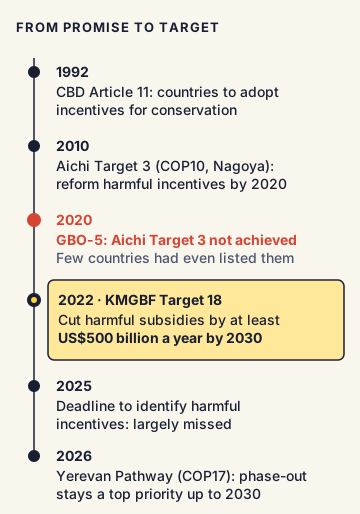
- 1992: Article 11 of the CBD asks each country to adopt incentive measures that support conservation and sustainable use.
- 2010: At COP10 in Nagoya, Japan, countries adopted the Aichi Biodiversity Targets. Aichi Target 3 said that by 2020, incentives including subsidies harmful to biodiversity should be eliminated, phased out or reformed.
- 2020: The Global Biodiversity Outlook 5 (GBO-5) report found Aichi Target 3 was not achieved. Little progress had been made, and few countries had even listed their harmful subsidies.
- 2022: KMGBF Target 18 set a clearer, number-based goal (details below).
- 2026: The Yerevan Pathway, agreed at COP17, again lists phasing out harmful subsidies as a top priority up to 2030.
What does Target 18 ask for?
Target 18 has three parts:
- Identify harmful incentives, including subsidies, by 2025.
- Eliminate, phase out or reform them in a fair and equitable way, cutting them substantially and step by step by at least US$500 billion a year by 2030, starting with the most harmful.
- Scale up positive incentives that reward conservation, such as paying communities to protect forests.
The CBD's guidance adds that "most harmful" does not always mean "largest in money terms". A small subsidy that drives a species to extinction can be more harmful than a big one with mild effects. Target 18 is linked to SDG target 12.c (reform wasteful fossil-fuel subsidies) and SDG target 14.6 (end fisheries subsidies that cause overfishing).
How are countries doing?
An IISD review of 135 national reports found that about two-thirds reported on Target 18, but only 44% mentioned harmful subsidies at all. Fewer than half of those named any specific harmful support. So the 2025 deadline to identify harmful incentives was largely missed.
Main sectors and examples
- Fossil fuels: Cheap petrol, diesel, coal and gas increase burning, air pollution and climate change, which in turn harms ecosystems.
- Agriculture: Support tied to producing more of one crop, or to cheap chemical inputs, can lead to monoculture (growing one crop again and again), overuse of fertiliser and pesticide, and clearing of natural land.
- Fisheries: Fuel and boat-building subsidies keep too many boats at sea. GBO-5 noted about US$22 billion a year going to subsidies that expand fishing fleets.
- Water and power: Free or very cheap electricity for pumping water can lead to over-extraction of groundwater.
The WTO fisheries deal: one real step
The WTO Agreement on Fisheries Subsidies was adopted at the WTO's 12th Ministerial Conference (MC12) in June 2022. It bans subsidies for illegal, unreported and unregulated (IUU) fishing, for fishing already overfished stocks, and for fishing on the unregulated high seas. It entered into force on 15 September 2025, after two-thirds of WTO members accepted it.
India deposited its acceptance in July 2026. This first part ("Fish 1") will end in about four years unless broader rules ("Fish 2") on subsidies that cause overcapacity are agreed.
India's position and Indian examples
India's subsidies are mostly aimed at food security and protecting poor farmers and consumers, so India supports a gradual, fair approach rather than sudden cuts. Some Indian examples:
- Fertiliser subsidy: Urea is sold at a fixed low price, while other fertilisers get a fixed subsidy per nutrient. Cheap urea encourages farmers to use too much nitrogen. The recommended balance of nitrogen, phosphorus and potash (N:P:K) is about 4:2:1, but Indian use leans heavily towards nitrogen. This harms soil health and pollutes water.
- PM-PRANAM (approved June 2023): This is a reform-style scheme. States that cut chemical fertiliser use below their 3-year average get a grant equal to 50% of the subsidy saved, to spend on alternatives.
- Free farm power: In several states, free electricity for farm pumps has encouraged over-pumping of groundwater.
- Positive incentives: Support for natural and organic farming, and payments under the Green Credit Programme, try to reward good behaviour instead.
- India's updated NBSAP (2024) includes a national target matching KMGBF Target 18. With support from UNDP's Biodiversity Finance Initiative (BIOFIN), studies have been carried out on which farm subsidies affect biodiversity.
Commonly confused concepts
- Environmentally harmful subsidies vs fossil fuel subsidies: Fossil fuel subsidies are only one part. Harmful subsidies also include agriculture, fisheries, water, forestry and more.
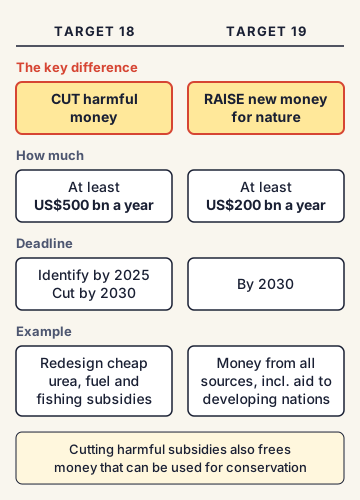
- Target 18 vs Target 19: Target 18 is about cutting harmful money (at least US$500 billion a year by 2030). Target 19 is about raising new money for biodiversity: at least US$200 billion a year from all sources by 2030, including international finance to developing countries.
- Aichi Target 3 vs KMGBF Target 18: Aichi Target 3 (2010) had a 2020 deadline and no money figure; it was not achieved. Target 18 (2022) has a 2030 deadline and a clear US$500 billion figure.
- Reform vs removal: Reform does not always mean ending support. It can mean redesigning it, for example paying farmers for soil health instead of for buying more urea.
Issues, criticism and the way forward
- Social impact: Removing subsidies can raise food and fuel prices for poor families. Many developing countries, including India, stress that reform must protect livelihoods and food security.
- Political difficulty: Subsidies have strong supporters, so governments find them hard to cut.
- Poor data: Many countries have not even listed their harmful subsidies, so progress is hard to measure.
- Fairness: Developing countries point out that rich countries give large farm and fossil-fuel subsidies too, and ask for finance and technology to help them change.
- Way forward: Experts suggest first listing all harmful subsidies, then redirecting money to positive incentives, using direct cash support for the poor instead of cheap inputs, phasing changes in slowly, and aligning national budgets with biodiversity goals, as the Yerevan Pathway recommends.
Concepts to Know
- Subsidy: Help from the government that lowers the price of something or adds to a producer's income, for example cheap urea or cheap diesel.
- Positive incentive: A reward for protecting nature, such as paying a village for keeping its forest standing.
- Monoculture: Growing the same single crop on the same land again and again. It reduces the variety of plants and insects and weakens the soil.
- Overfishing: Catching fish faster than they can breed and replace themselves, so fish stocks shrink.
- IUU fishing: Illegal, unreported and unregulated fishing: fishing that breaks rules, is hidden from authorities, or happens where there are no rules.
- GDP (Gross Domestic Product): The total value of all goods and services a country or the world produces in a year.
- NBSAP (National Biodiversity Strategy and Action Plan): Each country's own plan for how it will meet the CBD's goals and targets.
- CBD Article 11 (1992): asks Parties to adopt incentive measures for conservation
- Aichi Target 3 (2010, COP10, Nagoya): harmful incentives to be reformed by 2020; judged not achieved by GBO-5 (2020)
- KMGBF Target 18 (2022): identify by 2025; cut by at least US$500 billion a year by 2030; scale up positive incentives
- KMGBF Target 19: mobilise at least US$200 billion a year for biodiversity by 2030
- Earth Track estimates: US$1.8 trillion (2022 report); at least US$2.6 trillion, about 2.5% of world GDP (2024 update)
- Linked SDG targets: 12.c (fossil-fuel subsidies) and 14.6 (fisheries subsidies)
- WTO Agreement on Fisheries Subsidies: adopted June 2022 (MC12); in force 15 September 2025; India joined July 2026
- PM-PRANAM (June 2023): states get 50% of fertiliser subsidy savings as a grant
● Tracked since November 12, 2026 · last seen November 12, 2026 · updates as the daily brief publishes