Earth's Energy Imbalance (EEI)
Why the Planet Keeps Heating Up
Earth's energy imbalance, or EEI, is the difference between the energy that reaches the Earth from the Sun and the energy that the Earth sends back out to space. If the two are equal, the planet's temperature stays steady. If more comes in than goes out, the extra energy stays behind as heat and the planet warms. Today the imbalance is positive and growing, which means the Earth is gaining heat every second.
Why is it so important?
Think of the Earth as a bank account for heat. Sunlight is the money coming in, and the heat Earth sends to space is the money going out. The energy imbalance is the monthly savings. Global temperature tells you how much is in the account today. The imbalance tells you how fast it is growing. That is why many scientists call EEI the most basic measure of climate change: it shows how much more warming is still on the way, even before thermometers record it.
How does Earth's energy budget work?
Energy moves in two directions:
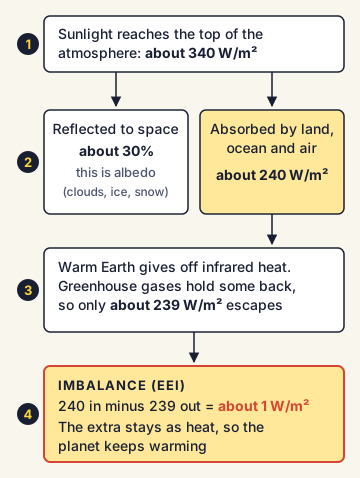
- Coming in: the Sun sends light energy. Averaged over the whole globe, day and night, about 340 watts per square metre (W/m²) reaches the top of the atmosphere. About 30% is reflected straight back to space by clouds, ice, snow and bright surfaces. This reflecting power is called albedo. The remaining roughly 240 W/m² is absorbed by the land, oceans and air.
- Going out: the warmed Earth gives off energy as invisible infrared heat (longwave radiation). In a balanced climate, this outgoing heat equals the absorbed sunlight.
Greenhouse gases like carbon dioxide and methane let sunlight in but absorb part of the outgoing infrared heat and send some of it back down. So less heat escapes. The Earth then has to warm up until it gives off enough heat to balance the budget again. Until that happens, an imbalance remains.
How big is the imbalance?
It is about 1 W/m². That sounds tiny next to 340 W/m². But it acts on every square metre of the planet, all the time. Spread over the whole Earth (about 510 million square kilometres), 1 W/m² adds up to roughly 500 trillion watts of extra heat. That is many times more than all the energy humans use.
Where did the idea come from?
Scientists have long known that a climate is stable only when incoming and outgoing energy balance. In 2005, a team led by NASA scientist James Hansen published a study in the journal Science using ocean data to show that Earth was taking in more energy than it lost. Since then, better tools have allowed it to be measured directly:
- Satellites: NASA's CERES (Clouds and the Earth's Radiant Energy System) instruments have measured sunlight reflected and heat given off by Earth since 2000.
- Ocean floats: the Argo programme, launched in 1999, began placing floats in 2000. Today about 4,000 robotic floats drift across the oceans. Every 10 days, each one dives to about 2,000 metres and comes back up, measuring temperature and saltiness.
It has doubled
A NASA and NOAA study (Loeb and others, 2021) used both satellites and ocean floats. Both showed the imbalance roughly doubled in 14 years, from about 0.42 W/m² in mid-2005 to about 1.12 W/m² in mid-2019. The WMO's State of the Global Climate 2025 report, released in March 2026, listed EEI as one of its key climate indicators for the first time.
Where does the extra heat go?
A major 2023 study (von Schuckmann and others) found that the Earth system gained about 381 zettajoules of heat between 1971 and 2020 (one zettajoule is a billion trillion joules). It was shared like this:
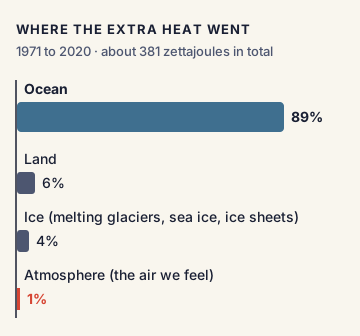
- Ocean: about 89%
- Land: about 6%
- Ice (used to melt glaciers, sea ice and ice sheets): about 4%
- Atmosphere: about 1%
So the air, where we feel the warming, gets only a tiny share. The ocean is the planet's main heat store. This is why ocean heat keeps setting records and why sea levels keep rising, because warm water expands.
Why is the imbalance growing?
Scientists point to several causes working together:
- More greenhouse gases: CO₂ and methane concentrations keep climbing, trapping more outgoing heat.
- Fewer bright clouds and less sea ice: less of the Sun's light is reflected, so more is absorbed.
- Cleaner air: tiny particles of pollution, called aerosols, reflect sunlight and help form brighter clouds. As countries cut air pollution, this "hidden cooling" weakens. One example is the 2020 International Maritime Organization rule that cut the allowed sulphur in ship fuel from 3.5% to 0.5%. Some scientists, including Hansen's group, argue this sped up warming; others think its effect is smaller.
- Natural cycles: ocean patterns like the Pacific Decadal Oscillation and El Niño can add to or reduce the imbalance for some years.
Why it matters for India
Most of the extra heat goes into the oceans that surround India. Warmer seas can strengthen cyclones, cause marine heatwaves that damage coral reefs and fisheries, and push up sea levels along a long, crowded coastline. On land, a growing imbalance means more frequent and harsher heatwaves, like the April 2026 heatwave that exposed 146.5 million people in India to extreme heat. India takes part in global ocean observation, including Argo, through the Indian National Centre for Ocean Information Services (INCOIS) in Hyderabad.
Commonly confused concepts
- Energy imbalance vs global temperature: temperature is the level of warming reached; the imbalance is the rate at which heat is being added. Temperature can dip for a year (for example during La Niña) while the imbalance stays high.
- Energy imbalance vs radiative forcing: radiative forcing is the push on the climate from a change, such as extra CO₂. The imbalance is what remains after the Earth has partly warmed and adjusted to that push.
- Energy imbalance vs greenhouse effect: the greenhouse effect is natural and keeps Earth livable. The imbalance appears when humans add greenhouse gases faster than the Earth can adjust.
- W/m² vs zettajoules: W/m² is a rate (how fast heat is coming in). Zettajoules is a total amount of heat gathered over a period.
Issues, criticism and the way forward
- Warming already "in the pipeline": even if emissions stopped tomorrow, the Earth would keep warming until the imbalance closes. This makes the Paris Agreement's 1.5°C goal harder to meet.
- Measurement limits: satellites measure changes very precisely, but the absolute value relies on ocean data. Gaps remain in the deep ocean below 2,000 metres and under sea ice.
- The aerosol dilemma: cutting air pollution saves millions of lives, but it removes a cooling cover. Scientists say the answer is to cut greenhouse gases faster, not to keep polluting.
- Way forward: quick cuts in short-lived gases like methane, which traps over 80 times more heat than CO₂ over its first 20 years, can slow warming relatively fast. Steady cuts in CO₂ are needed to close the gap in the long run. Experts also call for steady funding for satellites, ocean floats and weather services, since these are how the imbalance is tracked.
Concepts to Know
- Watt per square metre (W/m²): a unit that tells how much energy flows onto or out of one square metre every second. It is like measuring how fast water pours into a tank.
- Albedo: how much sunlight a surface reflects. Fresh snow reflects a lot (high albedo); dark ocean absorbs most (low albedo). Earth's average albedo is about 0.3.
- Infrared (longwave) radiation: the invisible heat that warm objects give off. You feel it standing near a hot stove without touching it.
- Aerosols: tiny solid or liquid particles in the air, such as sulphate from burning coal or ship fuel. Many of them reflect sunlight and cool the Earth a little.
- Zettajoule (ZJ): a very large unit of energy, equal to 10²¹ joules.
- ppm / ppb: parts per million and parts per billion; ways of showing how many molecules of a gas are present in a million or a billion molecules of air.
- EEI = incoming sunlight absorbed minus outgoing heat; positive EEI means the planet is gaining heat
- Average sunlight at the top of the atmosphere: about 340 W/m²; Earth's albedo about 0.3; absorbed about 240 W/m²
- EEI roughly doubled from about 0.42 W/m² (mid-2005) to about 1.12 W/m² (mid-2019) (Loeb and others, 2021, using CERES satellites and Argo floats)
- Heat gained 1971–2020: about 381 ZJ; split 89% ocean, 6% land, 4% ice, 1% atmosphere (von Schuckmann and others, 2023)
- Argo: launched 1999, floats from 2000, about 4,000 floats, profiles to 2,000 m every 10 days
- IMO 2020 rule: sulphur in ship fuel cut from 3.5% to 0.5%
- WMO State of the Climate Update 2026: EEI at its highest since monitoring began
● Tracked since November 09, 2026 · last seen November 09, 2026 · updates as the daily brief publishes