Greenhouse Effect
How Gases Trap Heat Around the Earth
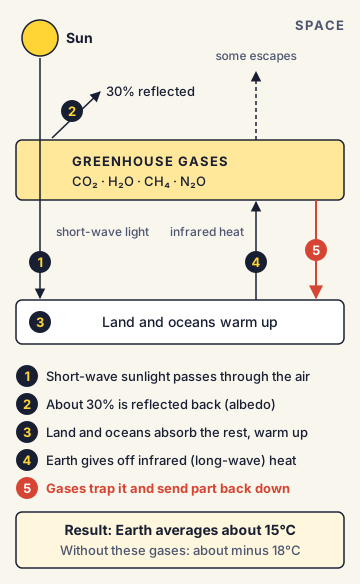
The greenhouse effect is the natural process by which some gases in the air trap the Sun's heat and keep the Earth warm. Sunlight comes in and warms the ground, and the warm ground sends heat back towards space. Certain gases, called greenhouse gases, catch part of this outgoing heat and send it back down. Without this effect, the Earth would be a frozen planet. With too much of it, the Earth heats up, and that extra heating is what we call global warming.
Why is it called a "greenhouse"?
A greenhouse is a glass house used to grow plants in cold countries. Sunlight enters through the glass, and the warm air stays trapped inside, so it is warmer inside than outside. Greenhouse gases do a similar job for the whole planet, like a blanket on a cold night. The comparison is not perfect: a real greenhouse mainly stops warm air from escaping, while greenhouse gases absorb and re-send heat rays. But the idea of "letting heat in and holding it back" is the same.
How does it work, step by step?
- The Sun sends energy mostly as visible light and short-wave radiation. This passes easily through the air.
- About 30% of this sunlight is reflected straight back to space by clouds, ice and bright surfaces. This share is called albedo.
- The rest is absorbed by land and oceans, which get warm.
- The warm Earth gives off heat as infrared (long-wave) radiation, the same kind of heat you feel from a hot road at night.
- Greenhouse gas molecules absorb this infrared heat and send it out again in all directions, including back down to the surface.
- So the surface stays warmer than it would otherwise be.
The two main gases in air, nitrogen (about 78%) and oxygen (about 21%), do not trap infrared heat. Only gases with three or more atoms, or with uneven molecules, like CO₂, water vapour and methane, can do this. That is why gases present in tiny amounts can still change the climate so much.
How big is the natural effect?
The Earth's average surface temperature today is about 15°C. Without any greenhouse gases it would be about minus 18°C. So the natural greenhouse effect keeps the Earth about 33°C warmer and makes liquid water and life possible. The problem is not the effect itself but the enhanced greenhouse effect: extra gases added by human activity that trap more heat than nature intended.
Where did the idea come from?
- Joseph Fourier (France) argued in the 1820s that the atmosphere keeps the Earth warmer than it would otherwise be.
- Eunice Foote (USA) showed in 1856 through experiments that air with more CO₂ heats up more in sunlight.
- John Tyndall (Ireland/UK) measured in 1859 which gases absorb heat radiation. He found water vapour, CO₂ and methane were strong absorbers.
- Svante Arrhenius (Sweden) in 1896 was the first to calculate how much the Earth would warm if CO₂ in the air changed. He estimated about 5–6°C of warming for a doubling of CO₂.
- Charles David Keeling began continuous CO₂ measurements at Mauna Loa, Hawaii, in 1958. The rising line on his graph, the Keeling Curve, became the clearest proof that CO₂ in the air keeps increasing.
The main greenhouse gases
Each gas differs in how strongly it traps heat and how long it stays in the air:
- Water vapour (H₂O): The largest natural greenhouse gas. Humans do not control it directly. It works as a feedback: warmer air holds more water vapour, which traps more heat and warms the air further.
- Carbon dioxide (CO₂): Comes mainly from burning coal, oil and gas, making cement, and cutting forests. It is the biggest driver of human-caused warming. Part of each emission stays in the air for centuries to thousands of years.
- Methane (CH₄): Comes from wetlands (natural), and from cattle, rice paddies, landfills, coal mines and oil and gas leaks (human). About 65% of methane emissions today are from human activities. It lasts only about 12 years in the air, but traps far more heat than CO₂ per kilogram.
- Nitrous oxide (N₂O): Comes mainly from nitrogen fertilisers, animal manure and some industries. It lasts about 109 years and also damages the ozone layer.
- Fluorinated gases (F-gases): Man-made gases used in ACs, fridges, electrical equipment and industry, such as HFCs, PFCs, SF₆ and NF₃. They exist in tiny amounts but are thousands of times stronger than CO₂.
- Ozone (O₃) near the ground: Formed from vehicle and factory pollution in sunlight. It is both a pollutant and a greenhouse gas.
How do scientists measure the warming effect?
They use radiative forcing: the extra energy, in watts per square metre, that greenhouse gases keep in the Earth system compared with before 1750. If more energy comes in than goes out, the Earth must warm until balance returns. To compare gases, scientists use Global Warming Potential (GWP), which tells how much heat one kilogram of a gas traps compared with one kilogram of CO₂ over a set time, usually 100 years.
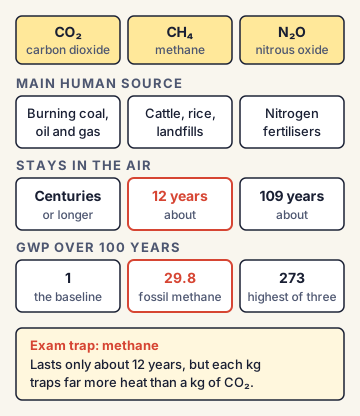
In the IPCC's 2021 report (AR6), the 100-year GWP of fossil methane is 29.8 and of nitrous oxide is 273.
Concentration vs emission
The amount of a gas in the air (concentration) is not the same as how much is released each year (emissions). Roughly half of the CO₂ we emit is absorbed by forests, soils and oceans, called carbon sinks. The rest piles up in the air. So even if emissions stop growing, concentrations keep rising until emissions fall close to what sinks can absorb. This is why warming is "locked in" for a long time.
The global response
- UNFCCC (1992): The UN climate treaty, adopted at the Rio Earth Summit, whose aim is to stabilise greenhouse gas concentrations at a safe level.
- Kyoto Protocol (1997): Set binding cuts only for developed countries, for a basket of gases: CO₂, CH₄, N₂O, HFCs, PFCs and SF₆, with NF₃ added by the Doha Amendment (2012).
- Paris Agreement (2015): All countries set their own targets, called Nationally Determined Contributions (NDCs), to keep warming well below 2°C and try for 1.5°C above pre-industrial levels.
- Kigali Amendment (2016) to the Montreal Protocol: phases down HFCs.
- Global Methane Pledge (2021): Aims to cut global methane emissions by 30% from 2020 levels by 2030.
India's position and Indian examples
- India is one of the world's largest total emitters, but its emissions per person are far below the world average. India argues that rich countries caused most past emissions and must act first and provide finance. This is the principle of Common But Differentiated Responsibilities (CBDR).
- India's updated NDC (approved in August 2022) aims to cut the emissions intensity of GDP by 45% by 2030 from 2005 levels and reach about 50% non-fossil power capacity by 2030. India announced net zero by 2070 at COP26 (2021).
- India crossed 50% non-fossil installed power capacity in June 2025, five years early.
- India's NDC for 2035, approved by the Union Cabinet in March 2026, targets a 47% cut in emissions intensity from 2005 levels and about 60% non-fossil power capacity by 2035.
- India has not signed the Global Methane Pledge. A large part of its methane comes from rice farming and cattle, which support millions of small farmers.
Commonly confused concepts
- Greenhouse effect vs global warming: The greenhouse effect is natural and needed for life. Global warming is the extra rise in temperature caused by the enhanced greenhouse effect.
- Greenhouse effect vs ozone hole: The ozone layer (in the stratosphere, about 15–35 km up) blocks harmful ultraviolet rays. Its thinning is caused by CFCs and is handled by the Montreal Protocol. It is a different problem, though some gases (CFCs, N₂O) affect both.
- Short-wave vs long-wave radiation: Sunlight arrives mainly as short-wave radiation, which greenhouse gases let through. The Earth sends back long-wave (infrared) heat, which greenhouse gases trap.
- Greenhouse gases vs aerosols: Aerosols (tiny particles like sulphate dust from coal burning) mostly cool the Earth by reflecting sunlight, hiding part of the warming. Black carbon (soot) is an exception that warms.
- Concentration (ppm/ppb) vs emissions (tonnes): One measures how much gas is in the air, the other how much is released.
Issues, criticism and the way forward
- Concentrations keep rising every year despite climate pledges, because emissions are still high and sinks absorb only part of them.
- Weakening sinks: Heat, droughts and fires can turn forests from sinks into sources, and warmer, more acidic oceans may absorb less CO₂.
- Methane's quick effect: Because methane is short-lived but powerful, experts see cutting it (fixing gas leaks, better rice farming, landfill gas capture) as the fastest way to slow warming in the near term.
- Fairness debates: Developing countries stress historical responsibility, per-person emissions and the need for climate finance, while developed countries push for all big emitters to cut faster.
- Way forward: Faster shift to clean energy, protecting and restoring forests, cutting methane and F-gases, and better monitoring of emissions.
Concepts to Know
- ppm and ppb: Parts per million and parts per billion. 426.8 ppm of CO₂ means about 427 molecules of CO₂ in every million molecules of air.
- Pre-industrial level: The amount of a gas before about 1750, when large-scale burning of coal began with the Industrial Revolution. CO₂ was about 278 ppm then.
- Infrared radiation: Heat rays we cannot see but can feel, like the warmth from a hot iron.
- Albedo: How much sunlight a surface reflects. Fresh snow has high albedo; dark oceans and forests have low albedo.
- Feedback: A loop where a change causes effects that make the original change bigger (positive feedback) or smaller (negative feedback).
- Emissions intensity: The amount of greenhouse gas released for every unit of GDP. It can fall even while total emissions rise.
- El Niño: A periodic warming of the central and eastern Pacific Ocean that raises global temperatures and causes droughts and fires in many places, weakening land sinks.
- Earth's average surface temperature: about 15°C; without greenhouse gases: about minus 18°C (a difference of about 33°C)
- About 30% of incoming sunlight is reflected back (Earth's albedo)
- Tyndall (1859) measured heat absorption by gases; Arrhenius (1896) first calculated CO₂-driven warming; Keeling began Mauna Loa CO₂ records in 1958
- Lifetimes: methane about 12 years; nitrous oxide about 109 years; part of CO₂ for centuries to millennia
- AR6 100-year GWP: fossil methane 29.8, non-fossil methane 27.0, nitrous oxide 273
- Kyoto basket: CO₂, CH₄, N₂O, HFCs, PFCs, SF₆ (+ NF₃ from the Doha Amendment, 2012)
- India's 2022 NDC: 45% cut in emissions intensity by 2030 (vs 2005); about 50% non-fossil capacity by 2030; net zero by 2070
- India's 2035 NDC: 47% cut in emissions intensity (vs 2005); about 60% non-fossil capacity
● Tracked since October 28, 2026 · last seen October 28, 2026 · updates as the daily brief publishes