Doppler Effect
How Motion Changes Waves
The Doppler effect is the change in the frequency (and wavelength) of a wave when the source of the wave and the observer are moving towards or away from each other. You hear it every day: an ambulance siren sounds higher-pitched as it comes towards you and lower-pitched as it moves away. The same thing happens with light. Scientists use it to measure the speed of things they cannot touch, from storms and cars to stars and galaxies.
Why does it happen?
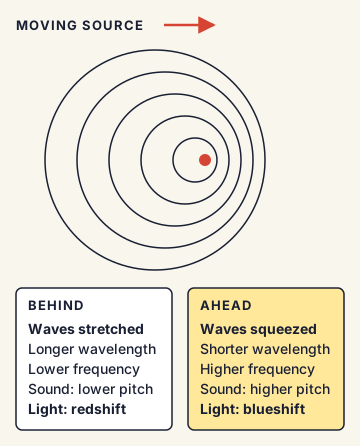
Imagine a duck in a pond tapping the water to make ripples. If the duck stays still, the ripples spread out evenly in all directions. If the duck swims forward, the ripples in front get squeezed together, and the ripples behind get stretched apart. Squeezed waves have a shorter wavelength and higher frequency. Stretched waves have a longer wavelength and lower frequency. For sound, a higher frequency means a higher pitch. For light, it means a change in colour.
Where did it come from?
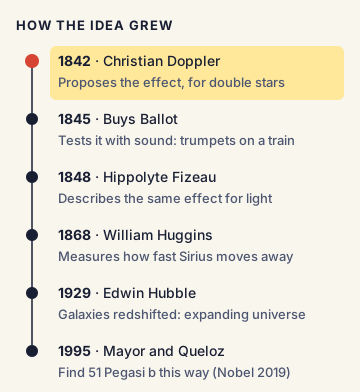
- 1842: Austrian physicist Christian Doppler proposed the idea. He wanted to explain the colours of some double stars.
- 1845: Dutch scientist Christophorus Buys Ballot tested it with sound. He put trumpet players on a moving train and had musicians with a good ear listen at the station. The note sounded higher as the train came closer and lower as it went away.
- 1848: French physicist Hippolyte Fizeau independently described the same effect for light.
- 1868: British astronomer William Huggins used the shift in the light of the star Sirius to estimate its speed away from Earth.
- 1929: Edwin Hubble showed that light from distant galaxies is shifted to the red, and that more distant galaxies move away faster. This led to the idea of an expanding universe.
How does it work for light? Redshift and blueshift
When light from a hot gas passes through a prism or a spectrometer, it shows bright lines at fixed colours (wavelengths). Each element, like iron or hydrogen, gives out its own fixed set of lines, like a fingerprint.
- If the gas is moving away from us, these lines shift towards longer wavelengths, towards the red end. This is called redshift.
- If the gas is moving towards us, the lines shift towards shorter wavelengths, towards the blue end. This is called blueshift.
- The size of the shift tells us the speed. A bigger shift means faster motion.
Only motion along the line of sight (straight towards or away from the observer) causes a Doppler shift. Sideways motion does not. So a Doppler measurement and an ordinary picture give two different pieces of information: the picture shows sideways movement, while the Doppler shift shows movement towards or away from us.
How is a "Doppler velocity image" made?
A coronagraph like VELC on Aditya-L1 records the light of a specific line given out by very hot iron in the corona (for example, the green line at 530.3 nanometres from iron atoms that have lost 13 electrons). At each point along the slit of the instrument, scientists find where the peak of the line falls and compare it with where it would be if the gas were still.
The shift is turned into a speed. Putting all these speeds together, point by point, gives a map that shows which parts of the corona are moving towards us and which are moving away, and how fast.
Where is the Doppler effect used?
- Weather: Doppler weather radars send radio waves into clouds and measure the shift in the echo. This shows how fast rain and wind are moving, which helps track cyclones and thunderstorms. India's Meteorological Department (IMD) had 51 Doppler weather radars as of September 2026, with more planned under Mission Mausam.
- Medicine: Doppler ultrasound measures how fast blood flows in arteries and veins, and is used to check the heart and the health of a baby in the womb.
- Traffic police: Radar speed guns measure the speed of vehicles.
- Astronomy: Astronomers find planets around other stars by watching the star's light shift back and forth as the planet tugs it (the radial velocity method). In 1995, Michel Mayor and Didier Queloz found 51 Pegasi b, the first planet around a Sun-like star, this way, and won the 2019 Nobel Prize in Physics.
- Satellites and navigation: The Doppler shift of satellite signals helps work out position and speed.
Commonly confused concepts
- Doppler redshift vs cosmological redshift: A Doppler redshift comes from an object moving through space away from us. The cosmological redshift of very distant galaxies comes mainly from space itself stretching as the universe expands. Both shift light to the red, but the cause is different.
- Redshift vs gravitational redshift: Light climbing out of a strong gravity field (like near a black hole) also loses energy and shifts red, even without motion.
- Frequency vs loudness: The Doppler effect changes the pitch (frequency), not mainly the loudness. A siren gets louder as it comes closer because it is nearer, which is a separate effect.
- Sound vs light: Sound needs a medium like air to travel, so its Doppler effect depends on movement relative to the air. Light needs no medium and travels through empty space.
Issues and limits
- Only one direction: Doppler shift measures only the speed along the line of sight. To know the full 3D motion, it must be combined with images or with views from other angles.
- Very small shifts: For slow-moving gas, the shift is tiny, so instruments need very high precision and careful calibration against a reference.
- Mixing of motions: In a hot gas, atoms move randomly in all directions, which widens a line instead of shifting it. Scientists must separate this widening (caused by heat and turbulence) from the overall shift (caused by bulk motion).
Concepts to Know
- Frequency: How many waves pass a point in one second. Higher frequency means higher pitch for sound and bluer colour for visible light.
- Wavelength: The distance between two neighbouring wave crests. Longer wavelength means lower frequency.
- Spectral line: A bright or dark line at a fixed wavelength in a spectrum, produced by a particular element. It works like a fingerprint for that element.
- Line of sight: The straight line from the observer to the object being observed.
- Radar: A system that sends out radio waves and listens for their echo to find the position and speed of objects.
- Proposed by Christian Doppler in 1842; tested with sound by Buys Ballot in 1845; described for light by Fizeau in 1848
- Moving away: redshift (longer wavelength); moving towards: blueshift (shorter wavelength)
- Only line-of-sight motion causes a Doppler shift
- Hubble (1929): galaxies' redshift and the expanding universe
- 51 Pegasi b (1995), found by the radial velocity (Doppler) method; Nobel Prize in Physics 2019 to Mayor and Queloz
- IMD Doppler weather radars: 51 as of September 2026; expansion under Mission Mausam
- VELC observes coronal lines including the 530.3 nm green line of iron
● Tracked since October 20, 2026 · last seen October 20, 2026 · updates as the daily brief publishes